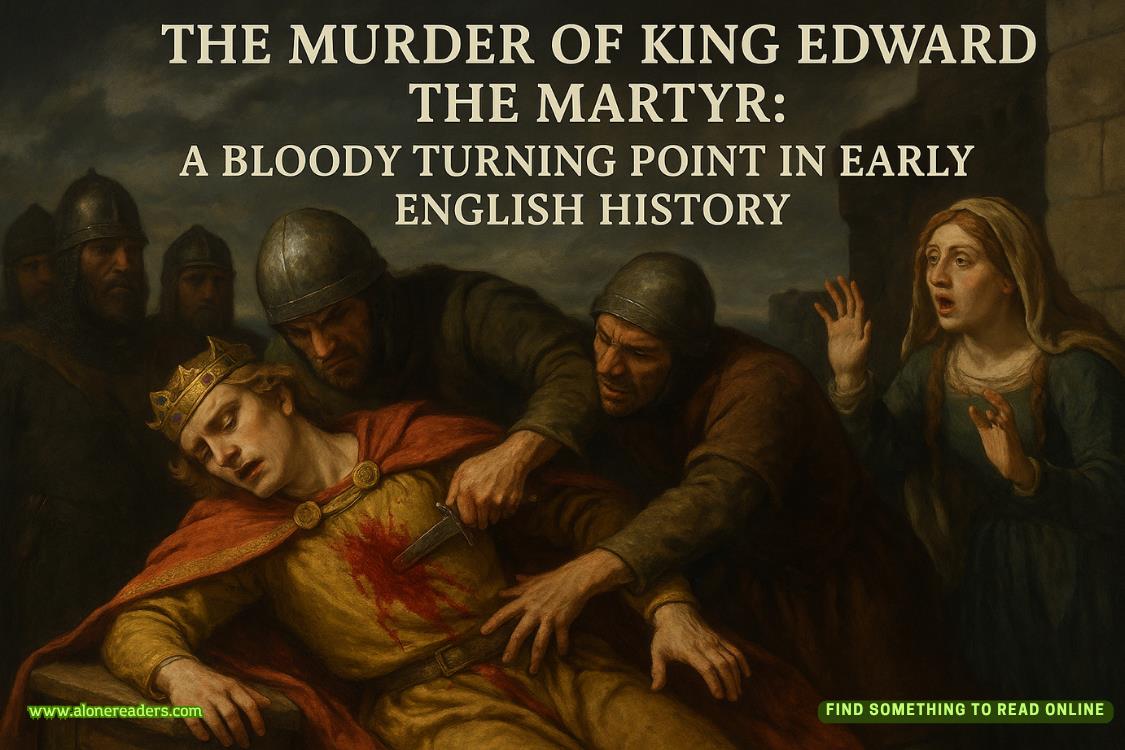
The murder of King Edward the Martyr in 978 CE remains one of the most infamous mysteries in early English history, a tragedy steeped in political intrigue, royal jealousy, and the violent struggle for power. As a young king of the House of Wessex, Edward inherited the throne during a time of deep internal division and mounting external threats from Viking incursions. His tragic assassination at Corfe led not only to national turmoil but also to the rise of his younger half-brother, a controversial figure later known as Æthelred the Unready. While revered as a martyr and saint by the Church, Edward’s short life and violent death reveal the volatile nature of Anglo-Saxon politics and the deadly consequences of disputed legitimacy.
Born around 962 CE, Edward was the eldest son of King Edgar the Peaceful, but his legitimacy was questioned due to uncertainty surrounding his mother’s status. Some chroniclers claimed she was of noble birth, while others suggested she was not fully recognized as queen, weakening Edward’s political position. After Edgar’s death in 975 CE, two strong factions emerged within the English court: one supporting Edward’s claim, backed by powerful clerics and nobles, and the other supporting his young half-brother Æthelred, whose mother, Ælfthryth, commanded a formidable political network. The choice between these two heirs was more than just a family matter; it represented a struggle between monastic reforms, social class interests, and the distribution of royal patronage.
During Edward’s brief reign, England faced significant instability. Although accounts emphasize his piety and earnestness, he was still a minor and lacked the authority and experience to completely manage his court. Rival nobles seized the opportunity to promote their agendas. The situation was worsened by growing resentment among aristocrats who felt sidelined by recent monastic reforms. These reforms, supported by senior church leaders such as Archbishop Dunstan, threatened the power of land-holding nobles by reclaiming estates granted to monasteries. Edward’s association with these reforms placed him in direct conflict with influential secular forces.
Tension between these groups escalated over the next three years. Historical sources depict Edward as morally upright but politically inexperienced, frequently manipulated by competing advisors. During this fragile period, Queen Dowager Ælfthryth steadily built support for her own son Æthelred. Many contemporary chroniclers later associated her with conspiracy, whether justified or not, showing how deeply her influence unnerved Edward’s supporters. Their rivalry would eventually culminate in one of the most shocking royal murders in England’s early medieval period.
On the evening of March 18, 978 CE, Edward visited Corfe, a royal estate in Dorset, where his stepmother and half-brother resided. Accounts emphasize that his arrival was unannounced, suggesting he had come in good faith and with minimal guard. While stopping to greet the household, Edward was offered a drink, and as he raised the cup to his lips, he was suddenly attacked. He was stabbed—historical descriptions differ on the weapon and circumstances—and mortally wounded. Attempting to flee, he fell from his horse, his foot caught in the stirrup, and was dragged along the ground until his body came to rest. He died without proper aid, abandoned in a moment that revealed the cold precision of the plot.
The immediate aftermath of the murder was chaotic. Edward’s killers hastily concealed his body, an action that contemporaries interpreted as clear evidence of guilt. Soon after, however, his body was discovered and retrieved by loyal supporters. His initial burial took place at Wareham, but miracles and signs attributed to his remains fueled growing veneration. Within a few years, his corpse was exhumed and reinterred at Shaftesbury Abbey, accompanied by increasing reports of healing powers and divine intervention. The Church proclaimed him a martyr, not because he died for religious doctrine, but because his violent death was seen as the consequence of his moral righteousness and rightful kingship.
Suspicion immediately fell upon Ælfthryth, whose political ambitions were widely known. Though no trial or formal investigation took place, chroniclers writing decades later consistently implicated her in the conspiracy, emphasizing her cunning and ruthlessness. Some historians argue that supporters of monastic reform intentionally shaped this narrative to tarnish her son’s reign. Others suggest that Edward’s death benefited too many influential nobles for the queen alone to bear responsibility. Æthelred himself, only around ten at the time, was crowned shortly afterward, and his rule would eventually become synonymous with weakness, mismanagement, and disaster. Whether he was aware of the plot or merely an unwilling beneficiary remains heavily debated.
The broader consequences of Edward’s murder were severe. Political legitimacy in the Anglo-Saxon world depended on both noble acceptance and religious endorsement. By rising to the throne after such a scandal, Æthelred inherited not only a crown but a moral shadow. Chroniclers later interpreted the catastrophic Viking invasions, failed diplomacy, and repeated tribute payments as divine punishment for murder at the highest level of authority. The subsequent decades plunged England into turmoil, culminating in the conquest of Sweyn Forkbeard of Denmark and later his son Cnut. Edward’s death thus marked the beginning of a century of instability that fundamentally altered English identity and governance.
In religious terms, Edward’s martyrdom strengthened perceptions of saintly intervention in royal politics. Reports of miracles at his gravesite attracted pilgrims, and monasteries dedicated to his memory became powerful institutions. His cult flourished not only as a spiritual movement but also as a subtle political statement supporting the legitimacy of alternative royal lineages. Over time, his sainthood became widely acknowledged, and by the 12th century, his cult was firmly established. The veneration of Edward served as a reminder of the dangers associated with political manipulation, unjust succession, and royal betrayal.
Modern historians approach the murder with more nuance, examining economic tensions, monastic politics, and shifts in land ownership. Many believe that Edward’s assassination was not simply a jealous family dispute but part of a broader backlash against the church’s increasing power. Monastic expansion under King Edgar had drastically reduced aristocratic autonomy, creating resentment among powerful families. Edward, as Edgar’s chosen heir, symbolized the continuation of these policies, and his removal allowed secular interests to regain influence under a more pliable king. In this interpretation, his murder was a calculated act designed to reverse reformist momentum.
Legal traditions were also transformed by the event. The notion that a king could be murdered by his own household shattered deep cultural assumptions about the sanctity of royal lineage. Anglo-Saxon culture placed enormous value on oath-keeping, loyalty, and family honor. Violating these principles not only undermined trust but also destabilized the entire political system. In the generations that followed, laws surrounding treason, land inheritance, and ecclesiastical protection of rulers grew increasingly strict. Edward’s death thus indirectly shaped legal reforms that would later influence medieval English common law.
Psychologically, the murder haunted Æthelred throughout his reign. Chroniclers describe a ruler burdened by guilt, indecision, and paranoia. While some historians argue that these accounts exaggerate his moral weakness, the political disasters he presided over—including the devastating Danish raids—offered fertile ground for legend. The nickname “Unready” did not imply lack of preparation as modern English suggests but was derived from “Unræd,” meaning ill-counseled. The implication was not just incompetence but spiritual punishment stemming from regicide.
The murder of King Edward the Martyr remains a cautionary tale about power, corruption, and legitimacy. It illustrates how personal ambition can destabilize entire kingdoms and how political violence can shape national destiny. His cult grew not simply because he died but because his death represented a violation of sacred order. To his supporters, Edward embodied moral kingship; to his assassins, he was an obstacle to influence. His legacy serves as a reminder that monarchy, far from being a purely ceremonial institution, has always been vulnerable to the darker impulses of human politics.
In the modern world, his story is studied not only through chronicles and archaeology but also through theological analysis and legal history. Edward’s murder has been commemorated in literature, local legend, and church tradition. Corfe Castle, though later rebuilt in stone by the Normans, remains symbolic of treachery and royal bloodshed. Shaftesbury Abbey, though damaged during the dissolution of monasteries, continued to protect Edward’s relics, further cementing his place in spiritual memory.
Ultimately, the murder of King Edward the Martyr stands as a defining moment in English medieval history. It changed the balance of power among nobles, altered the trajectory of royal succession, and set in motion events that would eventually reshape the nation. Through his violent death, Edward became more influential than he ever was in life, reigning as a saint over the moral conscience of the kingdom. His story demonstrates that even in eras ruled by sword and shield, the invisible forces of legitimacy, faith, and memory could determine the fate of empires.



 The Hundred Days Offensive: How the Allies Defeated Germany in World War I
 The Second Battle of the Marne: The Turning Point of World War I in 1918
 The Spring Offensive of 1918: Germany's Final Gamble to Win World War I
 The Treaty of Brest-Litovsk: How Russia Left World War I
 The Russian Revolution and World War I: How War Brought Down the Tsar
 The Zimmermann Telegram Explained: Germany's Secret Offer to Mexico in World War I