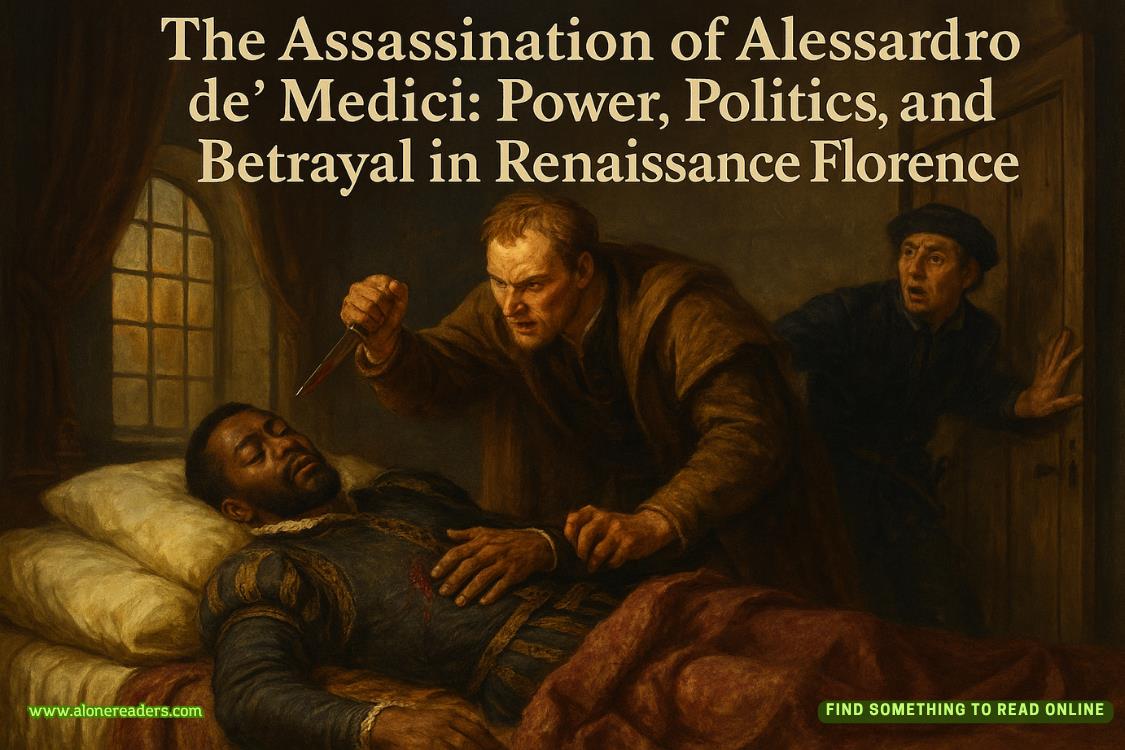
The murder of Alessandro de’ Medici in 1537 remains one of the most shocking political assassinations of the Renaissance era, blending personal betrayal, dynastic ambitions, and the volatile climate of Florentine politics. Alessandro, considered by many historians to be the first hereditary ruler of Florence, emerged from complex social origins, controversial legitimacy, and the power struggles that defined Italy during the sixteenth century. His short reign was marked by tensions between republicans and Medici loyalists, foreign influences, economic challenges, and the lingering scars of earlier political upheavals. When his assassination was carried out by Lorenzino de’ Medici, a distant cousin, it stunned Europe and opened the door to a dramatic shift in Florentine governance, ultimately paving the way for Cosimo I and the Grand Duchy of Tuscany. Understanding Alessandro’s rise, rule, and death offers a deep insight into the mechanisms of power, loyalty, and ambition in Renaissance Italy.
Alessandro de’ Medici was born around 1510, and his parentage has long been the subject of debate among historians. Officially, he was acknowledged as the son of Lorenzo II de’ Medici, the Duke of Urbino, but contemporary rumors spread widely that he was the illegitimate son of Pope Clement VII, formerly Giulio de’ Medici. Complicating the matter, Alessandro’s mother was widely believed to be an African servant or enslaved woman at the Medici court, leading modern researchers to consider Alessandro one of the earliest European rulers of mixed African ancestry. This background, while never officially acknowledged, played a silent but powerful role in how certain factions in Florence perceived him. Regardless of origin, what cannot be denied is that he was raised, educated, and groomed within the prestigious Medici network.
The political environment of Florence at the time was polarized. The Medici family, previously exiled, regained power through foreign military support after the Sack of Rome in 1527. Pope Clement VII orchestrated Alessandro’s rise, arranging strategic alliances and giving him authority backed by imperial forces. By 1532, Alessandro was invested as Duke of Florence after the city’s traditional republican government was dissolved and replaced with a more centralized and hereditary structure. This transition was deeply unpopular among republican-leaning nobles who valued Florence’s longstanding traditions of civic participation and rotating magistracies. Alessandro’s close ties to the papacy and the Holy Roman Emperor further alienated local elites who feared foreign domination.
Alessandro’s government aimed to strengthen centralized authority, reduce factional violence, and impose stability after years of turmoil. However, his methods attracted criticism from rival nobles. His opponents accused him of corruption, abuses of power, and tyrannical tendencies. Many of these accusations are difficult to prove historically, as they were often disseminated by exiled factions seeking to justify rebellion. Nonetheless, Alessandro’s genuine flaws included indulgence, occasional vindictiveness, and the tendency to rely on foreign troops rather than local alliances. These traits deepened resentment among those who still dreamed of restoring the Florentine Republic.
While Alessandro attempted to stabilize Florence economically by supporting trade, maintaining order, and investing in fortifications, resentment continued to simmer beneath the surface. Florence’s aristocrats felt increasingly marginalized and humiliated under the new political order. These social tensions provided fertile ground for conspirators. Among those discontented was Lorenzino de’ Medici, a distant relative of Alessandro. Lorenzino was an intelligent, cultured figure educated in humanist traditions, but his personality was marked by ambition, vanity, and dissatisfaction with his own political insignificance. His motivations remain debated: some argue he was driven by republican ideals, others by personal jealousy, and some by hope of gaining favor among exiled noble factions.
The assassination plot took advantage of Alessandro’s known personal habits. He had a reputation for romantic pursuits and affairs, sometimes with the wives of his own courtiers. Lorenzino exploited this weakness by promising Alessandro a secret encounter. On the night of January 6, 1537, Lorenzino lured the duke to his private residence under the pretense of meeting a woman. Alessandro arrived with little suspicion and a minimal escort. Once inside, Lorenzino locked the door and attacked the duke with a sword, assisted by a mercenary companion. The struggle was brutal, but Alessandro was ultimately overpowered and killed. Lorenzino fled Florence immediately after the assassination, fearing swift retaliation.
For a brief moment, some conspirators believed the murder would revive the republic. However, the political reality was far more complex. The Medici family still enjoyed strong support from the Holy Roman Emperor Charles V, who quickly intervened to prevent instability. Within days, the Medici faction maneuvered to select a new ruler. They settled on the teenage Cosimo de’ Medici, a distant cousin with little political baggage but strong symbolic value. Republican hopes evaporated almost instantly, as Cosimo consolidated authority with decisive action, eventually transforming his title into that of Grand Duke of Tuscany. Alessandro’s assassination thus ironically strengthened the Medici dynasty, rather than weakening it.
Lorenzino fled to Venice and later to France, publishing a written justification titled “Apology,” which compared his deed to classical tyrannicides who acted in the name of liberty. His arguments were celebrated by some intellectuals who opposed princely rule, but the practical result of his action contradicted his stated ideals. Years later, Lorenzino himself was murdered by imperial agents in Venice, almost certainly as revenge for Alessandro’s death. His assassination reinforced the perception that political betrayal within the Medici family would never go unpunished.
The murder had profound consequences for Florence. Under Cosimo I, the city transitioned from a fragile duchy into a stable grand duchy. Cosimo’s long rule brought administrative reform, artistic patronage, military fortification, and centralization. Ironically, many historians argue that Alessandro’s death was the necessary event that allowed a competent and visionary ruler to emerge. In a symbolic sense, Alessandro’s assassination marked the end of Florence’s lingering republican identity and the beginning of a more modern, dynastic state.
In art and literature, Alessandro’s legacy is controversial. Some portray him as a cruel tyrant, citing earlier chroniclers who disapproved of his rule. Others highlight his attempts to stabilize Florence after decades of conflict. His unique background has also interested modern historians, who emphasize his significance as one of the earliest European leaders of African descent. Paintings of Alessandro often depict him as somber and commanding, hinting at the weight of expectation placed upon him.
The murder has also been interpreted through the lens of Renaissance family politics. The Medici dynasty was sprawling, ambitious, and periodically torn apart by internal rivalry. Alessandro’s ascendancy represented one branch’s success, but that success generated jealousy within others. In Renaissance Italy, where power was fragmented and frequently contested, murder was both a political tool and a symbolic gesture. Lorenzino’s act cannot be understood purely as personal betrayal; it was also a statement about who deserved to control Florence’s destiny.
Diplomatically, Alessandro’s death troubled the papacy and the Holy Roman Empire. Pope Paul III feared a republican resurgence, and Emperor Charles V viewed the murder as an affront to his authority. For this reason, both powers strongly supported Cosimo’s rise. Their involvement demonstrated how deeply Florence had become entangled in international alliances. The city’s future was no longer determined solely by internal factions but by the geopolitical ambitions of Europe’s greatest powers.
Alessandro planned to strengthen Florence’s military infrastructure and protect its trade routes. His economic policies were moderate and cautious, seeking to recover from earlier financial crises. Critics argue he favored foreign mercenaries over local militias, weakening civic morale. Supporters counter that mercenaries were essential to preventing rebellion. His private life, often rumored to be indulgent and reckless, became political ammunition—character assassination was as powerful as literal assassination in Renaissance courts.
Modern historians approach Alessandro with greater nuance than many of his contemporaries did. Instead of focusing solely on his vices, they emphasize the challenges facing any ruler tasked with holding together a fractured city-state. Alessandro inherited a society exhausted by war, divided by ideology, and pressured by foreign monarchs. His assassination, while dramatic, reflects the difficulty of governing Florence during a period of transition.
The murder of Alessandro de’ Medici remains a pivotal moment in Renaissance history. It encapsulates the fragility of power, the influence of personal weakness on public duty, and the destructive potential of factional politics. Rather than restoring republican freedom, Alessandro’s death accelerated the consolidation of Medici authority. The tragedy lies not only in the violent end of a young duke but also in the idealistic illusions of those who believed assassination could reverse the tide of history. In the end, Florence continued toward centralized ducal rule, opening a new chapter that would redefine its culture, identity, and role within Europe.



 The Hundred Days Offensive: How the Allies Defeated Germany in World War I
 The Second Battle of the Marne: The Turning Point of World War I in 1918
 The Spring Offensive of 1918: Germany's Final Gamble to Win World War I
 The Treaty of Brest-Litovsk: How Russia Left World War I
 The Russian Revolution and World War I: How War Brought Down the Tsar
 The Zimmermann Telegram Explained: Germany's Secret Offer to Mexico in World War I