The Lost Colony of Roanoke stands as one of the greatest unsolved mysteries in American history, capturing the imagination of historians, archaeologists, and curious minds for centuries. Established in the late 16th century, Roanoke represented England’s earliest attempts to establish permanent settlements in the New World. What began as an ambitious endeavor to expand English influence ended in confusion, uncertainty, and speculation when the colony’s inhabitants mysteriously disappeared without any clear trace. Understanding Roanoke requires examining both the historical context that drove its creation and the circumstances that led to its enigmatic end.
In the 1580s, England was eager to join the race for overseas expansion, following the successful colonial ventures of Spain and Portugal. Sir Walter Raleigh received a charter from Queen Elizabeth I to establish a settlement in the Americas that would secure England’s foothold in the lucrative trade networks of the Atlantic. Raleigh’s first expedition in 1585 resulted in the creation of a military outpost on Roanoke Island, located off the coast of present-day North Carolina. However, conflicts with local Native American tribes, dwindling supplies, and poor communication with England led the initial settlers to abandon the outpost and return home. Raleigh remained determined and organized a new colonizing mission, this time including families rather than just soldiers, hoping to establish a thriving community.
In 1587, the second group of settlers arrived on Roanoke Island under the leadership of Governor John White. Their goal was to rebuild a modest English town, grow crops, and foster friendly relations with neighboring tribes. Within weeks of their arrival, however, signs of trouble became apparent. Resources were scarce, environmental knowledge was limited, and relationships with some Native groups quickly soured. Complicating matters further, the settlement’s location exposed it to unpredictable storms, isolation, and extreme vulnerability. Despite these challenges, the colonists worked to build homes, plant crops, and develop a community structure. Among the settlers was Eleanor Dare, who gave birth to Virginia Dare, the first English child born in the Americas, adding a symbolic significance to the colony.
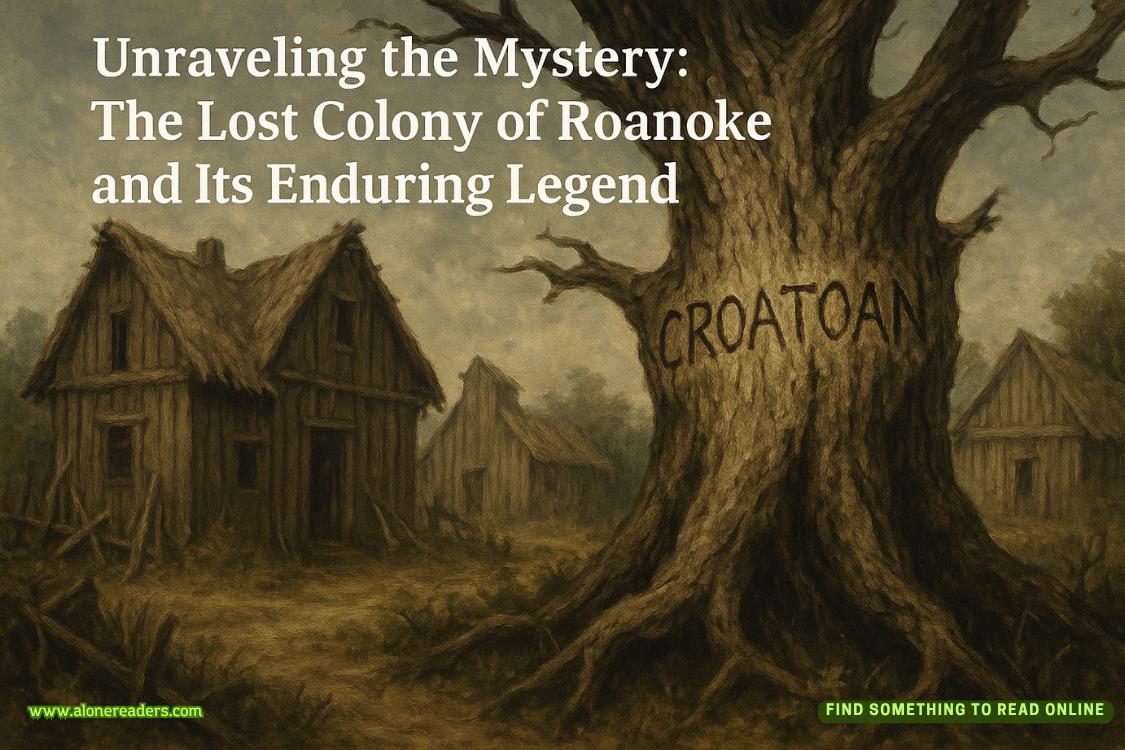
Recognizing the urgency of their situation, the colonists voted to send John White back to England to request additional supplies and reinforcements. White reluctantly agreed, planning to return as quickly as possible to support the growing colony. Unfortunately, his return was severely delayed due to ongoing conflicts between England and Spain, including the threat of the Spanish Armada. Years passed before White was finally able to secure passage back across the Atlantic, and when he arrived in 1590, the village he left behind had vanished. Houses were dismantled, tools were gone, and there was no sign of struggle, bodies, or destruction. The only clue was a single word carved into a wooden post: “CROATOAN.” Another carving nearby read “CRO,” suggesting the colonists may have relocated voluntarily. Yet with no definitive evidence and a sudden storm forcing White to leave again, the truth remained frustratingly out of reach.
From that moment onward, historians have speculated about what might have happened to the Lost Colony. One widely accepted theory is assimilation with nearby Native American tribes, particularly the Croatan or Hatteras peoples. Several early colonial records from later English settlements mention Native Americans with European features, supporting this possibility. Cultural blending would have offered the colonists access to food, shelter, and safety in an unfamiliar environment. Yet while plausible, archaeological proof remains elusive. Another theory involves relocation to the mainland, where the settlers may have attempted to establish a new settlement further inland, possibly along the Chesapeake Bay. Early English explorers reported hearing rumors of European captives or survivors in that region, but expeditions failed to confirm these accounts.
A darker possibility suggests the colonists may have faced hostility from tribes or internal conflict leading to their demise. Interactions between colonists and Indigenous peoples had been strained from the beginning. Mistrust, competition over resources, cultural misunderstandings, and violence were not uncommon. If relations deteriorated beyond repair, the colonists could have been attacked or forcibly dispersed. However, the absence of physical remains or clear evidence of battle makes this idea difficult to prove conclusively. Scholars continue to debate whether the colonists died from disease, starvation, or environmental disasters. Coastal North Carolina is prone to hurricanes, droughts, and saltwater intrusion, all capable of destroying crops and freshwater sources. A severe drought documented in tree ring records coincides with the colony’s timeline, suggesting environmental stress could have forced desperate relocation.
The most imaginative theories link the Lost Colony to supernatural or mythical explanations, including curses, sea monsters, and alien abduction narratives fueled by popular culture. While unsupported by evidence, such stories highlight how deeply Roanoke’s disappearance has embedded itself in the American imagination. Folklore surrounding Virginia Dare has grown particularly strong, casting her alternately as a heroic folk figure or tragic symbol of lost potential. Over time, Roanoke has become not only a historical puzzle but also a cultural touchstone explored in novels, films, and television series.
Modern archaeology has attempted to shed new light on the mystery through advanced technology such as ground-penetrating radar, genetic analysis, and underwater surveys. At sites on Hatteras Island, researchers have discovered European artifacts dating to the late 16th century, including tools and household items consistent with English manufacture. While these discoveries hint at assimilation, they do not definitively prove that these belonged to Roanoke survivors rather than trade goods. On the mainland near the Albemarle Sound, excavations known as “Site X” have uncovered further English ceramics and weapon fragments, suggesting that at least some settlers may have relocated inland. Yet the evidence remains too limited to form a complete narrative, and professional disagreement continues.
The Lost Colony has also become a focal point for discussions about early European colonization. It highlights the fragile nature of frontier settlements and the complex relationships between Indigenous cultures and European newcomers. Survival in the New World required adaptation, diplomacy, and knowledge sharing. Roanoke’s failure contrasted sharply with later English colonies such as Jamestown, which learned from earlier mistakes and survived through improved supply chains and alliances. Roanoke, therefore, serves as a case study in colonial vulnerability, reminding historians of the delicate balance required for sustained settlement.
Beyond its historical significance, Roanoke endures because it resists closure. In modern society, where science and technology reveal answers to long-standing questions, the thought of an entire community disappearing without explanation feels both eerie and compelling. The carvings left behind act as unfinished sentences, inviting endless interpretation. As each generation revisits the mystery, new theories emerge, fueled by discoveries, cultural perspectives, and a fascination with the unknown. Roanoke’s unresolved nature connects it to broader themes of human ambition, survival, and the unpredictable forces that shape history.
Today, Roanoke Island is home to museums, replicas, and historical sites dedicated to preserving the legacy of the lost colonists. The region hosts theatrical performances such as “The Lost Colony,” showcasing dramatic retellings that blend fact and imagination. Tourism continues to sustain local interest, allowing visitors to walk the grounds where the settlers once lived, contemplate their struggles, and consider their fate. Educational programs encourage archaeological exploration, and ongoing research keeps the possibility of breakthroughs alive. Whether the colony’s disappearance was the result of environmental collapse, assimilation, conflict, or migration, it remains a symbol of the unknown frontier that defined early colonial exploration.
Ultimately, the Lost Colony of Roanoke represents a convergence of history, archaeology, myth, and imagination. It underscores the challenges faced by England’s earliest settlers and highlights the broader narrative of European expansion into the Americas. Though centuries have passed, the colonists’ fate remains shrouded in mystery, reminding us that not all questions can be neatly answered. As long as artifacts continue to surface and new methods emerge, hope persists that the final chapter of Roanoke’s story may one day be revealed. Until then, it stands as a haunting testament to the dangers of ambition, the unpredictability of nature, and the endurance of unanswered questions in the human story.



 The Hundred Days Offensive: How the Allies Defeated Germany in World War I
 The Second Battle of the Marne: The Turning Point of World War I in 1918
 The Spring Offensive of 1918: Germany's Final Gamble to Win World War I
 The Treaty of Brest-Litovsk: How Russia Left World War I
 The Russian Revolution and World War I: How War Brought Down the Tsar
 The Zimmermann Telegram Explained: Germany's Secret Offer to Mexico in World War I










