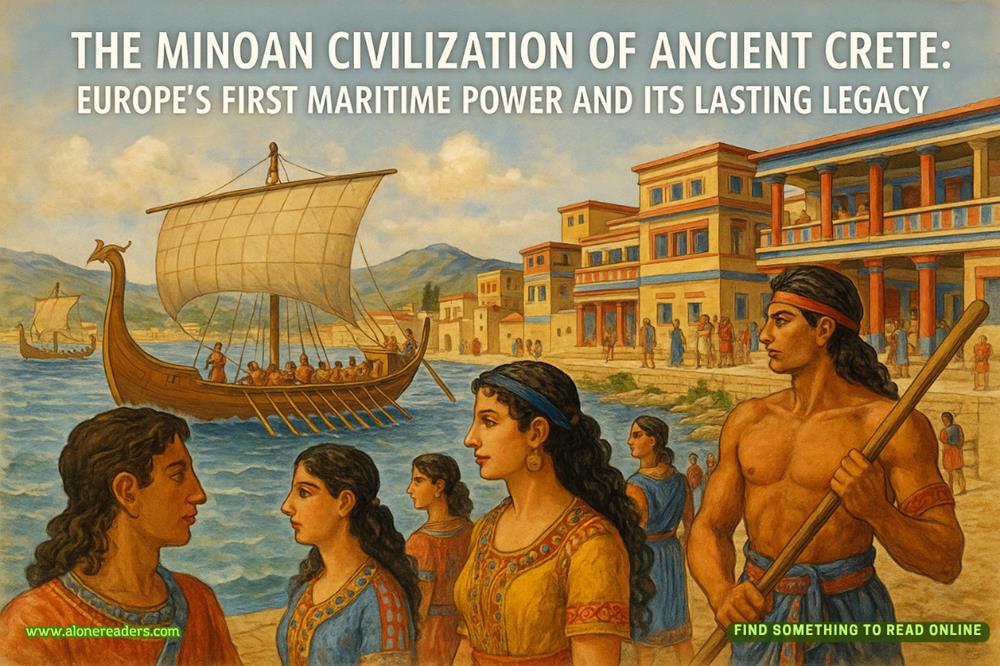
The Minoan Civilization of ancient Crete stands among the most intriguing societies of the Bronze Age, often regarded as Europe’s earliest advanced maritime power. Emerging around 3000 BCE and flourishing until approximately 1450 BCE, this civilization preceded the classical Greek world and shaped cultural developments across the Mediterranean. Named after the mythical King Minos, the Minoans established influential trade networks, developed advanced religious practices, constructed grand palatial complexes, and contributed to artistic and technological innovations that reverberated across centuries. Their achievements, prosperity, and sudden decline continue to captivate historians, archaeologists, and scholars, who seek to understand how such a highly developed society rose to prominence and then faded into obscurity.
Situated on the island of Crete, the Minoans benefited enormously from their strategic geographic position. Crete sits at the crossroads of the eastern Mediterranean, making it an ideal center for maritime exchange. Minoan ships traversed waters connecting Egypt, the Near East, and mainland Greece, allowing them to trade goods such as olive oil, wine, jewelry, bronze, and ceramics. This thriving network enriched the civilization economically and culturally, exposing the Minoans to foreign ideas, materials, and technologies. Their command over the sea was so robust that later Greek writers referenced a Thalassocracy, an empire of the sea, associated with Minos. Though mythological in presentation, this concept reflects real power dynamics, underscoring how the Minoans wielded influence across maritime routes rather than by territorial conquest.
One of the most striking aspects of Minoan society was the construction of sophisticated palatial complexes. The most notable of these was the Palace of Knossos, sprawling across multiple levels, featuring intricate corridors, large courtyards, storerooms, and administrative centers. Other important palaces included Phaistos, Malia, and Zakros. These structures served as administrative hubs for governance, religion, and economic management. Each complex was a microcosm of Minoan life, managed by bureaucratic systems that controlled production, trade, and distribution of goods. The architecture reflected a society capable of organizing large labor forces, planning advanced drainage systems, and utilizing innovative building materials. The design also demonstrated a unique aesthetic, favoring open courtyards and elaborate frescoes that celebrated nature and everyday life. The palaces were also centers for religious rituals, demonstrating how governance and spirituality merged in Minoan culture.
Artistry was another hallmark of the Minoan world. Frescoes adorned palace walls, depicting vivid scenes of nature, religious practices, and athletic events. Many of these frescoes represented everyday activities rather than warfare, suggesting a comparatively peaceful society. Their artwork included dynamic figures, flowing lines, and rich natural imagery such as dolphins, flowers, and marine life. The emphasis on natural scenes underscored a deep appreciation for environmental harmony and may reflect religious symbolism. Artisans crafted fine pottery with intricate geometric patterns and marine motifs, exemplified by the famous octopus vase style. Jewelry made from gold and stones further demonstrated advanced craftsmanship. These artistic forms have contributed to modern admiration for the Minoans and provided historians with invaluable insight into their daily lives, beliefs, and values.
Religion played a central role in Minoan society, defined by a complex ritual landscape featuring sacred caves, mountaintop shrines, and temple rooms within palaces. The dominance of a mother goddess figure, often associated with fertility and nature, is frequently inferred from figurines and frescoes. Snake-handling priestesses, bull imagery, and ceremonial cups suggest nuanced religious symbolism. One of the most iconic elements was bull worship. Bulls held symbolic power across many cultures, but in Crete, they appear to have been central to ritual performance. The legendary Minotaur myth, though mythologized by later Greeks, reflects the significance of bull iconography. Bull-leaping, depicted in frescoes, involved athletes grabbing a charging bull by the horns and vaulting over its back. Scholars debate whether this act was a rite of passage, athletic contest, or symbolic offering, but its presence demonstrates a deep ritualistic tradition within Minoan life.
The Minoans communicated through writing systems known as Linear A and Cretan hieroglyphics. Linear A remains largely undeciphered, which limits scholars’ ability to fully understand Minoan language and administrative practices. Despite this limitation, tablets and seals suggest sophisticated record-keeping for taxation, inventory, and the organization of trade goods. Administrative efficiency was a defining characteristic of their social organization. With centralized palace control, economies flourished, and officials regulated agriculture, craft production, and distribution networks. The lack of fortifications around palatial sites supports the theory that the Minoans relied on naval dominance to maintain security rather than ground-based defensive structures, reinforcing their identity as a maritime superpower.
The social structure of Minoan civilization appears to have been relatively hierarchical but surprisingly egalitarian in some respects. Art often depicts women in prominent positions, engaged in religious ceremonies and public events. This suggests that women held significant roles in administration, religion, and social life. Minoan clothing styles, featuring vibrant patterns and elaborate designs, further represented status and cultural identity across gender lines. The absence of heavy weaponry in graves and art has led some scholars to infer that the Minoans experienced fewer internal conflicts than other Bronze Age societies. Their approach to power was subtle, rooted in trade leverage, religious cohesion, and centralized administration rather than outright militarism.
Economically, agriculture formed the backbone of Minoan prosperity. The fertile plains of Crete supported crops such as barley, wheat, olives, and grapes. Livestock included cattle, sheep, goats, and pigs. Advanced irrigation systems supported farming efficiency. The surplus of agricultural products fueled trade exchanges with foreign lands, further boosting wealth. The Minoans also excelled in textile production and metallurgy, crafting bronze tools and weapons, although many of these items were used more for ceremonial purposes or trade rather than warfare. Their ability to manufacture and distribute goods across vast trade routes reinforced their economic dominance and positioned them at the heart of Mediterranean commerce.
While the Minoans reached extraordinary heights, their civilization witnessed severe disruptions. Around 1600 BCE, a devastating volcanic eruption occurred on the nearby island of Thera (modern-day Santorini). This eruption is considered one of the most powerful in recorded history and likely triggered tsunamis, ash fallout, climatic changes, and agricultural devastation. Although the Minoans demonstrated resilience and continued to rebuild, the disaster weakened their infrastructure and maritime control. Over the next century, signs of decline became apparent. By approximately 1450 BCE, many palatial centers were destroyed, possibly due to earthquakes or invaders. Scholars debate whether the Mycenaeans from mainland Greece conquered Crete or filled a power vacuum created by natural disasters. Evidence suggests that Mycenaean writing, known as Linear B, eventually replaced Linear A in administrative functions on Crete, indicating a cultural takeover.
The mysterious collapse of the Minoan civilization remains one of the most compelling historical puzzles. Multiple theories attempt to explain the end of their power, including seismic activity, social upheaval, economic competition, or gradual absorption into Mycenaean culture. Paleoclimatic studies suggest prolonged droughts, which could have crippled agriculture. Additionally, trade routes may have shifted due to changing alliances or emerging powers across the Mediterranean. Whatever combination of factors contributed, the final disappearance of Minoan dominance reshaped regional political dynamics and cleared the stage for subsequent Greek civilizations.
Despite their decline, the legacy of the Minoans persisted throughout history. The Mycenaeans adopted and adapted many Minoan symbols, artistic styles, and administrative practices. Elements of Minoan religion influenced Greek mythology, notably the myths surrounding Minos, Theseus, and the labyrinth. The labyrinth itself, a concept tied to Knossos’s palace, became a powerful cultural symbol of complexity and mystery. Archaeological rediscovery in the early twentieth century renewed global interest in Minoan achievements. Excavations revealed frescoes, pottery, administrative tablets, and architectural remains, painting a vivid picture of life on Bronze Age Crete. These discoveries reframed historical narratives, proving that advanced European civilization existed long before classical Athens.
Modern research continues to uncover new insights into Minoan culture, often using cutting-edge technologies. DNA analysis reveals population origins and migrations, while digital reconstruction allows scholars to visualize palatial architecture. Marine archaeology investigates trade routes and shipwrecks, deepening understanding of Minoan seafaring capabilities. Scholars continue to study Linear A in hopes of deciphering its meanings, and ongoing excavations reveal additional palatial complexes, workshops, and shrines. Every new discovery adds nuance to our perception of Crete’s Bronze Age past.
The Minoans’ achievements demonstrate a civilization capable of innovation, organization, artistic expression, and international influence. Their ability to connect diverse cultures through maritime trade advanced economic and cultural exchange. Their art celebrated life and nature in ways that resonate well beyond their era. Their religious practices highlighted symbolism and ritual that shaped mythologies for centuries. As Europe’s earliest maritime power, the Minoans bridged distant worlds, creating a legacy that echoed across the Mediterranean.
Today, the ruins of Knossos and other sites in Crete attract visitors from around the world, offering glimpses into the grandeur of an ancient society deeply connected to the sea. Museums display pottery, jewelry, fresco fragments, and tools that showcase artistic and technological sophistication. Scholars continue to analyze the civilization’s final years, seeking to understand exactly how such brilliance could fade so dramatically. This enduring mystery fuels fascination, encouraging continued research and exploration.
In understanding the Minoan civilization, historians gain perspective on the foundations of European culture. Their contributions to trade, governance, architecture, artistry, and religion helped lay the groundwork for later Mediterranean societies. Although they vanished from power, traces of their influence survived in the myths of Greece, the culture of the Aegean, and the archaeological record that endured beneath centuries of earth. As one of history’s forgotten ancient civilizations, the Minoans offer a timeless reminder of the fragility and brilliance inherent in human societies. Their story encourages reflection on the forces that shape civilizations, the creativity that drives cultural growth, and the mysteries that linger long after a society disappears from view.
The Minoan civilization’s combination of maritime dominance, artistic richness, religious complexity, and administrative precision elevates it as one of the most fascinating cultures of the ancient world. Its rise and fall exemplify how environmental shifts, external pressures, and political dynamics can dramatically alter the course of history. The legacy of ancient Crete lives on through continued research, public imagination, and the enduring allure of a civilization lost to time yet remembered through stone, art, and myth.





 The Hundred Days Offensive: How the Allies Defeated Germany in World War I
 The Second Battle of the Marne: The Turning Point of World War I in 1918
 The Spring Offensive of 1918: Germany's Final Gamble to Win World War I
 The Treaty of Brest-Litovsk: How Russia Left World War I
 The Russian Revolution and World War I: How War Brought Down the Tsar
 The Zimmermann Telegram Explained: Germany's Secret Offer to Mexico in World War I








