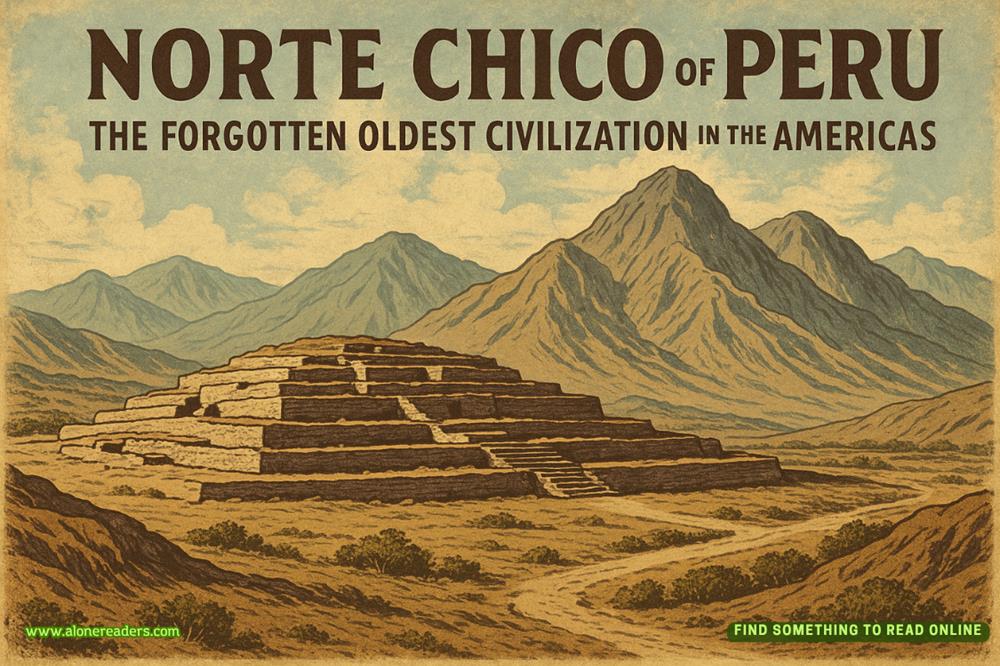
The distant sands and river valleys of coastal Peru conceal one of the most astonishing revelations in American archaeology, a civilization known as Norte Chico. Often overshadowed by the later and more widely celebrated cultures of the Andes, this civilization flourished thousands of years before the rise of the Incas, constructing complex urban centers, engaging in innovative agriculture, and exercising political and ceremonial influence over a vast region. Scholars now recognize Norte Chico as the oldest known civilization in the Americas, contemporary with ancient Egypt’s Old Kingdom and Sumer’s early city-states. Despite this incredible historical significance, it remained almost entirely forgotten until modern excavations rekindled interest in its enigmatic ruins. At its peak, the civilization maintained thriving communities that demonstrated advanced architectural capabilities, long-distance trade, and organized social hierarchies, shaping the development of the region for centuries. The story of Norte Chico illustrates not only the resilience of ancient Andean peoples, but also the remarkable adaptability of early human societies.
Long before monumental cities rose in Mesoamerica and thousands of years before mighty empires emerged across the Andean highlands, the people of Norte Chico began constructing stone platforms, ceremonial plazas, and large-scale complexes along Peru’s Supe, Pativilca, Fortaleza, and Huaura river valleys. The harsh environment of this region might appear inhospitable, with its stark desert sprawled across the coast, but ancient engineers fashioned an agricultural oasis using river irrigation systems. This enabled them to develop surplus production and, subsequently, urban settlement. Archaeological remains reveal more than thirty major population centers, with Caral serving as the most iconic of them all. At Caral, great platform mounds, amphitheater-like structures, and sunken circular plazas dominate the landscape. When examined with modern dating techniques, these features reveal their antiquity, stretching back as far as 3000 BCE. The sophistication of Norte Chico architecture is extraordinary when one considers that this civilization predates pottery, metallurgy, and many of the agricultural staples later associated with the Andes.
One of the most fascinating elements of Norte Chico’s society lies in its socioeconomic structure. Rather than relying on militaristic conquest as many later ancient civilizations did, the evidence suggests that Norte Chico may have thrived under systems of trade, ritual authority, and resource management. Their coastal proximity allowed access to rich marine life, while inland irrigation yielded cotton and other agricultural outputs. Cotton, in particular, was critical. This fiber served as the backbone of fishing nets, clothing, and possibly even ceremonial textiles, enabling coastal fishing communities to supply inland cities with protein, while agricultural settlements provided raw materials. This exchange fostered interdependence, strengthening regional unity. Because no defensive fortifications are prominent in archaeological findings, some scholars propose that social organization relied more heavily on religious or communal authority than on military domination. For early urban development, this is a remarkable deviation from patterns observed in other parts of the world.
Another captivating feature of the Norte Chico world is the presence of monumental construction on a scale that suggests centralized labor organization. The platform mounds are among the most striking achievements, serving as ceremonial or administrative hubs that likely hosted rituals central to community cohesion. Caral’s architectural heart includes a famous sunken circular plaza, an architectural form later repeated elsewhere in Andean civilizations, suggesting a cultural continuity spanning thousands of years. Some excavated areas may have held fire altars, musical ceremonies, or public gatherings, revealing a society heavily influenced by ritual performance. In addition, delicate artifacts such as flutes carved from animal bones and possible textile fragments hint at a thriving artistic culture. These objects reflect spiritual significance, possibly linked to seasonal cycles or agricultural rites. This focus on ceremony underscores the idea that Norte Chico’s leadership derived legitimacy from sacred authority rather than military strength.
One of the most intriguing mysteries surrounding Norte Chico concerns writing and record-keeping. Among artifacts recovered from excavations are examples of knotted cords resembling the later Incan quipu, a system used to record numerical information and administrative data. The presence of these early cords raises profound questions about the origins of Andean information systems. While scholars continue to debate whether Norte Chico’s cords represented a fully developed writing system, they suggest at least some form of symbolic communication. Such administrative complexity further implies the existence of taxation, workforce mobilization, and regulated distribution of resources. The use of early quipu-like devices marks Norte Chico as a crucial stepping stone in the intellectual evolution of Andean civilization.
Agriculture lay at the heart of Norte Chico society, though surprising differences distinguish it from other early civilizations. Instead of relying heavily on corn or potatoes as staples, the people cultivated cotton, squash, beans, and guava, while supplementing their diet through fishing. The convergence of marine protein and agricultural fibers provided a balanced economic model. Their irrigation systems reveal technological ingenuity and a deep understanding of the landscape. Stone-lined canals diverted river water across terraces, sustaining communities even during dry seasons. These networks also demonstrate early urban planning. The ability to predict water flow and manage supply reflects a high level of engineering skill. Without pottery, they likely stored water in organic containers or natural reservoirs, illustrating their remarkable adaptability.
Trade networks extended far beyond individual settlements. Archaeologists discovered materials from distant regions, including exotic shells and plant residues from non-local environments, implying that Norte Chico’s reach extended along the coast and possibly into the highlands. These interactions provided access to resources not available locally, strengthening political alliances and broadening cultural influence. The presence of traded goods also indicates a form of wealth differentiation. Elite members of society may have accumulated specialty items, while common laborers focused on agriculture and construction. The absence of obvious weaponry suggests that this hierarchical differentiation remained stable, perhaps mediated by religious leaders who promised prosperity through ritual observance.
The political structure of Norte Chico remains one of its most elusive features. Without written records, historians rely on architectural patterns and settlement distribution to infer social organization. Large platform complexes likely served as centers of elite authority, while surrounding residential areas housed laborers and craft workers. The coordination required to build such monuments implies centralized planning. Leaders may have leveraged religious symbolism, presenting themselves as intermediaries between the natural world and unseen spiritual forces. Control of irrigation may have reinforced this authority. Those who regulated water distribution held tremendous power over crop yields and community survival. This combination of religious, agricultural, and administrative control forms a plausible basis for Norte Chico’s political hierarchy.
Religion played a fundamental role in shaping daily life. Ritual fire pits discovered in ceremonial plazas indicate repeated ceremonial use, possibly related to offerings or purification rituals. Circular plazas may have been designed for acoustic resonance, amplifying chants and music during public ceremonies. The presence of musical instruments points to a tradition of performance that may have unified communities emotionally and spiritually. It is reasonable to infer that Norte Chico leaders used music, visual symbolism, and community gatherings to reinforce social cohesion. The cyclical nature of agriculture intertwined seamlessly with seasonal ceremonies. A spiritually charged worldview likely permeated every aspect of life, connecting the people to natural forces they perceived as sacred.
The decline of Norte Chico is shrouded in mystery. Environmental changes likely played a major role. Shifts in river flow patterns, compounded by drought or flooding, could have threatened irrigation networks. Coastal upwelling currents, which supply marine nutrients, may have fluctuated, reducing fish populations and weakening the economic exchange between coastal and inland settlements. Earthquakes are another possibility. Peru’s seismic activity has long shaped settlement patterns, and a major tectonic event may have damaged infrastructure. Alternatively, internal social pressures, such as resource competition or shifting religious authority, could have destabilized leadership structures. Whatever the cause, by around 1800 BCE, many of the major centers were abandoned, leaving behind only monumental stone silence.
Despite its disappearance, Norte Chico left an enduring legacy. Architectural styles, ceremonial layouts, and symbolic motifs appear to echo through later Andean civilizations. The sunken circular plaza, for example, reemerged thousands of years later in other Andean religious complexes. Systems of textile production may have influenced the cultural emphasis on weaving seen in later cultures. Irrigation management and centralized resource control also foreshadowed similar patterns in later Andean polities. In a broader sense, Norte Chico demonstrated how urban complexity can develop without warfare, metallurgy, or large-scale agriculture. This challenges long-held assumptions about the prerequisites for civilization. Instead, Norte Chico reveals a unique developmental pathway, driven by cotton production, fishing infrastructure, and ceremonial unification.
Modern-day recognition of Norte Chico continues to grow. As archaeologists analyze newly uncovered structures, they reveal a clearer picture of its cultural importance. Scholars increasingly refer to the civilization as Caral-Supe, highlighting its geographical nucleus. The Peruvian government has invested in preservation programs, establishing protected zones and visitor pathways. Yet, despite growing academic interest, the civilization remains relatively obscure outside specialist circles. Many school curricula still overlook it, focusing instead on the Inca Empire. However, public awareness is gradually increasing, as documentaries, museum exhibitions, and academic publications showcase its extraordinary contributions. It is crucial that this cultural heritage is studied, preserved, and celebrated. For Peru and the broader Americas, Norte Chico represents the earliest chapter of urban civilization, an intellectual milestone worthy of global recognition.
Understanding Norte Chico also sheds light on the diversity of ancient human innovation. It illustrates how societies independently developed complex economies without depending on the same staples found elsewhere in the world. While civilizations like Egypt built monumental tombs, Norte Chico constructed ritual platforms. Where Mesopotamia relied on intensive grain cultivation, Norte Chico utilized cotton and fishing. These differences highlight the adaptive brilliance of early humans, proving that civilization is not a singular blueprint but a spectrum of possibilities shaped by environment, resources, and cultural choice. The existence of early quipu-like cords also suggests intellectual systems that might challenge modern definitions of writing and mathematics. As research advances, Norte Chico may yet rewrite parts of global history.
The forgotten nature of this civilization raises important questions about cultural memory. Why do some societies fade from the collective consciousness while others linger? Geography, limited surviving artifacts, and lack of monumental art may have contributed to Norte Chico’s obscurity. But with continued archaeological work and public education, the world can rediscover this remarkable culture. It stands as a testament to humanity’s ancient capacity for complex organization, engineering, and spiritual expression. Its silent stone plazas and abandoned mounds whisper a profound narrative about innovation in the face of environmental challenge, cooperation over warfare, and the birth of urban life in the Americas.
Today, as travelers explore the desolate river valleys of Peru, they can walk among the remnants of temples and plazas where thousands once gathered for ritual celebrations. They bear witness to the earliest monumental architecture in the Western Hemisphere, now open to the sky and swept by desert winds. Each platform mound and carved staircase offers a glimpse into a chapter of human history nearly lost forever. To understand Norte Chico is to honor the ingenuity of ancient peoples who shaped their world using nothing but natural resources, faith in communal purpose, and relentless creativity.
In the broader scope of world history, Norte Chico deserves recognition alongside the great ancient civilizations of the Old World. Its emergence marks a crucial pivot point in the human story. The lessons gleaned from its ruins inspire reflection on the nature of progress, the fragility of civilization, and the enduring power of collective innovation. As one of the earliest cradles of civilization in the Americas, Norte Chico stands not only as a historical curiosity but as a vital reminder that human ingenuity knows no geographical boundary.
By bringing attention to this forgotten civilization, we acknowledge the monumental achievements of its builders and keep alive the legacy of a culture whose ingenuity helped shape the ancient Andean world. Their forgotten cities remind us that history is vast and often incomplete, but through careful study and renewed curiosity, we can continue piecing together the remarkable story of humanity.





 The Hundred Days Offensive: How the Allies Defeated Germany in World War I
 The Second Battle of the Marne: The Turning Point of World War I in 1918
 The Spring Offensive of 1918: Germany's Final Gamble to Win World War I
 The Treaty of Brest-Litovsk: How Russia Left World War I
 The Russian Revolution and World War I: How War Brought Down the Tsar
 The Zimmermann Telegram Explained: Germany's Secret Offer to Mexico in World War I








