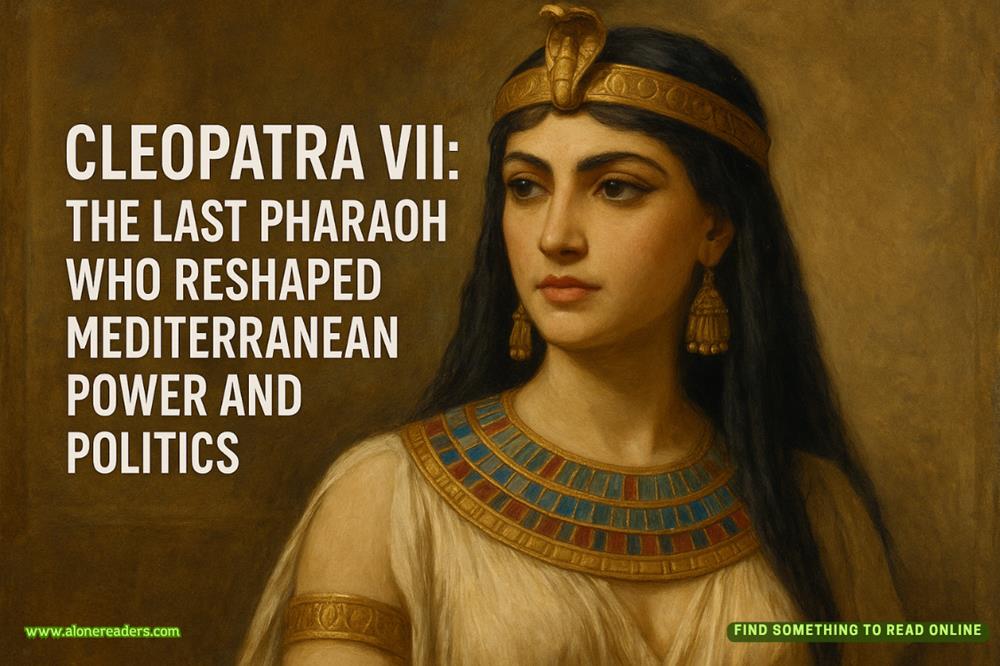
Cleopatra VII stands as one of the most captivating figures of the ancient world, renowned not only for her dramatic life and death but also for her remarkable political strategy that influenced the balance of power across the Mediterranean. As the last reigning pharaoh of Egypt, she fought relentlessly to preserve her kingdom’s sovereignty in the face of Roman expansion. Her legacy has echoed for centuries through historical texts, art, literature, and global culture, making her a symbol of power, intelligence, and extraordinary leadership. Behind the legends, however, lies a deeply complex ruler, one whose diplomatic genius and bold decisions placed her at the center of Mediterranean geopolitics. Her ascent to the throne, relationships with powerful Roman leaders, intellectual prowess, and skillful navigation of a crumbling dynasty allow a deeper understanding of how she reshaped her world. Though her story ended in tragedy, her influence persisted long after Egypt’s independence disappeared into the sweeping expansion of the Roman Empire.
Born in 69 BCE into the Ptolemaic dynasty, Cleopatra’s upbringing immersed her in an environment of political intrigue and dynastic conflict. She was one of several children competing for influence and succession in a family tradition of rivalry. The Ptolemies ruled Egypt not as native Egyptians, but as foreign monarchs descended from Greek conquerors. Unlike her predecessors, Cleopatra uniquely embraced Egyptian culture, presenting herself as a true native ruler rather than a distant foreign overlord. Her ability to speak multiple languages, including Egyptian, Aramaic, Greek, and others, became one of the many factors that set her apart. Her multilingual skills helped her directly communicate with foreign emissaries without relying on interpreters, an advantage that increased her diplomatic credibility. This intellectual versatility supported her broader political strategy, as she developed a reputation for cultivated reasoning, deep literacy, and philosophical curiosity. By embracing Egyptian religion and adopting traditional pharaonic imagery, she strengthened her legitimacy among the local population, avoiding one of the central weaknesses of previous Ptolemaic rulers.
Cleopatra’s early rule was complicated by a co-regency with her younger brother, Ptolemy XIII. As was customary, sibling marriages and power-sharing arrangements created instability within the palace. A political feud escalated between Cleopatra’s supporters and those loyal to her brother, leading Cleopatra to flee Egypt temporarily. However, she was far from defeated. When Roman general Julius Caesar arrived in Alexandria to mediate a royal dispute, Cleopatra seized an opportunity that would reshape her life and the future of Egypt. Famously smuggling herself into Caesar’s presence, she appealed directly for his support. Caesar, recognizing her intelligence and charisma, became her ally and later her lover. Their alliance was not merely personal but profoundly strategic. With Caesar’s military backing, Cleopatra defeated her brother’s faction and regained her throne. In a calculated move, she consolidated power by co-ruling with another younger brother, while maintaining full control of political decisions. Her relationship with Caesar resulted in the birth of a son, Ptolemy XV Caesarion, whom she viewed as the future of a rejuvenated Egyptian monarchy.
Following Caesar’s assassination in 44 BCE, the political landscape of Rome fractured into competing factions. Cleopatra sensed danger, yet she continued to pursue policies that would strengthen Egypt’s autonomy. Rome, no longer united, became an arena of intense rivalry. Mark Antony, one of the most powerful figures in Rome’s new leadership, summoned Cleopatra to explain her political stance and previous support of Caesar. Cleopatra, aware of Antony’s reputation and ambitions, traveled with the full splendor of Egyptian royal pride. Her arrival impressed Antony, and a second legendary partnership began. Their bond developed into both a political alliance and a romantic relationship, eventually producing three children. Antony and Cleopatra’s union threatened the authority of Octavian, Caesar’s adopted son and future first emperor of Rome. Octavian, masterful in propaganda, portrayed Cleopatra as a foreign temptress manipulating Antony for personal gain. In reality, Cleopatra’s strategy focused on stabilizing Egypt’s economy, expanding its territory, and maintaining independence in an era of Roman domination.
Cleopatra’s economic policies were as significant as her diplomatic maneuvers. She invested in agricultural reform, ensuring that Egypt’s rich grain supply remained a vital export to the Roman world. Trade with eastern kingdoms bolstered Egypt’s wealth, while Cleopatra encouraged scholarly activity at Alexandria’s libraries and temples. Under her rule, Egypt remained the intellectual epicenter of the Mediterranean. She supported advancements in science, medicine, and mathematics, reinforcing Alexandria’s status as a beacon of knowledge. Her leadership relied not on vanity but on calculated enhancement of Egypt’s resources. These decisions made Egypt indispensable to Rome, granting Cleopatra leverage when negotiating political alliances. That Egypt remained prosperous, despite Rome’s internal chaos, highlights the firmness of her administrative skill.
As tensions between Antony and Octavian escalated, Cleopatra’s position became increasingly precarious. She provided Antony with ships, troops, and financial support, binding their military fortunes together. Their alliance reached a climax at the Battle of Actium in 31 BCE, a naval confrontation that marked the beginning of the end for Cleopatra’s reign. Octavian’s forces eventually gained the advantage, and Antony and Cleopatra retreated to Egypt. Octavian pursued them relentlessly, determined to eliminate any threat to his authority. Facing inevitable defeat, Antony eventually committed suicide. Cleopatra, now cornered and aware of Octavian’s plan to parade her as a captive, made a fatal decision. According to tradition, she arranged her own death through the bite of a venomous asp, though the exact method remains debated. Her suicide marked the fall of the Ptolemaic dynasty and the absorption of Egypt into the Roman Empire.
Cleopatra’s death symbolized more than the end of her monarchy. It also represented the collapse of the last great independent kingdom in the Mediterranean. With Egypt’s annexation, Rome acquired immeasurable wealth, fertile lands, and a critical grain supply. Cleopatra’s son Caesarion, briefly declared pharaoh, was captured and executed on Octavian’s orders, extinguishing any future claim to independence. Cleopatra’s daughters were taken to Rome and raised by Roman elites, where they eventually married into noble families. Her legacy continued quietly through her descendants, one of whom would become an ancestor of future Roman emperors. Egypt’s transformation from a mighty kingdom into a provincial territory marked a profound shift in Mediterranean power. Cleopatra’s fall became a pivotal event in Octavian’s rise as Augustus, the first emperor of Rome, beginning the imperial era.
Despite the tragic end, Cleopatra’s influence reshaped politics, culture, and historical memory. Her ability to negotiate with Rome’s most powerful figures demonstrated an extraordinary diplomatic skill unmatched by many rulers of her era. She understood the importance of representation, constructing her public image with precision. As a patron of the arts and sciences, she fostered cultural development that echoed throughout the ancient world. Her decisions regarding foreign alliances were deeply strategic, aimed at preserving Egyptian independence rather than indulging personal ambitions. Contrary to the popular image perpetuated by later Roman propaganda, Cleopatra was not defined by beauty alone. Ancient records emphasize her intellect, persuasive talent, and leadership. These qualities made her a formidable adversary and a respected negotiator.
Modern interpretations of Cleopatra vary widely, from romanticized depictions to scholarly examinations of political complexity. Popular culture often focuses on her relationships, overshadowing her administrative accomplishments and linguistic genius. Yet, historians continue to revise these perspectives, recognizing her as one of the most competent rulers of the Ptolemaic line. Her life provides insight into the intersection of gender and power in antiquity. She navigated a world dominated by men, forging alliances on her own terms. Her ability to command loyalty, inspire fear, and stimulate admiration illustrates how she reshaped traditional expectations of female rulership. As the final pharaoh, she symbolized the survival of ancient Egyptian identity even as her kingdom fell under foreign rule.
Cleopatra’s story remains relevant because it highlights how political narrative can reshape legacy. Octavian’s propaganda portrayed her as dangerous, seductive, and irrational, framing his victory as a triumph of Roman virtue. Over centuries, these narratives persisted, influencing art, theater, and historical writing. However, reevaluating Cleopatra reveals a ruler who prioritized national sovereignty, economic stability, and cultural preservation. Her achievements in diplomacy and administration offer lessons in strategic governance under extreme pressure. She maneuvered through the complexities of imperial ambition while safeguarding her people’s identity. The persistence of her legend reminds us that history often reflects the perspective of the victor, and recovering lost nuance is essential to understanding the past.
As historians continue to analyze Cleopatra’s reign, they uncover a leader defined by resilience and tactical intelligence. She combined charisma with scholarship, political instinct with cultural insight. Her alliances with Caesar and Antony were not merely romantic entanglements but deliberate choices to protect her nation. Her ability to maintain Egypt’s independence in the shadow of Rome represents a remarkable achievement. While her ultimate defeat was inevitable given Rome’s expansionist momentum, her resistance delayed the empire’s annexation and secured a place for Egypt’s culture in the Mediterranean world. Through her leadership, Egypt remained prosperous, powerful, and intellectually vibrant at a time when neighboring kingdoms succumbed to Roman control.
Cleopatra VII’s legacy endures because she reshaped Mediterranean power through diplomacy, strategy, and symbolic influence. She stood at the center of the ancient world, shaping events that determined the rise of Rome as an empire. Her life demonstrates how leadership is not defined solely by conquest, but by the preservation of culture, identity, and autonomy. Her reign marked the final chapter of ancient Egyptian civilization as an independent political force. The echoes of her impact can be found in literature, art, and historical thought, where her story continually inspires debate and reflection. Through careful governance, shrewd alliances, and cultural patronage, she reshaped the Mediterranean political map. Although she could not halt Rome’s expansion indefinitely, her legacy as a powerful female ruler endures as a testament to her extraordinary influence on ancient history.
Cleopatra stands not only as the last pharaoh but also as one of the most influential women in history. Her reign symbolizes the struggle to maintain sovereignty against overwhelming foreign power. Her intelligence, multilingual fluency, and political instincts allowed her to navigate treacherous alliances, preserve Egypt’s economy, and support its cultural institutions. She was a leader who embraced her heritage while mastering the complexities of international diplomacy. Even in death, she dictated the terms of her legacy by choosing autonomy over humiliation. Her story continues to captivate because it reflects universal themes of power, identity, resistance, and the reshaping of world order. Cleopatra’s influence extended beyond borders, and her decisions altered the trajectory of Mediterranean history. She remains a brilliant example of how a determined leader, even in the face of inevitable defeat, can leave an indelible mark on the world.




 The Hundred Days Offensive: How the Allies Defeated Germany in World War I
 The Second Battle of the Marne: The Turning Point of World War I in 1918
 The Spring Offensive of 1918: Germany's Final Gamble to Win World War I
 The Treaty of Brest-Litovsk: How Russia Left World War I
 The Russian Revolution and World War I: How War Brought Down the Tsar
 The Zimmermann Telegram Explained: Germany's Secret Offer to Mexico in World War I