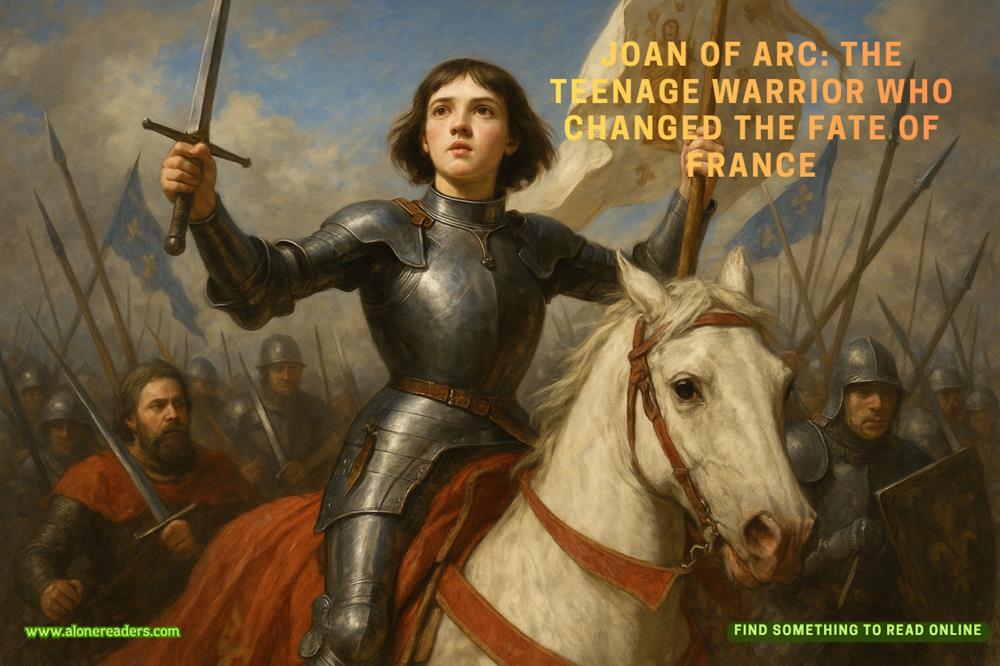
Joan of Arc stands as one of the most extraordinary figures in world history, a symbol of courage and conviction who rose from total obscurity to become a military leader and a national heroine of France. Born a simple peasant girl with no formal training, Joan’s deep faith, unshakable determination, and strategic brilliance changed the course of the Hundred Years’ War. Her remarkable ascent was grounded in powerful religious visions and an unwavering belief in her divine mission. Despite overwhelming odds, she rallied a demoralized nation, helped secure the coronation of Charles VII, and fought with dignity and intensity rarely seen in medieval Europe. Her story, rich in sacrifice and heroism, echoes across centuries and remains a potent reminder of how the voice of even the most unlikely individual can reshape the destiny of nations.
Joan was born around 1412 in Domrémy, a small rural village in northeastern France. Living in a humble farming household, she grew up during a time when the war between France and England had ravaged communities, uprooted families, and shaken the stability of the French monarchy. The English, allied with the Burgundians, controlled vast regions of France. The rightful heir to the throne, known as the Dauphin Charles, struggled for legitimacy and survival. In this climate of political tension and national despair, Joan experienced a series of powerful spiritual visions beginning at the age of thirteen. These visions featured angelic figures and saints whom she believed were instructing her to support Charles and drive out the English invaders. To others, her claims seemed unbelievable, but to Joan they were a sacred mission that guided every step she would take.
As Joan matured, her sense of destiny intensified. She firmly believed she was chosen by a higher power to save France. Her determination was astonishing for someone so young, as she repeatedly sought audiences with local leaders to gain access to the royal court. After persistent efforts, she finally secured a chance to speak with Charles himself. Many nobles doubted her, yet her charisma and conviction impressed the Dauphin. Her knowledge of military matters, uncommon confidence, and unwavering religious devotion convinced him to take a chance. Charles authorized her to accompany an army to the besieged city of Orléans, handing her not only a banner but significant influence over strategy and morale.
When she arrived at Orléans in 1429, the French army had been battered and demoralized. The English siege threatened to crush the city and deal a decisive blow to the French royal cause. Joan’s presence transformed the army’s spirit. Her enthusiasm, faith, and insistence on discipline inspired soldiers and commanders alike. She rode at the front lines wearing armor, carrying her banner high, and motivating troops with fearless resolve. She participated in assaults, encouraged offensives that more cautious commanders avoided, and insisted that victory was possible. Her leadership culminated in a dramatic breakthrough that lifted the siege of Orléans and marked a stunning turning point. The victory electrified France and stunned Europe. A teenage peasant girl had led one of the most important military successes in the war.
Following the triumph at Orléans, Joan pressed for further action. She believed that Charles must be crowned king in the traditional location of Reims to unite France under a single legitimate ruler. The journey to Reims was perilous, passing through enemy-controlled regions, but Joan’s persistence prevailed. As the army advanced from town to town, French morale soared and enemy resistance faltered. On July 17, 1429, Charles VII was crowned, with Joan standing proudly by his side. This coronation symbolized more than a royal victory. It represented the rebirth of national pride, the revival of French identity, and the validation of Joan’s divine mission. For many citizens, she was not merely a warrior; she was a saint sent to secure France’s destiny.
Despite her impressive achievements, Joan soon faced challenges from within. Politics, jealousy, and fear of her influence began to erode trust at court. Her miraculous success had drawn admiration from soldiers and common people, but also resentment from nobles and clergy who felt uneasy with her unconventional power. Charles VII, once so reliant on her, began to distance himself. Nevertheless, Joan continued leading troops, attempting to force the English from French territory. She participated in campaigns around Paris and other contested areas, often pushing for bold strategies that others hesitated to pursue.
In 1430, Joan was captured during a military engagement near Compiègne by Burgundian forces, who were allied with the English. Her capture marked the beginning of a tragic chapter. Rather than negotiate her release, the French court did little to intervene. The Burgundians sold her to the English, who viewed her as both a dangerous foe and a threat to their legitimacy. They feared her symbolic power, believing she might ignite rebellion wherever she went. To neutralize her influence, they sought to destroy her reputation through legal and religious charges.
Joan was placed on trial in Rouen in early 1431. Her judges were not impartial; they were English sympathizers determined to convict her. She was accused of heresy, witchcraft, and the dangerous claim that God spoke to her directly. The trial was conducted under conditions of intimidation and manipulation. Yet Joan displayed remarkable intelligence, courage, and eloquence. Her answers were sharp, thoughtful, and grounded in her faith. She defended her visions without hesitation and refused to deny her mission. The trial records reveal her astonishing composure, particularly for someone barely nineteen years old.
Ultimately, the court found her guilty. She was condemned as a heretic and sentenced to death. On May 30, 1431, Joan of Arc was executed by burning in Rouen’s marketplace. Witnesses later described her final moments as both dignified and tragic. She asked for a cross, called upon divine mercy, and maintained her innocence until the flames consumed her. Her death was intended to silence her story forever, yet it achieved the opposite. Many who saw her execution were struck with grief and doubt. Her courage in facing death elevated her from mere warrior to martyr.
In the years following her death, Joan’s legend continued to grow. As the war progressed, the French ultimately regained control of their lands, and Charles VII’s legitimacy became secure. Questions remained about the trial that condemned her, and decades later, a posthumous investigation overturned the verdict. She was declared innocent, recognized as a victim of political manipulation, and officially revered as a martyr. Over centuries, her reputation expanded beyond military achievement. She became a symbol of national unity, female empowerment, faith-driven leadership, and resistance against oppression.
Joan of Arc’s legacy extends far beyond medieval France. Around the world, she is celebrated in literature, theater, films, and art. Scholars study her military tactics, psychologists examine her resolve, theologians debate her visions, and activists praise her defiance of gender boundaries. Her story resonates with anyone who has ever questioned their own worth or faced impossible odds. She broke societal conventions simply by believing that her voice mattered. In an age when women were denied almost all public authority, she commanded armies and changed the fate of kingdoms.
The significance of her gender cannot be overlooked. Medieval Europe was rigidly patriarchal, with laws and customs that confined women to domestic duties. Joan’s leadership challenged deeply entrenched beliefs about women’s roles. Her success proved that courage and intellect are not confined by gender, social class, or education. Her armor became both a literal and symbolic defense against prejudice, demonstrating that great leadership emerges from conviction rather than birthright.
Even centuries later, Joan remains an inspirational figure for countless people. She embodies the ideal that one individual—driven by purpose—can transform history. Her life underscores themes of national identity, moral duty, and the sometimes painful collision between politics and faith. Her death reflects the cruel price that visionaries often pay when their influence threatens established powers. And yet, her vindication and eventual canonization in 1920 reveal how societies evolve and reinterpret their past heroes.
The enduring fascination with Joan of Arc stems from the extraordinary contrasts in her story. She was young but wise, humble but powerful, illiterate yet articulate, and devoutly religious yet militarily brilliant. Her medieval world was filled with turmoil, yet she cut through chaos with clarity and purpose. Her journey was short—lasting only a few years on the public stage—but contained enough drama for multiple lifetimes. Few historical figures have captured the imagination of so many cultures for so long.
Today, Joan’s legacy serves as a rallying point for those who feel unheard or underestimated. She inspires movements focused on gender equality, national sovereignty, and the right to personal conviction. Her life teaches that greatness lies not in privilege, but in the courage to follow one’s beliefs despite danger. She calls us to recognize that inner strength can overcome external barriers, and that the human spirit, once ignited, can move armies.
Ultimately, Joan of Arc is remembered not only for what she achieved but for how she achieved it. She demonstrated unwavering faith in a vision that others ridiculed. She confronted fear with calm resolve. She saw victory when others saw only defeat. Her story reminds us that history is not written solely by kings and generals, but also by those obscure individuals who rise unexpectedly when fate demands. The teenage warrior from Domrémy saved France at its darkest hour, secured its rightful king, and became a beacon of hope for generations.
Centuries after her martyrdom, statues of Joan stand across France and throughout the world. Her image graces cathedrals, museums, and public squares. She is honored as a saint, a heroine, a warrior, and a champion of conviction. Her life encourages us to challenge limitations, fight for justice, and believe—even when the world doubts. Her story is a testament to the power of faith, courage, and the enduring human spirit, immortalizing Joan of Arc as one of history’s most influential women.



 The Hundred Days Offensive: How the Allies Defeated Germany in World War I
 The Second Battle of the Marne: The Turning Point of World War I in 1918
 The Spring Offensive of 1918: Germany's Final Gamble to Win World War I
 The Treaty of Brest-Litovsk: How Russia Left World War I
 The Russian Revolution and World War I: How War Brought Down the Tsar
 The Zimmermann Telegram Explained: Germany's Secret Offer to Mexico in World War I