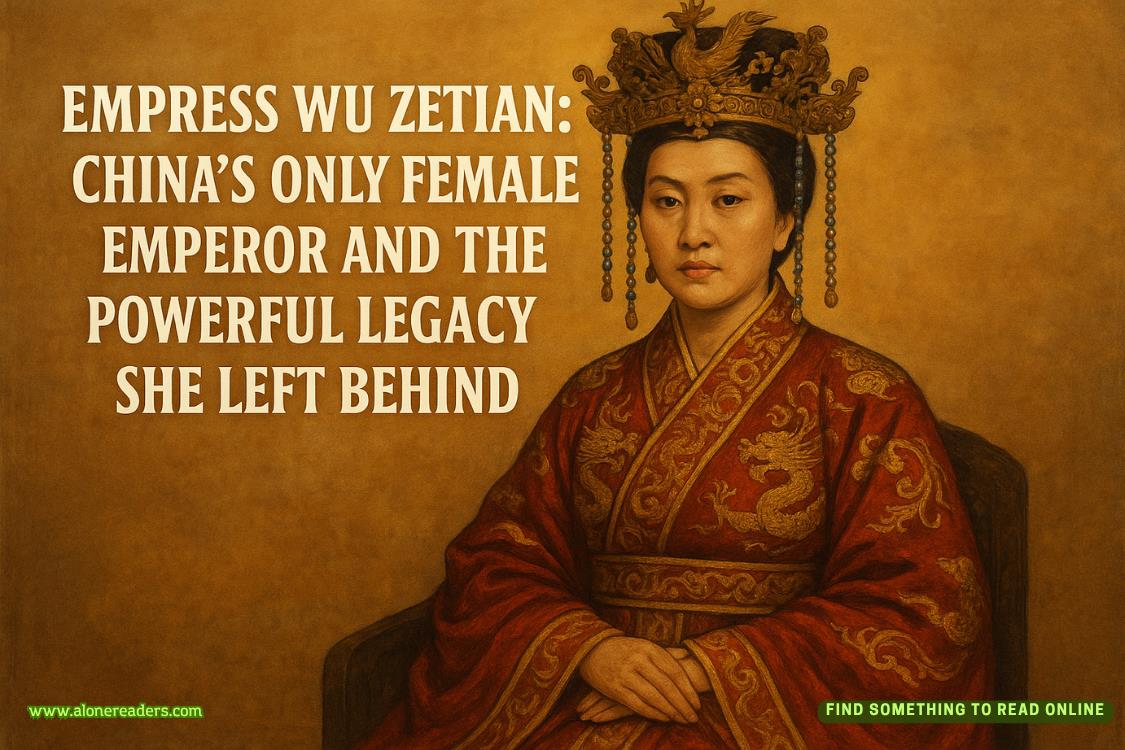
Empress Wu Zetian occupies a remarkable and controversial chapter in the long annals of Chinese history. As China’s only female emperor, she defied deeply entrenched patriarchal norms, shattered political conventions, and reshaped imperial governance during one of China’s most prosperous eras. Born in the seventh century during the Tang Dynasty, Wu’s ascent from a lesser consort to the absolute ruler of the Chinese empire remains one of history’s most intriguing political transformations. Her life is a study of ambition, intellect, strategic prowess, and the delicate balance between ruthless political maneuvers and visionary governance. Though demonized by traditional historians, modern scholarship reveals a more nuanced picture that speaks volumes about her talent, leadership, and the changing role of women in imperial China.
Wu Zetian entered palace life at a young age as a concubine of Emperor Taizong, the formidable ruler who established the Tang Dynasty as a central power in East Asia. As a palace attendant, she initially held a relatively low rank, but even then, she distinguished herself through remarkable literacy, quick comprehension, and political subtlety. Her unique ability to read classical Chinese texts allowed her to engage in intellectual discussions uncommon for women of her time, positioning her apart from other consorts. After Emperor Taizong’s death, Wu entered a Buddhist nunnery, but her story did not end there. Emperor Gaozong, Taizong’s son, eventually brought her back to court, captivated by her charisma and intellect, setting the stage for her historic rise.
Once back at court, Wu gradually elevated her status through calculated alliances and unwavering political acumen. The Tang court was rife with competition between consorts, aristocratic clans, and bureaucrats, and Wu navigated this web with careful intent. She gave birth to the emperor’s children, cementing her place in the imperial lineage, and used her position to counter the influence of other prominent families. Through circumstances shrouded in historical debate, she overthrew former rivals and became empress, taking control of court politics as Emperor Gaozong’s health deteriorated. From that moment, she effectively ruled behind the throne, shaping policy, appointing officials, and strengthening the central government.
By the time she declared herself emperor in 690 CE, Wu Zetian had consolidated enough power to found her own dynasty, known as the Zhou Dynasty, interrupting the Tang line. This extraordinary act made her the first and only woman in Chinese history to rule openly as emperor rather than through marriage or regency. Her reign was marked by far-reaching reforms that transformed the imperial bureaucracy. Wu understood that aristocratic families dominated the government, often stifling merit and innovation. To address this, she expanded the imperial examination system, allowing talented individuals from lower social backgrounds to attain official positions. This system strengthened central authority and fostered a government based more on merit than birthright.
Empress Wu’s reign also witnessed the flourishing of Chinese culture and intellectual life. She supported scholars, encouraged the compilation of historical texts, and strengthened the influence of Buddhism, which provided ideological justification for her authority. Temples and monumental carvings commissioned during her rule promoted the idea that a woman could serve as the chosen ruler of the empire. In an era dominated by masculine interpretations of power, her embrace of Buddhism allowed her to reshape public perception and challenge Confucian ideals that marginalized women.
Despite her significant contributions, Wu Zetian’s rule was not without opposition. Members of the aristocracy, Confucian scholars, and conservative factions viewed her leadership as an affront to tradition. Rumors, slander, and accusations of cruelty circulated widely, painting her as a manipulative and ruthless tyrant. Stories of intrigues, purges, and political trials became embedded in historical narratives, often amplified by male historians who resented her authority. Many accounts portrayed her as a ruler who relied on fear and punishment, though modern historians argue that such measures were not uncommon among male emperors of the era. The fact that she was a woman in power intensified and preserved much of the criticism in the historical record.
As a ruler, Wu Zetian also demonstrated remarkable sensitivity to the needs of her subjects. She lowered taxes, improved agricultural policies, and implemented land redistribution to support farmers. Her administration supported infrastructure projects, including irrigation systems, which boosted food production. These policies contributed to population growth and economic stability. By rewarding competent officials and rooting out corruption, she fostered a period of prosperity that would later contribute to the Tang Dynasty’s golden era after her abdication.
Wu’s governance style was complex. She balanced reward and punishment to maintain control over an empire of immense size and diverse cultures. She surrounded herself with officials whose loyalty was earned rather than inherited, creating a government less dependent on aristocratic lineage. This shift in power dynamics marked a turning point in Chinese political structure, reducing the influence of hereditary clans and setting the stage for future reforms under later emperors. Her methods, while criticized, were effective in stabilizing government administration and reinforcing imperial authority.
Empress Wu faced numerous rebellions and conspiracies throughout her reign, but her strategic decisions repeatedly secured her rule. She established an elaborate secret police network, both to identify threats and ensure loyalty among officials. While this earned her a reputation for political paranoia, it also enabled her to outmaneuver factions that sought to depose her. Nevertheless, critics argue that such tactics fostered a climate of fear in the palace and may have contributed to instability after her reign.
In her final years, declining health weakened her grasp on power. Internal court factions eventually forced her to abdicate in favor of restoring the Tang Dynasty under Emperor Zhongzong. After stepping down, she lived quietly until her death, marking the end of one of the most extraordinary political careers in Chinese history. Following her passing, many of the reforms she introduced remained influential, shaping the imperial state for centuries to come.
Empress Wu Zetian’s legacy has been fiercely debated for more than a thousand years. Traditional Confucian historians often painted her as a villain who inverted the natural order. They emphasized alleged acts of brutality and accused her of immoral behavior. Such portrayals reveal as much about the gender biases of the time as they do about her actual deeds. Later historians, especially modern scholars, have offered a more balanced perspective. They note that male rulers who used similar tactics rarely faced equivalent moral condemnation. Wu’s reign, when evaluated objectively, reveals a ruler who was pragmatic, strong-willed, and remarkably effective.
Her reforms to the imperial examination system arguably had the most enduring impact. By opening government positions to talented individuals from diverse backgrounds, she encouraged social mobility and improved administrative efficiency. This merit-based approach became a defining characteristic of Chinese bureaucracy for centuries, influencing Confucian governance and shaping the civil service model admired worldwide. Additionally, her patronage of Buddhism left a significant cultural imprint, contributing to the religion’s spread and architectural legacy across China.
From a social and gender equality perspective, Wu Zetian’s reign symbolizes the possibility of female leadership in a world dominated by patriarchal hierarchies. Her ability to rise within a rigid social structure demonstrates exceptional determination and political intelligence. For many feminist historians, she serves as a case study of how gender biases shape historical memory. Her accomplishments challenge the notion that powerful women are inherently destructive or unfit for leadership. Instead, they illustrate how cultural narratives often distort the legacies of influential female figures.
Despite the controversy surrounding her reputation, the economy thrived, arts flourished, and the government experienced a new wave of talent during her time. The empire did not crumble under her rule; rather, it remained stable and continued to prosper. This fact alone stands as a testament to her competence and adaptability as a leader. Under her direction, China’s influence expanded, diplomacy thrived, and the imperial court became a center of intellectual debate.
Modern reevaluations of Wu Zetian highlight her as one of China’s most consequential rulers. Museums, television series, academic studies, and novels have reignited interest in her life. She is often cited as an example of extraordinary political leadership against overwhelming odds. Her story resonates beyond East Asia, inspiring discussions about female leadership, media portrayal, and power dynamics. Today, she stands among the ranks of historical figures whose legacies continue to evolve as new evidence emerges and societal values shift.
In considering Wu Zetian’s legacy, it is important to separate myth from fact. While she undoubtedly used harsh methods to maintain authority, her policies improved government efficiency, expanded social opportunities, and fostered cultural growth. Her reign, though brief by imperial standards, left permanent marks on Chinese political institutions. By challenging the monopoly of aristocratic elites, she strengthened the central government and helped shape the bureaucratic model that would define later centuries.
Her life story illuminates the complexities of political power and the biases embedded in historical narratives. She defied predetermined roles and rose to the highest authority in a society that fundamentally opposed female sovereignty. Her success reveals the capacity of individual talent to overcome structural limitations. Whether admired for her achievements or criticized for her methods, Wu Zetian’s reign remains one of the most astonishing chapters in imperial history.
Ultimately, Empress Wu Zetian’s rule represents a convergence of ambition, intelligence, perseverance, and controversial leadership. Her actions redefined the potential of women in positions of power and reshaped the administrative foundation of the Chinese empire. Her legacy endures not only through the reforms and cultural contributions she left behind but also through the ongoing conversations about gender, authority, and the complexities of historical memory. Among the countless rulers who have shaped China’s destiny, Wu Zetian remains a singular figure: a woman who seized the throne, forged her own dynasty, and reshaped history through her relentless pursuit of power and stability.



 The Hundred Days Offensive: How the Allies Defeated Germany in World War I
 The Second Battle of the Marne: The Turning Point of World War I in 1918
 The Spring Offensive of 1918: Germany's Final Gamble to Win World War I
 The Treaty of Brest-Litovsk: How Russia Left World War I
 The Russian Revolution and World War I: How War Brought Down the Tsar
 The Zimmermann Telegram Explained: Germany's Secret Offer to Mexico in World War I










