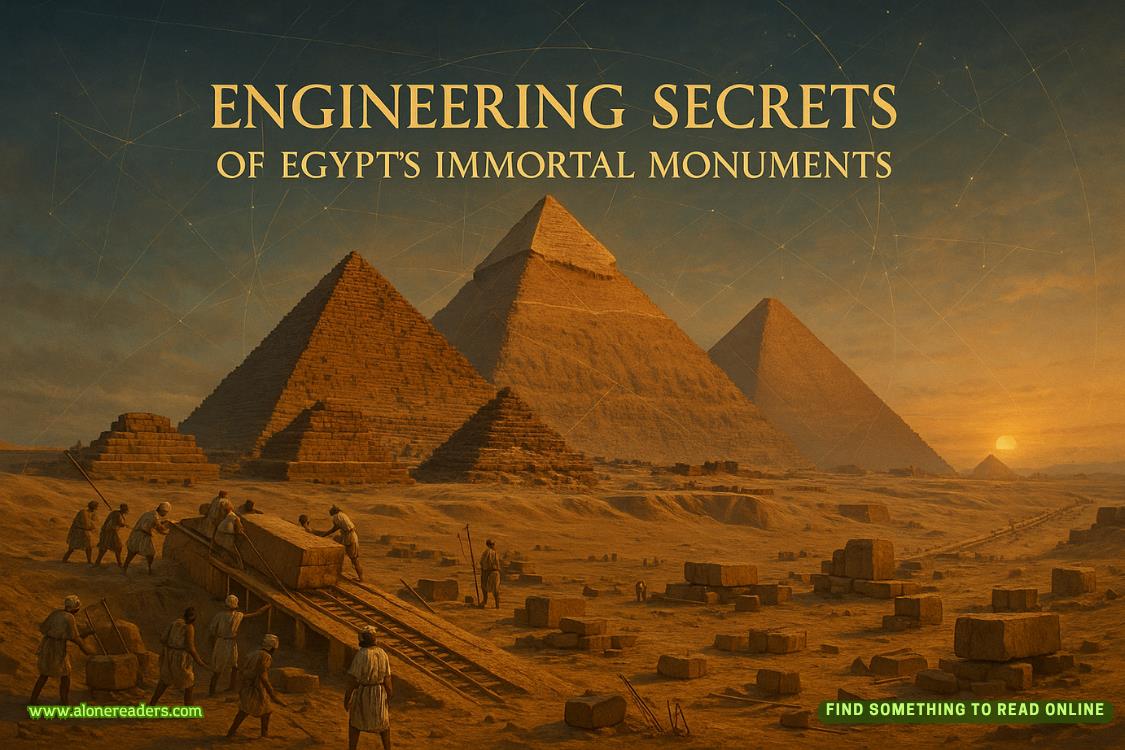
Among the countless human achievements that define civilization, few rival the Great Pyramids of Giza in grandeur, mystery, and endurance. Rising above the Egyptian desert for more than 4,500 years, these colossal structures remain both an archaeological treasure and an architectural enigma. Built during the Fourth Dynasty under Pharaohs Khufu, Khafre, and Menkaure, the pyramids served as eternal resting places and cosmic gateways for the rulers of ancient Egypt. Yet, their design and construction continue to challenge modern engineers, mathematicians, and historians alike.
The scale of their creation defies simple explanation. The Great Pyramid of Khufu, the largest of the three, originally stood 146.6 meters tall and was composed of an estimated 2.3 million limestone and granite blocks, each weighing between 2.5 and 15 tons. Without cranes, iron tools, or modern surveying instruments, how did ancient Egyptians achieve such perfection in scale, symmetry, and alignment?
One of the most astonishing aspects of the Great Pyramids is their precise alignment with the cardinal points—north, south, east, and west. Modern measurements show that the Great Pyramid deviates from true north by a mere fraction of a degree. This precision suggests advanced astronomical knowledge. Scholars propose that ancient Egyptian engineers used the circumpolar stars, specifically Kochab and Mizar, as reference points to align the pyramid. Others argue that the alignment may have been achieved by tracking the sun’s shadow during equinoxes. Whatever the method, it reveals a deep understanding of both celestial motion and geometry.
Equally impressive is the mathematical proportion embedded within the pyramid’s design. The slope angle of approximately 51°52′ is no coincidence—it encodes the ratio between the pyramid’s height and base, which approximates the mathematical constant π (pi). This geometric harmony was likely intentional, symbolizing the Egyptians’ quest for cosmic balance, or “Ma’at.” Some researchers even argue that the Great Pyramid’s perimeter corresponds closely to the Earth’s circumference when scaled appropriately, leading to speculation that the ancient builders possessed geodetic knowledge far beyond their time.
The question of how the pyramids were constructed remains a subject of passionate debate. The traditional theory posits that massive limestone blocks were dragged on sledges over ramps made of mudbrick or limestone chippings. Yet, the logistics of building a ramp long enough and sturdy enough to haul millions of stones to such heights seem implausible. More recent theories propose a circular or spiral ramp wrapping around the pyramid as it rose, or even a system of internal ramps concealed within the structure—an idea supported by microgravity scans showing potential voids and passageways inside Khufu’s pyramid.
Engineering ingenuity also extended to material handling and logistics. Workers may have reduced friction by wetting the sand in front of sledges, as experiments have shown that slightly damp sand cuts resistance nearly in half. Copper chisels and dolerite pounding stones were used to shape blocks, while sledges and wooden rollers helped transport them from the quarries. The logistics would have required extraordinary organization—an estimated workforce of 20,000 to 30,000 laborers, rather than the mythical armies of slaves once imagined. These workers were skilled artisans, laboring under strict management systems with divisions of tasks, supply chains, and even medical care.
The pyramids’ internal architecture also showcases unprecedented foresight. The Great Pyramid’s internal structure includes the King’s Chamber, Queen’s Chamber, and a Grand Gallery—a 47-meter-long passageway with precision-cut stone corbeling designed to distribute weight evenly. Above the King’s Chamber lie five “relieving chambers” made of massive granite slabs, cleverly engineered to prevent collapse from the pyramid’s immense weight. The chamber itself, lined with Aswan granite transported over 800 kilometers, demonstrates the logistical sophistication of an empire that mastered both engineering and supply chain management.
Ventilation shafts inside the pyramid point toward specific constellations—Orion’s Belt and the circumpolar stars. This alignment was no accident. The ancient Egyptians believed the pharaoh’s soul would ascend to join the gods in the afterlife, particularly Osiris, symbolized by Orion. Thus, astronomy and spirituality merged seamlessly into the pyramid’s geometry, transforming it from a tomb into a celestial launch pad for the divine journey of the king’s soul.
Another layer of mystery lies beneath the sands—the subterranean chamber and causeways that connect the pyramids to their valley temples and mortuary complexes. These served as ceremonial pathways for the “Opening of the Mouth” rituals, where priests symbolically reanimated the pharaoh’s spirit. The entire Giza complex—complete with solar boats, mastabas, and temples—was a unified architectural statement about divine power and eternal life.
The durability of the pyramids is not just symbolic but structural. Their core masonry follows a concentric block pattern that redistributes pressure outward, while the base rests on solid bedrock, ensuring stability against earthquakes. The casing stones, originally polished white Tura limestone, reflected the desert sun so intensely that the pyramids gleamed like celestial beacons visible from miles away. Over millennia, most of these outer layers were stripped for later construction projects, but remnants still reveal the exquisite craftsmanship of their builders.
In recent years, cutting-edge research has uncovered new insights. Thermal imaging and muon tomography have revealed hidden voids and temperature anomalies inside the Great Pyramid, suggesting unexplored chambers or cavities that might shed light on construction techniques. Some archaeologists now propose that these voids served as weight-relief spaces or internal transportation corridors used during building. Others suggest symbolic rather than functional purposes—perhaps spaces for ritual objects or spiritual “pathways” within the structure itself.
Despite centuries of study, the Great Pyramids remain a testament to human ambition and the synthesis of science, religion, and art. They embody a civilization’s ultimate expression of permanence—an eternal link between Earth and the heavens. The builders of Giza did not merely pile stones; they encoded within those stones a philosophy of eternity, balance, and divine order.
Visiting the pyramids today evokes the same awe they must have inspired in ancient times. Standing before Khufu’s monumental creation, one can still feel the precision, labor, and vision that transcended human mortality. Every chisel mark and angle tells a story—not just of a pharaoh’s quest for immortality, but of a society that fused engineering genius with cosmic purpose.
The Great Pyramids of Giza continue to whisper through the desert winds, challenging our understanding of ancient technology and reminding us that humanity’s reach for the eternal began not in the modern age—but in the golden sands of Egypt, beneath the eternal gaze of the sun and stars.



 The Hundred Days Offensive: How the Allies Defeated Germany in World War I
 The Second Battle of the Marne: The Turning Point of World War I in 1918
 The Spring Offensive of 1918: Germany's Final Gamble to Win World War I
 The Treaty of Brest-Litovsk: How Russia Left World War I
 The Russian Revolution and World War I: How War Brought Down the Tsar
 The Zimmermann Telegram Explained: Germany's Secret Offer to Mexico in World War I