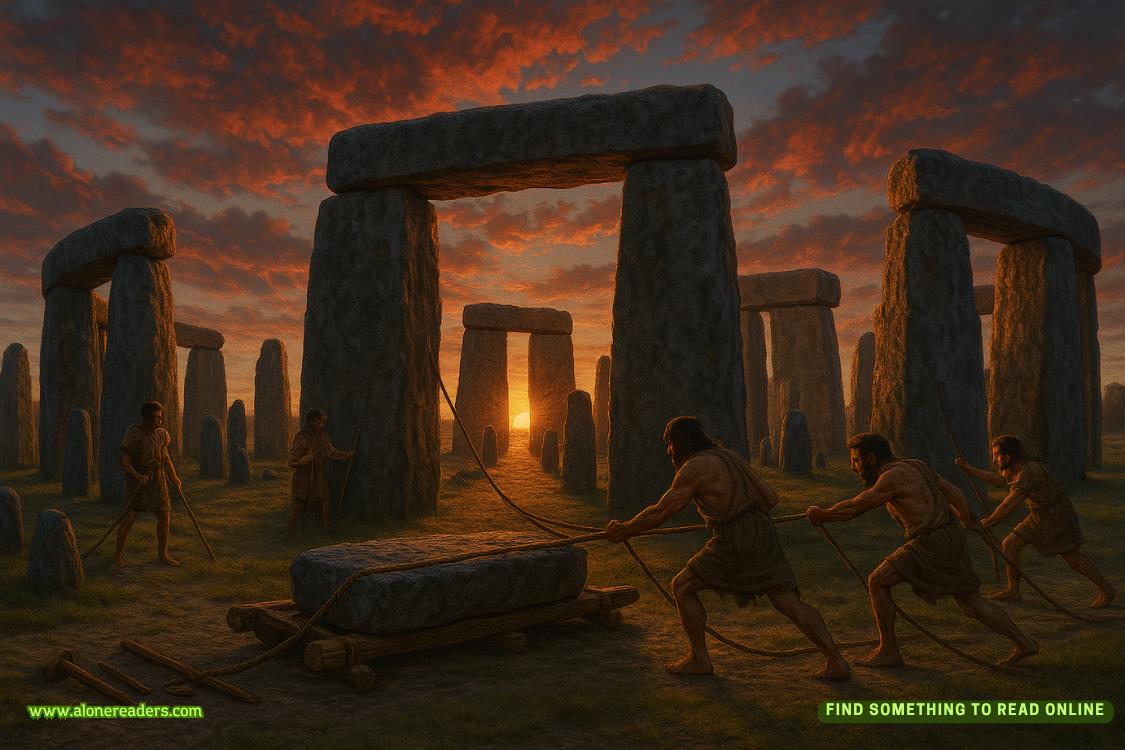
Stonehenge, the enigmatic ring of massive stones rising from the Salisbury Plain in southern England, has captivated historians, archaeologists, and astronomers for centuries. Its haunting silhouette, especially at dawn during the summer solstice, speaks to the extraordinary skill and cosmic understanding of its Neolithic builders. Beyond its mystical aura, modern research increasingly suggests that Stonehenge was not merely a ceremonial monument—it was a precisely engineered celestial calendar that aligned human activity with the rhythms of the cosmos. Understanding how people, armed only with primitive tools more than 4,000 years ago, managed to create such an astronomical masterpiece reveals the astonishing ingenuity of early civilization.
The origins of Stonehenge date back to around 3000 BCE, during the late Neolithic period, when the first circular earthworks were constructed. Over the following centuries, the monument evolved through multiple phases, culminating around 2500 BCE with the placement of the iconic sarsen stones. Each weighing between 20 and 30 tons, these stones were arranged with remarkable geometric precision into a horseshoe and circular formation. Smaller bluestones, quarried from the Preseli Hills in Wales—over 240 kilometers away—were also transported and set within the structure. The logistical complexity of moving these massive stones without the wheel or metal tools underscores the engineering brilliance of these prehistoric builders.
The sheer precision of Stonehenge’s layout has long intrigued researchers. When viewed from its central axis, the monument aligns almost perfectly with the summer solstice sunrise and the winter solstice sunset. On midsummer morning, the first rays of the rising sun pass directly through the Heel Stone—an isolated monolith located northeast of the circle—and illuminate the heart of the monument. Conversely, during the winter solstice, the setting sun aligns with the main axis in the opposite direction. Such intentional positioning is no coincidence; it reflects an advanced understanding of the solar cycle, possibly used to mark the changing seasons and guide agricultural or ritual activities. In essence, Stonehenge acted as a solar calendar, enabling Neolithic communities to anticipate crucial moments in the yearly cycle of life.
The monument’s alignment extends beyond simple solar observations. Some researchers suggest that the arrangement of stones also allowed the tracking of lunar cycles and eclipses, a level of astronomical awareness that would have required generations of careful observation. The spacing between certain stones and the placement of outlying markers like the Station Stones could have served as points for predicting moonrise and moonset patterns. In doing so, Stonehenge may have operated as a combined solar-lunar observatory, allowing its builders to reconcile the complex differences between the solar year and the lunar month. This dual calendar system would have held both practical and spiritual significance—ensuring agricultural success while embedding celestial order into their cosmology.
Engineering such an intricate and massive structure demanded an extraordinary blend of innovation, cooperation, and endurance. The construction likely involved thousands of laborers organized under skilled leaders who possessed deep knowledge of geometry, astronomy, and mechanical leverage. Archaeological evidence suggests that the stones were dragged on wooden sledges over lubricated tracks or rolled on wooden logs. To raise them, builders dug deep pits and used a combination of ropes, levers, and earthen ramps. Once upright, lintel stones—each weighing several tons—were placed atop vertical stones using mortise-and-tenon joints, a technique that provided surprising stability. This jointing system, rarely seen in structures of that age, demonstrates a sophisticated grasp of engineering principles that predates recorded mathematics.
Transporting the smaller bluestones from Wales was another monumental feat. Scholars believe they were moved using a combination of sledges, river rafts, and coastal barges—a journey spanning mountains, rivers, and sea routes. The decision to source these stones from such a distant location indicates more than mere practicality. The bluestones may have carried symbolic or spiritual significance, possibly connected to ancestral homelands or sacred landscapes. Their integration into Stonehenge thus infused the monument with layers of cultural meaning that extended far beyond its physical form.
Equally impressive was the site’s architectural geometry. The layout of Stonehenge incorporates precise circles, ellipses, and alignments that conform to mathematical relationships later formalized in classical geometry. The builders’ ability to maintain near-perfect symmetry across such a vast scale suggests they used standardized units of measurement and advanced planning techniques. Postholes, ditches, and banks around the site reveal a complex design that evolved over time, indicating that each construction phase was meticulously calculated to maintain astronomical accuracy as the structure grew. In this sense, Stonehenge was both a work of architecture and an evolving scientific instrument.
Beyond its practical functions, Stonehenge served as a ceremonial and communal hub, bringing together people from across Britain. Excavations around the site have uncovered animal bones, pottery, and evidence of feasting, suggesting large gatherings coincided with solstices and seasonal transitions. These events likely combined ritual observance with social cohesion, reaffirming the community’s connection to cosmic cycles. In a world without clocks or calendars, the sun’s movement across the stones would have been a living testament to the passage of time, binding the spiritual and agricultural lives of Neolithic people into a single cosmic order.
Over millennia, Stonehenge’s meaning evolved, but its role as a symbol of cosmic alignment and human craftsmanship endured. Later Bronze Age and Iron Age societies continued to venerate the site, and even in medieval times it was regarded as a place of mystery and power. Modern archaeological methods, including ground-penetrating radar and 3D laser scanning, have only deepened our appreciation of its design. These studies reveal that Stonehenge was not an isolated monument but part of a larger ceremonial landscape connected by avenues, burial mounds, and timber circles—all aligned to celestial events. Together, they form a vast ritual landscape of time, where architecture, astronomy, and belief intersected.
The precision of Stonehenge challenges our assumptions about early societies. Far from primitive, the Neolithic builders displayed an extraordinary ability to observe, record, and interpret natural phenomena. They recognized patterns in the sky and translated them into physical form using nothing more than stone, timber, and human ingenuity. In doing so, they built not only a monument but also a bridge between earth and sky, a perpetual reminder of humanity’s quest to understand its place in the cosmos.
Today, as thousands gather each year to witness the midsummer sunrise at Stonehenge, they stand in the footsteps of those ancient astronomers who first aligned stone and shadow to mark the turning of the year. The monument continues to function as intended—marking the celestial rhythm that has governed life on Earth since time immemorial. Its endurance across 5,000 years is a testament to both its engineering mastery and its spiritual resonance. Stonehenge remains one of the world’s greatest reminders that long before written history, humans looked to the heavens not only for guidance but also for meaning.
In the end, Stonehenge’s brilliance lies not merely in its size or age but in the intellectual leap it represents. It embodies a civilization that measured time by the sun, celebrated the cycle of life through architecture, and embedded its scientific knowledge in enduring stone. It stands as proof that even in prehistory, human beings were not passive observers of nature—they were engineers of the cosmos, crafting monuments that transformed the sky itself into a calendar of eternity.



 The Hundred Days Offensive: How the Allies Defeated Germany in World War I
 The Second Battle of the Marne: The Turning Point of World War I in 1918
 The Spring Offensive of 1918: Germany's Final Gamble to Win World War I
 The Treaty of Brest-Litovsk: How Russia Left World War I
 The Russian Revolution and World War I: How War Brought Down the Tsar
 The Zimmermann Telegram Explained: Germany's Secret Offer to Mexico in World War I










