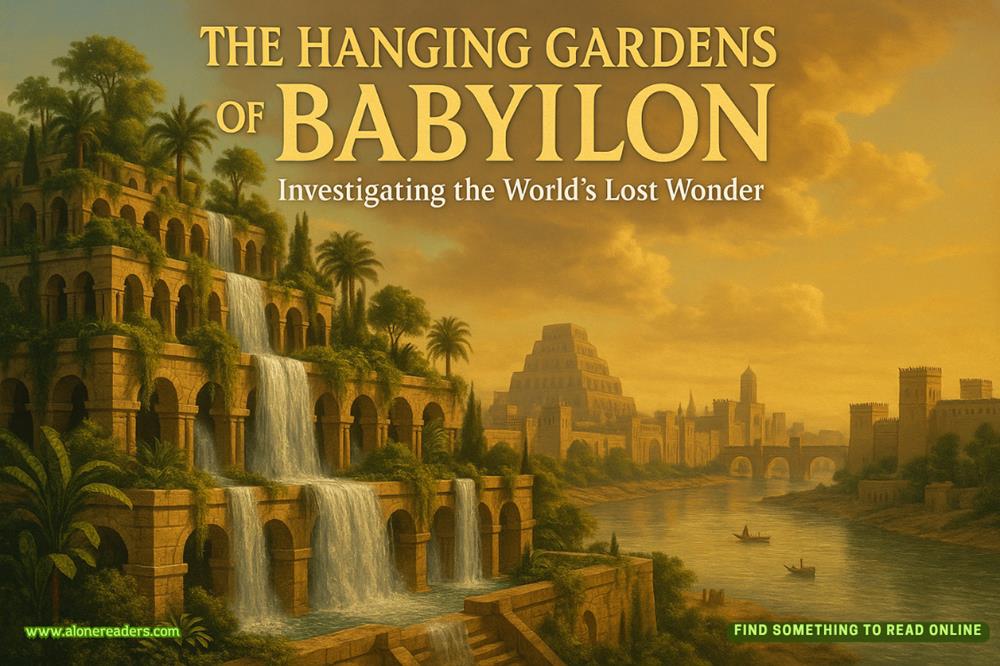
The Hanging Gardens of Babylon stand as one of history’s most captivating enigmas—a marvel celebrated in ancient texts yet lost without a trace in the sands of time. Described as an architectural and botanical masterpiece, the gardens were said to have been built in the heart of Babylon, near modern-day Hillah in Iraq, around the 6th century BCE. They are one of the Seven Wonders of the Ancient World, yet unlike the Great Pyramid or the Colossus of Rhodes, no confirmed archaeological evidence has ever been found. The story of the Hanging Gardens bridges the realms of myth and history, symbolizing the ingenuity and imagination of ancient engineers while leaving scholars to ponder whether they ever existed at all.
According to ancient historians such as Strabo and Philo of Byzantium, the Hanging Gardens were a monumental series of tiered terraces rising high above the plains of Mesopotamia. These terraces, lush with exotic trees, flowers, and vines, appeared to hang in the air—an illusion achieved through their elevated, layered structure. The gardens supposedly rose like a green mountain, supported by massive stone columns and vaulted platforms, irrigated by an ingenious hydraulic system that drew water from the nearby Euphrates River. The visual spectacle would have been breathtaking—a vibrant contrast to the dusty landscape of Babylon and a testament to human mastery over nature.
Tradition attributes the creation of this verdant paradise to King Nebuchadnezzar II, who reigned from 605 to 562 BCE. The legend holds that the king built the gardens to console his homesick wife, Amytis of Media, who longed for the green hills and forests of her homeland. Babylon, with its arid plains, offered little resemblance to the mountainous regions of Media. To ease her sorrow, Nebuchadnezzar is said to have ordered the construction of a magnificent artificial mountain filled with trees, flowers, and flowing water. It was both a gesture of love and a demonstration of his empire’s engineering capabilities—a display of wealth and power meant to astonish all who entered Babylon’s gates.
However, the mystery deepens when we realize that no Babylonian inscriptions, tablets, or direct records from Nebuchadnezzar’s reign mention such a garden. The Babylonians, known for their meticulous recordkeeping, left behind extensive documentation of their architectural achievements, including the famous Ishtar Gate and the walls of Babylon, but none describing the Hanging Gardens. This silence in the historical record has led many scholars to question whether the gardens were ever located in Babylon at all.
The descriptions of the Hanging Gardens that survive come primarily from Greek historians writing centuries after Babylon’s peak. Herodotus, often called the “Father of History,” makes no mention of them, though he described Babylon in great detail. Later writers such as Strabo, Diodorus Siculus, and Quintus Curtius Rufus provide accounts that vary in structure, scale, and irrigation methods. These inconsistencies suggest that the gardens’ image may have evolved through retellings, blending reality with legend. Yet despite the contradictions, certain core features remain consistent: terraced levels, abundant vegetation, and a complex water-lifting system unlike anything else known from the ancient world.
One of the most fascinating aspects of the Hanging Gardens legend is its implied technological sophistication. To sustain a massive, multi-level garden in the desert climate of Mesopotamia, engineers would have needed an advanced irrigation system capable of continuously delivering water to elevated terraces. Ancient descriptions mention an “Archimedean screw” or similar water-lifting device centuries before its known invention. If true, this would make the gardens an early example of hydraulic engineering far ahead of its time. Archaeological excavations in the Babylon region have uncovered complex canal systems and reservoirs, evidence that the Babylonians possessed the technical ability to manipulate large-scale water flow, though none directly linked to the gardens.
In the late 20th century, a bold new theory emerged that could rewrite the story entirely. British archaeologist Stephanie Dalley of Oxford University proposed that the Hanging Gardens were not in Babylon but in Nineveh, the capital of the Assyrian Empire, located hundreds of kilometers to the north. Dalley based her argument on cuneiform texts from the reign of King Sennacherib (704–681 BCE), which describe a magnificent garden complex with extraordinary waterworks—an “invention for raising water” unlike any seen before. Sennacherib himself referred to his palace as having a “wonder for all peoples.” The Assyrian king’s inscriptions describe a lush, terraced garden sustained by aqueducts that brought water from distant mountains, a feat verified by the discovery of the Jerwan aqueduct, one of the oldest stone aqueducts in the world. This evidence aligns closely with classical descriptions of the Hanging Gardens, leading many to believe that Greek historians may have confused Nineveh with Babylon over time.
If Dalley’s theory is correct, the Hanging Gardens may have been a wonder of Assyrian rather than Babylonian origin. This possibility reshapes our understanding of ancient Near Eastern engineering and political power. The confusion could easily have arisen because later Greek and Roman historians often referred to the entire Mesopotamian region as “Babylonia,” merging its different cultures into a single mythic landscape. The Assyrians, like the Babylonians, were masters of irrigation and monumental construction. Sennacherib’s palace complex in Nineveh included water channels, canals, and a sophisticated system of screw-like devices that lifted water to great heights, perfectly matching the technological feats described in the ancient sources.
Despite the compelling case for Nineveh, the image of the Hanging Gardens remains deeply tied to Babylon in the collective imagination. Babylon’s grandeur, symbolized by its ziggurats, palaces, and massive walls, makes it a fitting setting for such a wonder. The very name evokes visions of ancient splendor—a city at the heart of civilization, bridging myth and history. Whether or not the gardens physically stood there, the association endures as part of Babylon’s enduring legend. The notion of a man-made paradise in the middle of the desert reflects the Mesopotamian ideal of bringing order and fertility to chaos—an earthly reflection of divine power and royal magnificence.
Archaeological efforts to locate the Hanging Gardens in Babylon have continued intermittently for more than a century. Excavations by Robert Koldewey between 1899 and 1917 revealed a network of vaulted structures and deep wells that he believed might be the remnants of the gardens’ foundations. However, subsequent studies have shown that these structures were likely part of the royal palace’s storage and defense systems rather than a terraced garden. The problem is compounded by the shifting course of the Euphrates River, which has likely eroded or buried much of the ancient city under centuries of sediment. Without direct evidence—such as inscriptions, irrigation pipes, or botanical remnants—the mystery remains unresolved.
Still, the legend persists not merely because of historical curiosity but because it captures something universal: the human longing to transform barren landscapes into living sanctuaries. The Hanging Gardens symbolize humanity’s eternal struggle to impose beauty and harmony upon a harsh environment. They represent the intersection of art, architecture, and nature—an ancient precursor to the modern idea of sustainable design and urban green spaces. Whether myth or reality, the gardens embody the highest aspirations of civilization: creativity, love, and the quest for perfection in an imperfect world.
The story of the Hanging Gardens also serves as a reminder of how history is often reconstructed through fragments and imagination. Ancient accounts, transmitted through generations, blend memory with myth until the boundaries between them blur. Perhaps the gardens never existed in physical form, yet they live on as a metaphor for human innovation and devotion. The image of Nebuchadnezzar’s terraced paradise—trees swaying in the desert breeze, water cascading from terrace to terrace—continues to inspire artists, architects, and dreamers across millennia.
In the end, the Hanging Gardens of Babylon remain both a mystery and a monument to the power of imagination. Whether they once flourished on the banks of the Euphrates or the Tigris—or existed only in the minds of poets and travelers—they endure as a symbol of humankind’s ability to dream beyond the boundaries of the possible. Their legacy, suspended between earth and sky, continues to remind us that even lost wonders can leave an indelible mark on the story of civilization.




 The Hundred Days Offensive: How the Allies Defeated Germany in World War I
 The Second Battle of the Marne: The Turning Point of World War I in 1918
 The Spring Offensive of 1918: Germany's Final Gamble to Win World War I
 The Treaty of Brest-Litovsk: How Russia Left World War I
 The Russian Revolution and World War I: How War Brought Down the Tsar
 The Zimmermann Telegram Explained: Germany's Secret Offer to Mexico in World War I