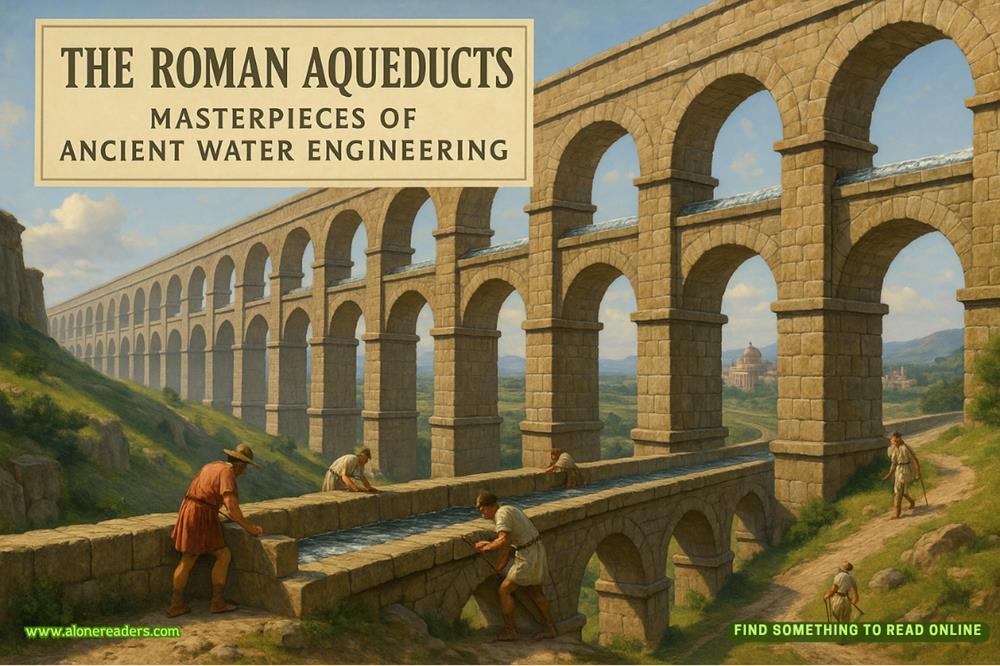
The Roman aqueducts stand as one of the most awe-inspiring achievements in ancient engineering, representing a combination of technical brilliance, aesthetic grandeur, and social impact that reshaped the ancient world. For over five centuries, the Romans mastered the science of hydraulic architecture, creating a network of water systems so advanced that many still influence modern civil engineering today. These monumental structures were not merely pipelines; they were symbols of imperial power, civic pride, and the triumph of human ingenuity over nature’s challenges.
At the heart of this engineering marvel was a simple yet revolutionary concept: transporting clean water across vast distances using gravity alone. The Romans perfected the principle of the gradient, ensuring water could flow gently downhill from distant springs, lakes, or rivers into their bustling urban centers. While earlier civilizations—such as the Assyrians and Greeks—had experimented with rudimentary aqueduct systems, the Romans elevated this practice to an art form and a science. Through precise calculations and unparalleled craftsmanship, they constructed aqueducts that stretched for miles, traversing rugged mountains, valleys, and plains.
One of the most remarkable aspects of the Roman aqueduct system was its sophisticated design and modular structure. A typical aqueduct consisted of several components: catchment areas to collect water, settling tanks to filter sediment, underground conduits for protection, arched bridges for crossing valleys, and distribution reservoirs called castella aquae that regulated flow into city networks. The use of arches, one of Rome’s greatest architectural innovations, not only added strength and flexibility but also aesthetic beauty. Each arch distributed the immense weight of the water channel above, allowing for taller and longer spans that could withstand centuries of use.
The Pont du Gard in southern France exemplifies this engineering mastery. Constructed around the first century CE, it carried water over 50 kilometers to the Roman colony of Nemausus (modern-day Nîmes). Rising nearly 50 meters high with three tiers of arches, it remains one of the best-preserved and most majestic aqueducts ever built. Its precision is astonishing: the gradient drops only 34 centimeters per kilometer—a testament to Roman mathematical and surveying skills. Similarly, the Aqua Claudia and Anio Novus in Rome, completed under emperors Caligula and Claudius, supplied millions of gallons of water daily to baths, fountains, and private households. Their combined reach spanned more than 80 kilometers, integrating underground tunnels and monumental bridges that still dominate parts of the Roman countryside today.
What made the Roman aqueducts truly unique was not just their construction but the comprehensive hydraulic infrastructure that accompanied them. Once water reached the city, it was distributed through a network of lead and terracotta pipes to public baths, ornamental fountains, gardens, and private villas. Rome itself eventually possessed eleven major aqueducts, delivering an estimated 1 million cubic meters of water every day. This abundance of water transformed urban life, supporting hygiene, leisure, and agriculture on an unprecedented scale. The famous Baths of Caracalla and Thermae of Diocletian depended entirely on this constant flow, allowing citizens to enjoy warm and cold baths, exercise spaces, and libraries—luxuries made possible by hydraulic precision.
The materials and construction techniques employed were equally ingenious. Roman engineers utilized pozzolana cement, a volcanic ash that hardened underwater and provided remarkable durability. Stone, brick, and concrete were used in strategic combinations, ensuring both strength and adaptability to diverse terrains. To maintain proper flow, the channels were lined with opus signinum, a waterproof plaster of crushed tiles and lime, which minimized leakage. Ventilation shafts and inspection points were placed along the route, enabling maintenance crews to access and clean the channels periodically—a feature that shows remarkable foresight in preventive engineering.
The Romans also developed innovative surveying tools such as the chorobates (a leveling instrument similar to a modern spirit level) and the groma (used for aligning straight lines). Through meticulous measurement, they maintained gradients as slight as one part in several thousand, ensuring smooth water flow without causing erosion or stagnation. These small technical details highlight how Roman engineers combined empirical observation with practical experimentation, long before the advent of modern hydraulics.
Beyond their utilitarian purpose, aqueducts served a powerful symbolic and political function. They were statements of imperial authority and civic prosperity. By bringing fresh water to every corner of the empire—from Britain’s Aqua Sulis in Bath to the deserts of North Africa—Rome projected its image as a civilizing force. The emperors often inscribed their names on aqueducts, using them as monuments of generosity and divine favor. Public fountains and baths bore plaques dedicating the water’s source to the glory of Rome, linking technological prowess with imperial ideology. In many ways, these aqueducts were the arteries of an empire, sustaining both its cities and its sense of grandeur.
Despite their size and complexity, Roman aqueducts were remarkably sustainable and efficient. Water was sourced from natural springs rather than rivers, ensuring clarity and purity. Gravity provided the only driving force, requiring no external energy input. Maintenance was centralized, with curatores aquarum (water commissioners) overseeing repairs and distribution. Laws and penalties regulated water usage, preventing illegal tapping and ensuring equitable access among citizens. This level of administrative organization reveals the depth of Roman understanding not only of engineering but also of urban management and environmental stewardship.
The decline of the aqueducts paralleled the fall of the Roman Empire. As political instability and invasions disrupted civic life, maintenance of the vast water systems deteriorated. Many channels collapsed or became clogged with sediment, and their stone blocks were repurposed for medieval buildings. Yet even in decay, their remnants continued to inspire awe. Renaissance architects and engineers, including Leonardo da Vinci, studied their remains to rediscover lost techniques of proportion and hydraulic balance. The principles that governed Roman aqueduct design—gravity flow, modular construction, and hydraulic pressure control—remain foundational in modern civil and environmental engineering.
Today, aqueducts like the Aqua Virgo, which still supplies water to Rome’s famous Trevi Fountain, stand as living proof of Roman endurance and technical brilliance. Modern pipelines, dams, and water treatment systems trace their conceptual roots to these ancient masterpieces. Engineers continue to marvel at how the Romans achieved such precision without advanced instruments, powered machinery, or digital modeling. Their secret lay in observation, patience, and an unwavering commitment to functionality fused with beauty.
The legacy of the Roman aqueducts extends far beyond their arches of stone. They represent a civilization’s ability to merge art and science, to think on a continental scale, and to solve complex problems with elegant simplicity. They remind us that innovation is not merely about new tools but about understanding nature’s laws and harnessing them to improve human life. From the murmuring flow over ancient channels to the cascading fountains that delighted emperors and commoners alike, the Roman aqueducts remain timeless symbols of ingenuity, discipline, and the eternal human pursuit of perfection.
In essence, these monuments of stone and water are more than remnants of an ancient empire—they are enduring testaments to the Roman belief that engineering was a form of civilization itself. Through their aqueducts, the Romans not only quenched the thirst of their people but also built a legacy of knowledge that continues to flow through the veins of modern engineering.




 The Hundred Days Offensive: How the Allies Defeated Germany in World War I
 The Second Battle of the Marne: The Turning Point of World War I in 1918
 The Spring Offensive of 1918: Germany's Final Gamble to Win World War I
 The Treaty of Brest-Litovsk: How Russia Left World War I
 The Russian Revolution and World War I: How War Brought Down the Tsar
 The Zimmermann Telegram Explained: Germany's Secret Offer to Mexico in World War I










