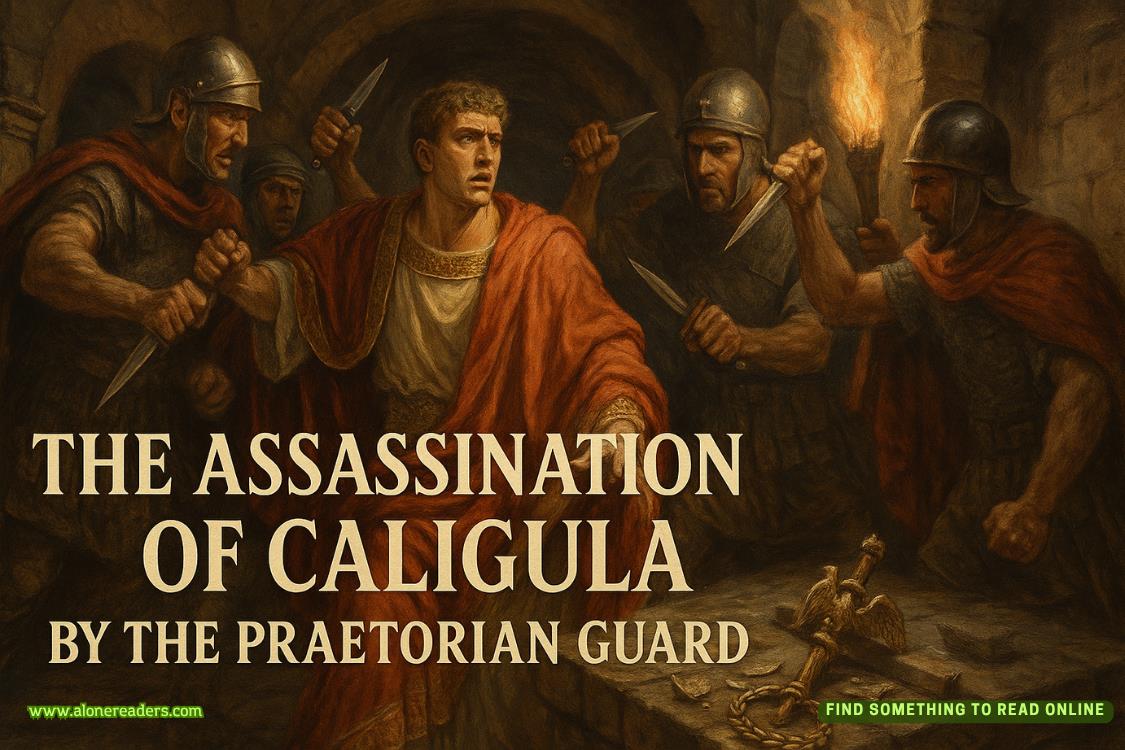
The assassination of Emperor Caligula by the Praetorian Guard stands as one of the most dramatic moments in the political history of ancient Rome, a violent eruption of resentment, fear, and betrayal inside the heart of imperial power. What unfolded on that January day in 41 CE was not simply the murder of a ruler but the culmination of a deepening crisis within Rome’s political establishment, a crisis fueled by the emperor’s unpredictable behavior, his confrontational leadership style, and the mounting conviction among Rome’s elite that the empire itself was at risk under his authority. The event remains a fascinating study in the dynamics of autocracy, the fragility of loyalty, and the limits of imperial power when confronted with the very guards sworn to protect it.
From the moment Caligula—born Gaius Julius Caesar Germanicus—ascended to the throne, he was enveloped in extraordinary public enthusiasm. The Roman people saw him as the beloved son of Germanicus, the charismatic general whose death years earlier had provoked mass mourning throughout the empire. Caligula’s early reign reflected this optimism. For the first few months, he enacted public reforms, freed political prisoners, and entertained the population with games and spectacles. Yet underlying this seemingly positive beginning was the psychological and political instability that would soon define his rule. After a severe illness early in his reign, Caligula’s behavior reportedly shifted sharply, revealing a darker, more volatile side that unsettled Rome’s senators, administrators, and the Praetorian Guard who served as the emperor’s elite protectors.
To the governing class, Caligula’s later actions appeared increasingly erratic and even dangerous. His tendency to humiliate senators, flaunt his absolute power, and engage in extravagant expenditures strained the already fragile relationship between emperor and aristocracy. His notorious declaration that he could make his horse a consul—whether meant seriously, satirically, or as a political statement about senatorial incompetence—was interpreted as a sign of contempt for Rome’s traditional institutions. Additionally, his financial mismanagement created new tax burdens, his public spectacles drained resources, and his execution or exile of high-ranking figures created a climate of fear. For many, the emperor’s conduct was no longer merely eccentric; it was a threat to the stability of Rome.
Among those most deeply affected were the Praetorians themselves. They had elevated Caligula to the throne after the death of Tiberius, benefiting materially in the process. Yet Caligula’s relationship with the Guard deteriorated as several of their commanders fell victim to his paranoia, dismissals, or sudden executions. No figure felt this more acutely than Cassius Chaerea, a veteran officer whom Caligula mocked relentlessly. Caligula’s habit of assigning Chaerea humiliating watchwords and openly questioning his masculinity pushed the seasoned soldier beyond the limits of tolerance. Such personal insults, layered atop broader political frustrations, helped crystallize a conspiracy that had been quietly developing within the Guard and among senators who believed that removing Caligula was necessary for Rome’s survival.
The plot gained momentum as the conspirators realized that Caligula’s growing unpredictability made the timing crucial. Any delay risked exposure and swift execution. The plan centered on Caligula’s movements inside the imperial palace complex, particularly the narrow underground corridors that connected the palace to the theater, where the emperor often attended performances. These passageways offered the ideal location: enclosed, dimly lit, and sparsely guarded. The conspirators calculated that they could strike quickly, escape through alternate routes, and then assert control of the palace before loyalists could react.
On the day of the assassination—January 24, 41 CE—Caligula attended a series of games and performances at the Palatine. According to accounts, he was in high spirits, unaware that his own guards had been plotting his death for weeks. After leaving the games, he walked through the subterranean passageway toward his private quarters. It was in this confined space that the conspirators waited. Cassius Chaerea was the first to step forward, delivering the initial blow that stunned the emperor and shattered the illusion of safety within the palace walls. The attack quickly escalated as multiple guards, emboldened by Chaerea’s strike, joined in. The scene, though brief, was chaotic and brutal. Caligula, overwhelmed and outnumbered, attempted to defend himself but succumbed to the repeated stabbing, the violence symbolizing the pent-up frustrations of the Roman elite and military alike.
Yet the conspirators did not stop with Caligula. Determined to eliminate any potential heirs who might claim the throne, they turned their attention to his wife and young daughter, both of whom were murdered in efforts to prevent dynastic continuity. This ruthless extension of the assassination underlined the conspirators’ belief that the imperial system itself needed a reset, one that could not be achieved as long as Caligula’s bloodline remained intact. Their ambitions seemed aligned with restoring power to the Senate or possibly reshaping the imperial structure entirely.
However, their expectations unraveled almost immediately. While the conspirators occupied the palace, attempting to assert control, a separate group of Praetorian Guards located Claudius—Caligula’s uncle—hiding behind a curtain. Whether out of genuine loyalty or strategic calculation, these guards proclaimed Claudius emperor and marched him to their camp for protection. Their decision shifted the balance of power instantly. The conspirators had envisioned a post-Caligula government shaped by senatorial leadership or at least broader political consensus. Instead, they watched the empire slide back into dynastic succession within hours of Caligula’s death, driven by the very military institution that had enabled the assassination.
Claudius’s rapid elevation highlighted a crucial reality: the Praetorian Guard had become the true kingmakers of Rome. Their actions in both killing Caligula and then installing Claudius demonstrated that imperial legitimacy relied less on senatorial approval or public mandate and more on military backing. The assassination thus marked a turning point in the evolution of Roman political power. It revealed that the emperor’s security was only as strong as his relationship with the Guard and that the institution designed to protect the emperor could just as easily destroy him.
Caligula’s assassination also left behind a complex legacy. For some Romans, his death represented a necessary removal of a tyrant whose actions had destabilized the empire. For others, it symbolized the dangerous precedent of military interference in politics, a precedent that future emperors would struggle to navigate. While Caligula’s reign is often remembered for its excesses and controversies—some exaggerated, others authentic—the circumstances of his death underscore the broader tensions inherent in Rome’s imperial system. When a ruler’s authority depended on the loyalty of armed protectors capable of independent political action, the line between security and vulnerability became perilously thin.
In the aftermath, Claudius worked to reestablish order, punish the conspirators, and assert his own legitimacy. Yet the shadow of Caligula’s fall lingered over Rome. The event revealed how swiftly political equilibrium could collapse when an emperor alienated his key supporters and allowed mistrust to define his relationship with the governing class. Caligula’s fate was not simply the product of his personality but a reflection of the structural weaknesses of the early principate, a system still learning how to manage the balance between autocratic authority and institutional stability.
The assassination of Caligula by the Praetorian Guard remains one of the most dramatic episodes in Roman history. It encapsulates the dangers of unchecked imperial power, the volatility of military politics, and the fragility of leadership in a world where loyalty could evaporate with a single insult or perceived threat. The emperor’s violent end, hidden in the shadows of the palace corridors, continues to symbolize the profound instability that lay beneath Rome’s majestic imperial façade, reminding us that behind every throne in ancient Rome stood men with swords—men whose loyalty could shift as swiftly as the empire’s ever-changing tides.



 The Hundred Days Offensive: How the Allies Defeated Germany in World War I
 The Second Battle of the Marne: The Turning Point of World War I in 1918
 The Spring Offensive of 1918: Germany's Final Gamble to Win World War I
 The Treaty of Brest-Litovsk: How Russia Left World War I
 The Russian Revolution and World War I: How War Brought Down the Tsar
 The Zimmermann Telegram Explained: Germany's Secret Offer to Mexico in World War I