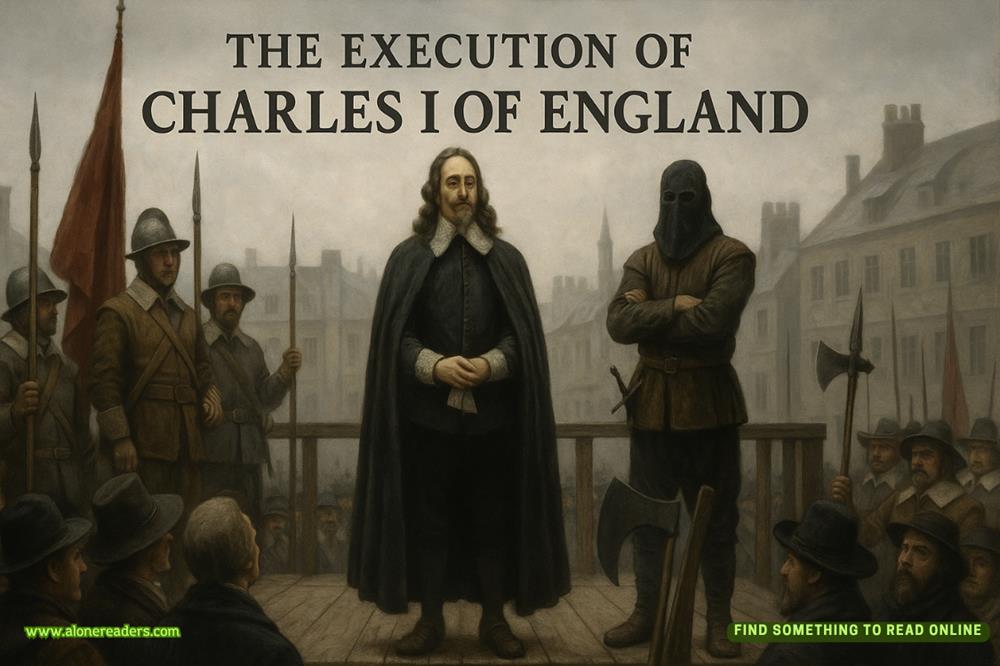
The execution of Charles I of England on a bitterly cold morning in January 1649 remains one of the most dramatic and transformative moments in British history, marking the first and only time an English monarch was tried and executed by his own subjects. This defining event was not merely the end of a king; it was the collapse of an entire worldview—one built on the belief in the divine right of kings, the structure of absolute monarchy, and the assumption that the crown stood above all earthly judgment. The king’s downfall was the result of decades of political missteps, ideological clashes, civil wars, and an increasingly fractured relationship between sovereign and people. Understanding the execution requires delving into the king’s actions, the brewing tensions between religious and political factions, the unprecedented trial that shocked Europe, and the legacy that reshaped the future of the British Isles.
Charles I ascended the throne in 1625 with a vision of monarchy rooted in divine authority and personal conviction. He believed deeply and unshakeably in his mission as God’s chosen ruler, a belief that would guide—some would argue blind—his approach to governance. His determination to enforce religious uniformity, particularly through the promotion of Anglican high-church practices, alienated significant groups in both England and Scotland. The king’s marriage to the Catholic Henrietta Maria of France further intensified the suspicion among Protestant subjects, who feared a potential return to Catholic influence after decades of religious turmoil.
Charles’s reign soon became defined by his escalating disputes with Parliament. The monarch saw Parliament primarily as a source of revenue, while parliamentarians increasingly viewed the institution as a necessary check on the king’s expanding power. The conflict reached new heights when Charles attempted to rule without Parliament altogether, launching the period known as the Eleven Years’ Tyranny. During this time, the king raised funds through controversial means such as ship money, fines, and archaic feudal taxes, actions that sparked widespread resentment across the kingdom.
These political tensions were compounded by religious unrest. Charles’s reforms in Scotland, especially the forced introduction of the Book of Common Prayer, triggered massive resistance. The Bishops’ Wars that followed drained the monarchy’s finances and forced Charles to recall Parliament for assistance. This decision would ultimately be his undoing. The newly summoned Long Parliament was determined not only to challenge the king’s authority but to dismantle many of the mechanisms he had used to impose his will on the kingdom.
By the early 1640s, distrust between king and Parliament had escalated to the point of open conflict. Charles’s failed attempt to arrest five leading members of Parliament confirmed suspicions that he intended to use military force to reassert control. The country became increasingly polarized, culminating in the eruption of the First English Civil War in 1642. On one side stood the Royalists, loyal to the king and the traditional order of monarchy. On the other were the Parliamentarians, backed by reformers, Puritans, merchants, and regional leaders. The conflict was brutal, prolonged, and deeply divisive, with families and communities split along political and religious lines.
Although the Royalists held early advantages, the rise of the New Model Army, a disciplined and ideologically driven force under leaders like Oliver Cromwell, began to shift the balance. Charles’s defeat in 1646 did not bring peace; instead, it led to negotiations, betrayals, and renewed conflict. The king’s secret alliances and his attempt to spark uprisings against Parliament fueled the Second Civil War, convincing many Parliamentarians that Charles could not be trusted under any circumstances.
With this renewed bloodshed came a dramatic shift in public opinion among radical factions. The more extreme wing of the Parliamentary movement, known as the Independents, believed that the king’s actions constituted treason against the people and the nation. For the first time, the idea emerged that a monarch could legitimately be held accountable to law—a notion that would have been unthinkable in earlier centuries. The army intervened directly in politics, purging Parliament in the event known as Pride’s Purge, leaving behind the “Rump Parliament” that now had the authority and determination to put the king on trial.
The trial of Charles I was unprecedented. Never before had a reigning monarch been subjected to a judicial process by his own people. The king refused to plead, arguing that no court in England had the authority to judge him. He maintained that his sovereignty came from God, not Parliament, and that the very fact of the trial was a violation of the natural and divine order. His refusal to acknowledge the legitimacy of the court was interpreted as defiance, sealing his fate. Despite the lack of legal precedent and the controversy surrounding the proceedings, Charles was declared guilty of being a “tyrant, traitor, murderer, and public enemy.”
The sentence was death.
On January 30, 1649, Charles was led from St James’s Palace to the scaffold erected outside the Banqueting House at Whitehall. The atmosphere was tense, silent, and heavy with unease. Many spectators arrived not in celebration, but in shock. The execution of a king—God’s anointed ruler—was an act that defied centuries of tradition and belief. Charles appeared calm and composed, dressed in two shirts to avoid shivering in the cold, which he feared might be mistaken for fear. He delivered a short but powerful speech defending his integrity and emphasizing that he died as a martyr of liberty, claiming he had always sought to protect the people’s rights and the nation’s laws.
The presence of a masked executioner added to the drama and the mystery. The identity of the man who would strike the fatal blow was never fully confirmed, adding to the myth and speculation that would surround the event for centuries. The axe fell quickly, severing the king’s head with a single stroke. A moan rose from the crowd, not of triumph, but of collective shock and sorrow. The execution marked the symbolic end of monarchy, at least temporarily, and paved the way for the establishment of the Commonwealth of England, a republic under the leadership of Oliver Cromwell.
However, the aftermath of the execution was far from peaceful. Rather than settling the political future of the nation, the king’s death intensified the conflicts within Parliament and the army. The Commonwealth struggled to manage economic pressures, political dissent, and uprisings across England, Ireland, and Scotland. Cromwell’s eventual rule as Lord Protector was effectively that of a military dictator, despite its republican framework. The promise of freedom and democratic reform remained largely unfulfilled.
Ironically, the execution of Charles I would ultimately strengthen the monarchy in the long term. After Cromwell’s death and the collapse of the Protectorate, public sentiment shifted dramatically. Many English citizens longed for stability and tradition after years of war and political turbulence. This led to the Restoration of Charles II, son of the executed monarch, in 1660. The monarchy was reborn, but not unchanged. The executed king had become a symbol, and Parliament had tasted unprecedented power. Future monarchs would rule with the knowledge that their authority was not infinite and that they could be held accountable.
The execution of Charles I thus stands as a defining moment—a turning point that transformed the constitutional landscape of Britain. It demonstrated the dangers of unchecked authority, the power of political ideology, and the capacity of a nation to challenge its own traditions. It revealed the complex interplay between religion, politics, and personal conviction, and it exposed the deep fractures at the heart of English society.
Even today, the event remains a subject of intense historical debate. Some view Charles as a martyr, a principled ruler destroyed by radical revolutionaries. Others see him as a stubborn monarch whose refusal to compromise plunged the nation into chaos. Regardless of perspective, his execution reshaped not only the monarchy but the very foundations of governance, law, and citizenship in the English-speaking world. It signaled the beginning of modern constitutional monarchy and laid the groundwork for the parliamentary democracy that would emerge in the centuries to come.
The fall of Charles I was not the simple execution of a king—it was the execution of an era. His death marked the end of unchallenged sovereign authority and the beginning of a new political consciousness, one in which the rights of citizens and the limits of power would increasingly come to define the character of a nation.



 The Hundred Days Offensive: How the Allies Defeated Germany in World War I
 The Second Battle of the Marne: The Turning Point of World War I in 1918
 The Spring Offensive of 1918: Germany's Final Gamble to Win World War I
 The Treaty of Brest-Litovsk: How Russia Left World War I
 The Russian Revolution and World War I: How War Brought Down the Tsar
 The Zimmermann Telegram Explained: Germany's Secret Offer to Mexico in World War I










