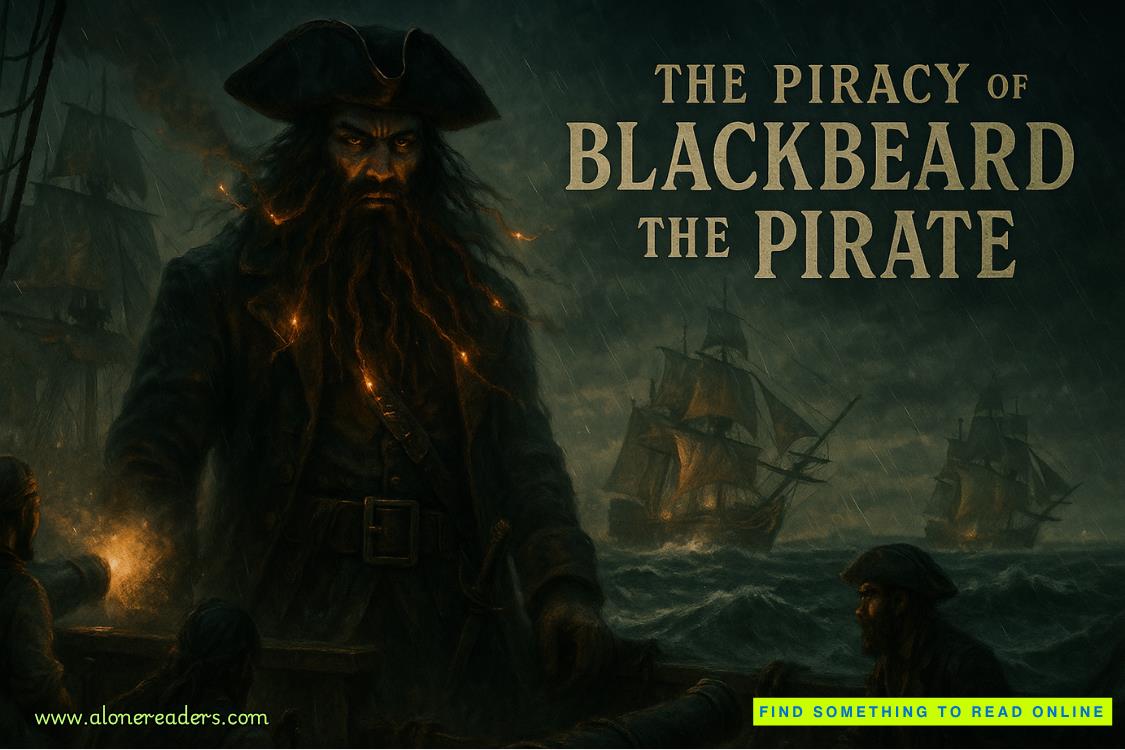
Edward Teach—better known as Blackbeard—remains the most iconic pirate of the Golden Age of Piracy, a figure who blended brutal violence, theatrical intimidation, and unmatched naval cunning to dominate the waters of the Caribbean and the American eastern seaboard in the early eighteenth century. His career was relatively short, spanning only a few years, yet the impact he left on colonial powers, maritime trade, and popular imagination was profound. His name alone became synonymous with terror, and the image of a towering pirate with a smoke-filled beard became a psychological weapon more powerful than any cannon aboard his ship. Understanding Blackbeard’s piracy requires delving into the strategic mind behind the myth, the environments he exploited, the ships he commanded, and the final battle that transformed him into a legend.
Blackbeard’s origins remain shrouded in uncertainty. Scholars debate whether he was born in Bristol, London, or another English port city, but what is widely accepted is that he came from a maritime background. His early adulthood coincided with the War of Spanish Succession, a global conflict that produced thousands of seasoned English sailors trained in naval combat. Following the war’s end, many of these men—now unemployed—turned to privateering or piracy. Blackbeard was one of them. His initial years as a pirate were spent under the mentorship of Benjamin Hornigold, a renowned privateer who operated out of Nassau in the Bahamas. This environment, sometimes referred to as the “Pirate Republic,” was the perfect incubator for Teach to sharpen his skills, observe strategic piracy, and study intimidation as a form of control.
What separated Blackbeard from the common sea robber was his mastery of psychological warfare. He recognized that terror could win battles faster—and with fewer casualties—than brute force. His towering frame, often described as “devilish,” was amplified by his notorious practice of weaving slow-burning fuses into his long black beard. During confrontations, these fuses would smolder and emit smoke, giving him an almost supernatural appearance in the eyes of sailors who already feared the superstitions of the sea. Blackbeard’s persona was carefully crafted to be larger than life, and he used this cultivated fear to seize ships without firing a shot. Many captains surrendered at the first sight of his ship, Queen Anne’s Revenge, knowing that resistance would be useless.
Blackbeard’s flagship became his greatest weapon. Originally a French slave ship named La Concorde, he captured it in 1717 and transformed it into a floating fortress. He mounted around forty guns on the vessel—an enormous arsenal for a pirate ship—and reinforced its hull for ramming and blockade operations. With its incredible firepower and intimidating silhouette, the Queen Anne’s Revenge dominated the waters from the Bahamas to the Carolinas. Blackbeard used it to blockade major ports, most famously Charleston in 1718. This brazen act of piracy demonstrated not only his tactical brilliance but his understanding of political theatre. By controlling the entrance to a bustling colonial harbor, he halted all ship movements, took hostages, demanded medical supplies, and forced the entire city into paralyzing fear without bloodshed. This maneuver cemented his reputation as an unmatched strategist who could challenge entire colonies with only a handful of men.
Contrary to the popular image of pirates constantly seeking treasure, Blackbeard operated with calculated motive. He targeted high-value cargo, including sugar, rum, medicines, weaponry, and textiles. He understood the logistics of trade routes and exploited predictable ship movements. His methods were efficient: he preferred intimidation over violence, negotiation over slaughter, and manipulation over chaos. He commanded loyalty among his crew not through brutality but through confidence, inspiration, and a shared sense of opportunity. Many accounts emphasize his charisma, his ability to maintain order, and his surprisingly fair treatment of his men. The democratic structure aboard pirate ships—where crews voted on decisions—further strengthened Blackbeard’s influence, as he appeared both a leader and a comrade.
Yet Blackbeard was not without ruthlessness. Several encounters reveal that he was willing to employ extreme measures when necessary. His reputation alone often provoked submission, but in cases where resistance persisted, he unleashed devastating attacks. His ship’s heavy artillery made him capable of crippling vessels with a single broadside. He also used deception, flying false flags to lure ships into false security before revealing his true identity. One of his most cunning tactics involved intentionally leaking misleading information or staging displays of disorder to trick colonial authorities into underestimating him. This blend of intimidation, deception, and raw firepower made Blackbeard nearly untouchable during the peak of his piracy.
Blackbeard’s relationship with the colonies was far more complex than simple criminal antagonism. In the early 1700s, many colonial governors secretly collaborated with pirates, exchanging pardons or turning a blind eye in return for economic favors. Trade restrictions imposed by European powers left colonial merchants frustrated, and pirates provided access to cheaper goods. Blackbeard exploited these political tensions masterfully. After the King’s Pardon of 1718 offered forgiveness to pirates willing to surrender, he strategically accepted it in North Carolina. But while officially “retired,” he continued piratical activities through covert operations, often transporting goods through the shallow inlets and hidden waterways of Ocracoke Island. These waters, known for their shifting sandbars, provided natural protection against large naval vessels, allowing Blackbeard to operate with near immunity.
His downfall was triggered by growing pressure from merchants and colonial officials who saw him as a threat to economic stability. Governor Alexander Spotswood of Virginia, operating outside his legal jurisdiction, secretly sent two ships under Lieutenant Robert Maynard to eliminate Blackbeard. The mission was perilous, as the waters around Ocracoke favored Blackbeard’s intimate knowledge of the terrain. When Maynard’s forces arrived in November 1718, they encountered Blackbeard’s ship anchored amidst the shallow channels. Blackbeard, rather than fleeing, chose to confront the attackers directly. What followed was one of the most dramatic pirate battles in colonial history.
Blackbeard’s crew initially outgunned the British forces, using the Queen Anne’s Revenge’s surviving firepower to devastating effect. But Maynard anticipated this and devised a counter-strategy: he kept many of his men hidden below deck, allowing Blackbeard to believe the British numbers were small. The deception worked. When Blackbeard boarded Maynard’s ship for hand-to-hand combat, dozens of hidden soldiers burst forth, triggering a chaotic melee. Eyewitnesses recounted that Blackbeard fought like a man possessed, taking multiple gunshots and sword wounds but refusing to fall. His resilience was so extraordinary that only after sustaining more than twenty wounds did he collapse. To prove the pirate’s death beyond doubt, his head was severed and displayed on Maynard’s ship—a grim trophy intended to deter future outlaws.
Blackbeard’s legend, however, did not die with him. His tactics influenced naval warfare, his persona shaped centuries of pirate mythology, and his story became embedded in folklore across the world. The Queen Anne’s Revenge itself remained hidden beneath the waters until its rediscovery centuries later, revealing cannons, medical equipment, personal items, and remnants of Blackbeard’s life at sea. These artifacts reaffirmed the complexity of his operations, the sophistication of his naval strategies, and the reality behind the myth.
The legacy of Blackbeard endures because he embodied the pinnacle of pirate ingenuity. He was not merely a violent criminal but a master tactician, a psychological manipulator, and a figure who understood the power of spectacle in warfare. His short but explosive career reshaped colonial maritime security, inspired countless stories, and elevated him to mythic status. Even today, his name conjures images of smoky beards, flaming fuses, and the silhouette of a mighty ship cutting through the dark waters of the Carolina coast.
Blackbeard’s piracy remains a testament to a time when the seas were ruled by men who stood outside the boundaries of empire yet influenced imperial policy. His story is one of cunning, fearlessness, and the creation of an unforgettable persona that still haunts maritime history. Through a blend of audacity and intelligence, he transformed a brief career into an everlasting legend, ensuring that his name—Blackbeard—would echo across oceans long after he vanished beneath the waves.



 The Hundred Days Offensive: How the Allies Defeated Germany in World War I
 The Second Battle of the Marne: The Turning Point of World War I in 1918
 The Spring Offensive of 1918: Germany's Final Gamble to Win World War I
 The Treaty of Brest-Litovsk: How Russia Left World War I
 The Russian Revolution and World War I: How War Brought Down the Tsar
 The Zimmermann Telegram Explained: Germany's Secret Offer to Mexico in World War I