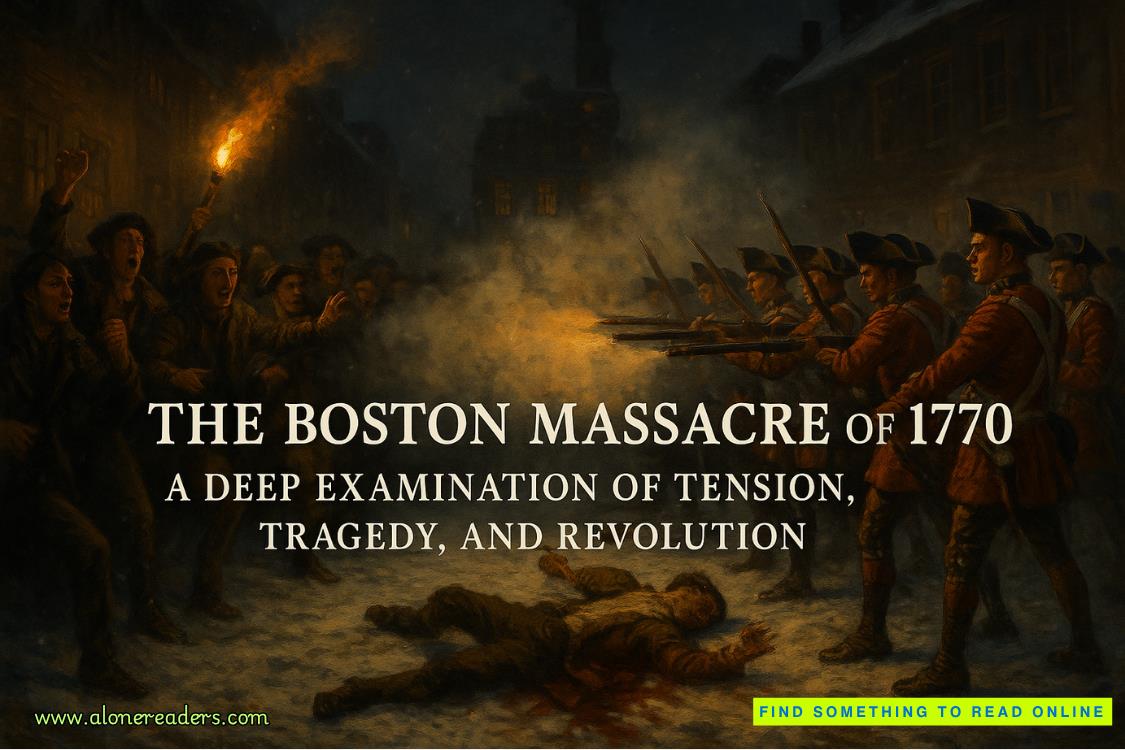
The Boston Massacre of 1770 stands as one of the most consequential and emotionally charged events leading to the American Revolution, not because of its scale—only five colonists died—but because of its symbolic enormity. It was an event shaped by years of festering resentment, economic pressure, political mistrust, and the sense that everyday colonial life had become dominated by distant power. The Massacre itself lasted mere minutes, yet it transformed colonial politics, fueled revolutionary propaganda, and hardened attitudes on both sides of the Atlantic. Understanding the Boston Massacre requires not only a recounting of what happened on the cold March night but a deep exploration of the tensions that made such violence almost inevitable.
The roots of the conflict were embedded in the aftermath of the French and Indian War, when Britain emerged victorious but financially strained. The Crown expected its colonies to shoulder part of the cost of maintaining the empire, leading to the imposition of laws and taxes that colonists increasingly saw as unfair, intrusive, and imposed without their consent. The Stamp Act, Townshend Acts, and duties on everyday goods such as tea, paper, and paint stirred discontent in every colony, but nowhere more intensely than Boston. Boston was a port city whose economic life depended on trade, and every tax, restriction, or customs inspection felt like a direct threat not just to prosperity but to autonomy and dignity.
By 1768, the atmosphere had reached a breaking point. British customs officials in Boston, facing open hostility from colonists who saw them as corrupt and oppressive, requested military reinforcement. In October of that year, British soldiers—distinct in their bright red uniforms and rigid discipline—marched into Boston, a city of only about 16,000 people. Their presence ignited deep anger. Many Bostonians believed that standing armies were instruments of tyranny, and colonial tradition held that a free people should never be policed by military force in times of peace. The tension between soldiers and civilians escalated daily, often erupting into insults, shoving, and occasional violence.
The soldiers themselves were underpaid, often despised, and resented by locals for taking part-time work from laborers. Competition for jobs created especially bitter tensions among the lower classes. One of the most important precursors to the Massacre occurred on March 2, 1770, when soldiers working at a ropewalk became embroiled in a brutal fistfight with local workers. The conflict quickly became symbolic of a larger struggle—soldiers represented imperial authority, while the ropewalk workers symbolized the colonial fight for economic survival and personal independence.
Against this backdrop of simmering hostility, the night of March 5, 1770, unfolded with tragic inevitability. It began innocently enough: a lone British sentry, Private Hugh White, stood guard outside the Custom House on King Street. The building symbolized British taxation and enforcement, making it a natural target for colonial anger. When a young wigmaker’s apprentice confronted White over an alleged unpaid bill, the argument drew a small crowd. More onlookers gathered, fueled by anger, frustration, and perhaps the cold night air. Insults flew. Snowballs and chunks of ice were thrown. The sentry called for backup.
As bells rang—often associated with fire alarms—more colonists poured into the street, believing an emergency was unfolding. A detachment of British soldiers, led by Captain Thomas Preston, arrived to support White. They formed a semi-circle, bayonets fixed, muskets at the ready. The crowd, larger and more agitated now, pressed dangerously close. According to several witnesses, the scene was a volatile mixture of fear, confusion, taunts, and threats, a deadly combination under the unstable leadership of a few nervous soldiers surrounded by hundreds of angry civilians.
The exact moment the first shot was fired remains disputed, and contemporary accounts contradict one another. What seems clear is that the tension reached a point where any sudden sound—a snowball hitting a musket, a slip on the icy ground, or a shouted order misheard—could serve as the spark. One soldier fell after being struck by a thrown object, and in the chaos that followed, he may have discharged his weapon unintentionally. In a matter of seconds, a volley of musket fire erupted into the crowd.
The result was devastating. Crispus Attucks, a man of mixed African and Native American ancestry, was the first to fall, struck by multiple bullets. His death became deeply symbolic: he would later be hailed as the first martyr of the American Revolution, embodying the diverse and complex identity of the emerging American cause. Four other colonists were killed, and several wounded. The soldiers, realizing the severity of what had just occurred, stood in stunned silence. Captain Preston, horrified, attempted to regain control and ordered the men to cease fire.
Almost immediately, Boston exploded in outrage. Word of the killings spread rapidly through the city, and thousands of colonists gathered, demanding justice. Local leaders such as Samuel Adams understood the political power of the moment. He and others in the patriot movement saw the Massacre not merely as a tragic confrontation but as an opportunity to unite colonists against British rule. Through carefully crafted narratives, illustrations, and public speeches, the event was transformed from a street clash into an emblem of unrestrained British tyranny.
Paul Revere’s famous engraving, though historically inaccurate in its portrayal of the event, played an enormous role in shaping public perception. It depicted disciplined British soldiers firing simultaneously into a peaceful, unarmed crowd—an image that inflamed emotions across the colonies. The power of this propaganda cannot be overstated. Many colonists who had previously felt distant from Boston’s political struggles now saw the incident as irrefutable proof of Britain’s willingness to kill its own subjects.
Yet what followed the Massacre also demonstrates an important dimension of colonial society: its commitment, at least in principle, to law and justice. The soldiers involved were arrested and put on trial. In a remarkable display of integrity, John Adams, who would later become the second President of the United States, agreed to defend them despite immense public anger. Adams believed that everyone deserved a fair trial, even those representing the authority the patriots opposed. His defense was skillful and courageous, arguing that the soldiers acted in self-defense under extreme provocation. In the end, six soldiers were acquitted, while two were convicted of manslaughter and branded on the thumb—a relatively lenient punishment given the circumstances.
The Boston Massacre, although violent and tragic, became a catalyst for unity and action. In the following years, it helped galvanize colonial resistance, contributing to the formation of committees of correspondence, spreading anti-British sentiment, and intensifying calls for independence. Each March, commemorations of the event were held in Boston, reinforcing its symbolic importance. What had been a brief and chaotic confrontation had transformed into a mythic episode that embodied the broader colonial struggle.
In a broader sense, the Boston Massacre represents a turning point when ordinary people—dockworkers, apprentices, laborers, and soldiers—became unwilling participants in the unfolding drama between empire and colony. Their lives and deaths shaped history far beyond anything they could have imagined. The Massacre revealed how fragile peace had become, how rapidly resentment could turn into violence, and how a single moment could reshape a nation’s destiny.
The event also highlights the power of storytelling and imagery in shaping political identity. Through speeches, pamphlets, and engravings, the patriot movement turned five deaths into a rallying cry. The narrative of innocent colonists murdered by ruthless soldiers became foundational to the American cause, influencing both domestic opinion and international perceptions of British rule.
Ultimately, the Boston Massacre of 1770 was not just a deadly confrontation on a winter night but a decisive step toward revolution. It crystallized the colonial belief that freedom and self-governance were worth fighting for, and it forced many neutral or undecided colonists to confront the harsh realities of life under British authority. The tragedy illuminated the widening divide between Britain and America, a divide that would soon erupt into full-scale war. In the story of America’s journey toward independence, the Boston Massacre remains a profound and enduring symbol of sacrifice, injustice, and the unstoppable momentum of a people moving toward revolution.



 The Hundred Days Offensive: How the Allies Defeated Germany in World War I
 The Second Battle of the Marne: The Turning Point of World War I in 1918
 The Spring Offensive of 1918: Germany's Final Gamble to Win World War I
 The Treaty of Brest-Litovsk: How Russia Left World War I
 The Russian Revolution and World War I: How War Brought Down the Tsar
 The Zimmermann Telegram Explained: Germany's Secret Offer to Mexico in World War I










