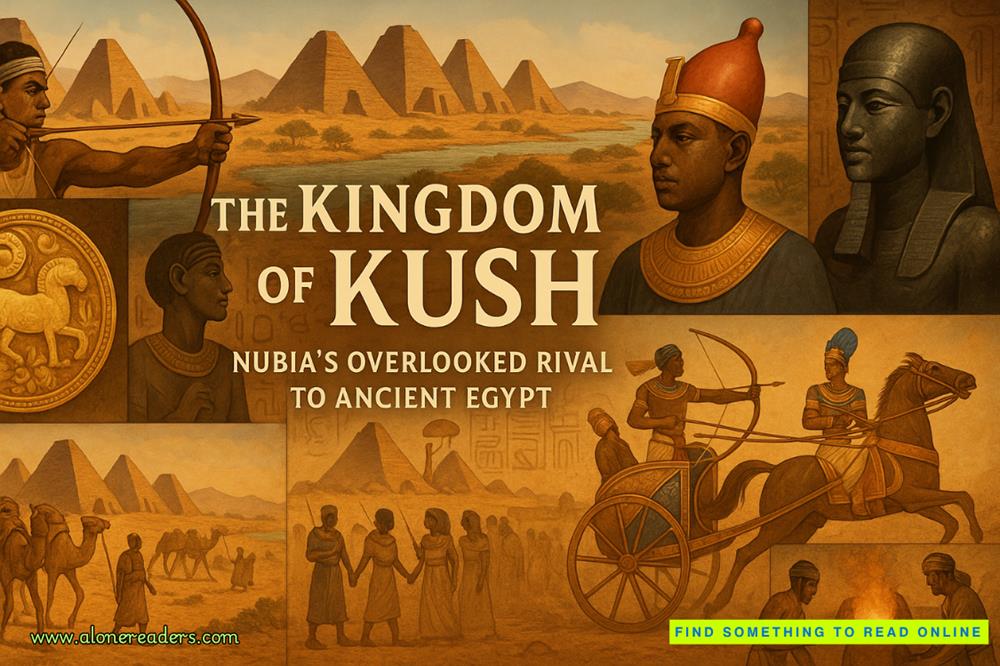
The story of ancient northeastern Africa is too often told as the story of Egypt alone, leaving in shadow a civilization that not only matched Egypt in power and ambition but at times surpassed it. The Kingdom of Kush, rising from the deep deserts and river valleys of Nubia, stands as one of the most remarkable political, cultural, and military forces of the ancient world. For centuries it shaped regional history through conquests, diplomacy, innovation, and trade, yet it remains marginalized in global narratives. Understanding Kush is essential for understanding Africa’s ancient past, because within its borders flourished a civilization defined by indigenous strength, remarkable adaptability, and a legacy far more enduring than its modern obscurity suggests.
Situated south of Egypt along the Nile, ancient Nubia was a land of gold, iron, incense routes, and fierce warriors whose skill and resilience earned both admiration and fear. From this land emerged the Kushites — a people whose identity evolved through several major phases, from the early kingdom centered at Kerma to the later dynasties of Napata and the iron-working metropolis of Meroë. Each phase contributed to a long tapestry of achievement that challenged Egyptian dominance, influenced the geopolitics of the ancient Near East, and helped shape cultural patterns that lasted well into the medieval period. What makes Kush truly extraordinary is its combination of regional power, cultural originality, and extraordinary political endurance, which together forged a civilization that lasted for more than 2,000 years.
One of the earliest shining moments in Kushite history came from the Kerma Kingdom, one of Africa’s oldest urbanized states. Kerma’s monumental structures, including its massive mud-brick temple called the Deffufa, reveal a society of skilled architects and religious thinkers. Kushite tombs from this period contain weapons, ornate pottery, and lavish goods that demonstrate a society of elites with a broad economic reach. The wealth of Nubia’s gold mines, in particular, played a crucial role in shaping the region’s political landscape. These mines made the Kushites indispensable trading partners — and formidable enemies — to the pharaohs of Egypt, who sought control over the valuable southern territories. This early phase of Kush exemplifies a civilization that was already powerful, culturally rich, and strategically vital long before it appears in Egyptian texts.
The rivalry between Egypt and Kush intensified across centuries, marked by alternating periods of warfare, occupation, diplomacy, and cultural exchange. Kush’s warriors were legendary, especially its archers, whose accuracy and range were so impressive that Egyptian sources referred to Nubia as “Ta-Sety,” the land of the bow. These archers would play a decisive role in battles across the Nile Valley and Near East, eventually becoming a symbol of Kushite military power. Despite Egyptian attempts to dominate Nubia, Kushite identity survived and adapted, producing leaders who embraced certain Egyptian cultural forms while maintaining uniquely Nubian practices. The interaction between the two civilizations was never one-sided; instead, it was a dynamic relationship, with the Kushites acting not as passive recipients but as selective adopters and powerful interlocutors.
Perhaps the most dramatic moment in the Kushite story occurred during the Napatan period, when the Kushite kings rose northward and conquered Egypt itself, establishing the illustrious Twenty-Fifth Dynasty. Led by rulers such as Piye, Shabaka, and Taharqa, the Kushite pharaohs restored monumental buildings, reformed religious practices, and revived classical Egyptian traditions with renewed vigor. In many ways, this era represents a cultural renaissance driven by an African kingdom that understood Egypt’s heritage deeply and sought to preserve it. The fact that a Nubian dynasty sat on the throne of Egypt for decades underscores the geo-strategic might and political sophistication of Kush. It is one of the clearest demonstrations that the power dynamic between the two civilizations was not a simple hierarchy but a shifting landscape in which Kush could rise to dominance.
Kushite rule in Egypt was not merely a military occupation; it was a philosophical and cultural project. The kings portrayed themselves as guardians of Ma’at — the Egyptian concept of cosmic balance — and invested heavily in temples, sculptures, and hieroglyphic inscriptions. Yet their art also retained distinct Nubian features: rounded facial structures, full lips, and unique royal regalia, symbolizing a blend of influences that reflected both continuity and self-identity. This period shows the striking duality of Kushite political thinking: they could adopt the grandeur of Egyptian kingship while simultaneously reaffirming their Nubian roots. The Twenty-Fifth Dynasty eventually fell to the Assyrians, but it left behind a legacy of cultural restoration and political unity that shaped Egypt’s final centuries as an ancient civilization.
After withdrawing to Nubia, the Kushite state shifted its center of power to Meroë, marking the beginning of one of Africa’s most innovative ancient economies. Meroë became famous for its massive iron-smelting industry, producing weapons, tools, and agricultural implements on a scale unmatched anywhere else in Africa at the time. Forests were managed for charcoal production, workshops lined the landscape, and the city’s economy thrived on trade extending deep into sub-Saharan Africa. Camel caravans carried goods from the Red Sea shores into the heart of Africa, while Nile traffic connected Meroë to Mediterranean markets. This period showcases Kush as an economic powerhouse that adapted its strategies to new environments, taking advantage of its central location between multiple trade worlds.
The pyramids of Meroë, though smaller and steeper than their Egyptian counterparts, are among the most visually striking symbols of Kushite civilization. They served as tombs for kings, queens, and nobles, reflecting a unique blend of artistic styles and spiritual beliefs. Unlike the pharaohs, Kushite monarchs were often buried with lavish goods and symbolic offerings that show a deep connection to traditional African religious practices. The prominence of queens, particularly the Kandakes — powerful female rulers who sometimes commanded armies and negotiated diplomacy — highlights a society in which women could hold extraordinary authority. Figures like Queen Amanirenas, who famously resisted Roman expansion into Nubia, embody the fierce independence and political acumen of Kush’s leadership.
Religion in the Kingdom of Kush was rich and layered, embodying a fusion of indigenous African beliefs with certain Egyptian elements. The lion-headed god Apedemak, worshipped primarily in Meroë, became a central symbol of royal strength and fertility. Temples dedicated to Apedemak feature elaborate carvings of kings making offerings or engaging in ritual acts, suggesting a deeply rooted spiritual system distinct from Egypt’s pantheon. This religious diversity demonstrates that while Kush borrowed elements from Egyptian culture at certain points, it maintained a strong traditional identity that evolved independently over centuries.
Kush’s decline around the 4th century CE is often attributed to environmental changes, overuse of natural resources, shifting trade routes, and the rise of competing powers such as Aksum. Yet even in decline, Kush continued to influence neighboring regions, passing on technologies, artistic motifs, burial traditions, and social structures. The legacy of Kush is visible today not only in archaeological remains but also in the cultural memories of Sudan and surrounding regions. The civilization’s long endurance reflects exceptional resilience, creative adaptation, and a deep-rooted cultural confidence that allowed it to survive political upheavals, foreign invasions, and environmental pressures.
What makes the Kingdom of Kush truly extraordinary — and tragically overlooked — is the richness of its contributions to the ancient world. It was a master of metallurgy, a titan of African statecraft, a patron of monumental art, and a military force powerful enough to conquer Egypt, one of history’s most iconic empires. Kush shows that Africa’s ancient past was dynamic, complex, and far more globally influential than mainstream narratives often admit. Recognizing Kush does more than fill historical gaps; it restores an essential part of humanity’s shared story.
To rediscover the Kingdom of Kush is to reshape our understanding of ancient civilization itself. It reveals a world where African ingenuity, leadership, and cultural brilliance reshaped regional politics and left enduring marks on architecture, religion, and identity. In the deserts and river valleys of Nubia, a civilization once stood that dared to rival Egypt, absorb its traditions, and ultimately redefine them. The tale of Kush is not simply a footnote to Egyptian history; it is a powerful reminder that great civilizations can rise from unexpected places, forging legacies that endure long after their names fade from memory.





 The Hundred Days Offensive: How the Allies Defeated Germany in World War I
 The Second Battle of the Marne: The Turning Point of World War I in 1918
 The Spring Offensive of 1918: Germany's Final Gamble to Win World War I
 The Treaty of Brest-Litovsk: How Russia Left World War I
 The Russian Revolution and World War I: How War Brought Down the Tsar
 The Zimmermann Telegram Explained: Germany's Secret Offer to Mexico in World War I








