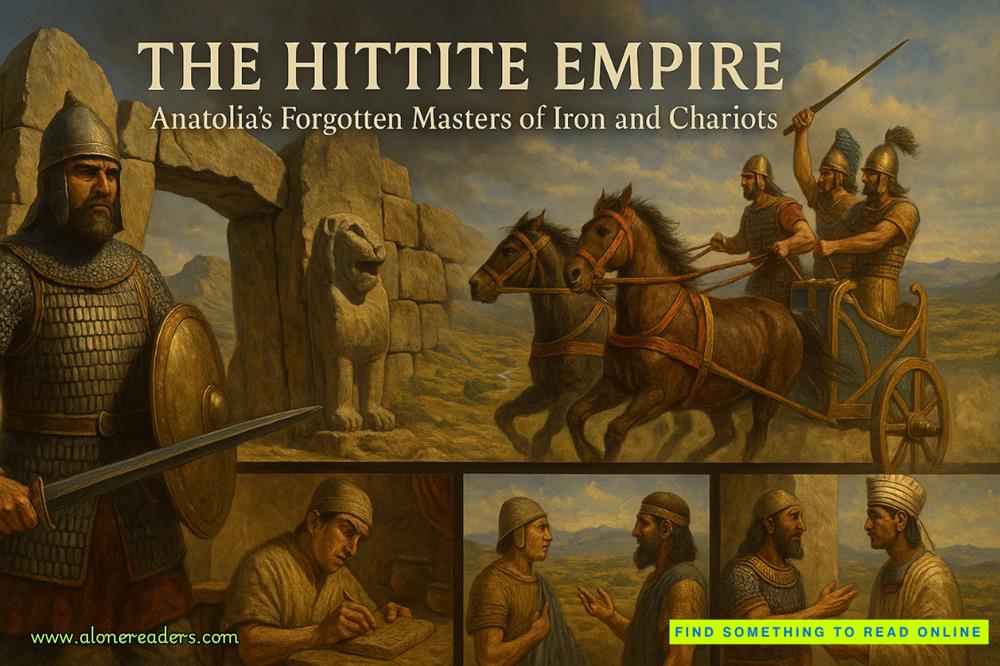
The story of the Hittite Empire is one of astonishing ascent, technological brilliance, and sudden disappearance. Once a dominant superpower standing shoulder-to-shoulder with Egypt, Babylon, and Assyria, the Hittites ruled Anatolia with unmatched mastery of ironworking, chariot warfare, and intricate diplomatic networks. Yet today, this vast empire remains overshadowed by its more famous contemporaries, often tucked into the margins of historical memory. The Hittites, however, deserve far more—because their innovations shaped the ancient world in ways that still echo through technological, military, and political history. Their homeland stretched across the rugged highlands of central Anatolia, but their influence radiated far beyond those mountains. Their kings engaged in international diplomacy, fought legendary battles, forged peace treaties, and managed a complex imperial system supported by written law, monumental architecture, and an economy that thrived on agriculture, trade, and military plunder. Despite this sophistication, the civilization experienced a mysterious downfall during the Late Bronze Age Collapse, vanishing almost overnight. Rediscovered only in the late 19th century through archaeological excavation and deciphered clay tablets, the Hittites emerged from obscurity as one of the most technologically advanced and geopolitically cunning civilizations of their time.
The Hittite world began to take shape around the 17th century BCE, when local Anatolian kingdoms were unified under a powerful ruler who consolidated the region’s fractious city-states into a coherent political entity. The geography of their homeland played a central role in their rise. Anatolia’s mountains and plateaus provided natural defenses but also forced its people to become adaptable, resilient, and adept at developing agriculture suited to challenging environments. This tough terrain molded a culture accustomed to conflict and negotiation, allowing the Hittites to build their strength quietly before stepping onto the grand stage of Near Eastern politics. As they expanded outward, they captured strategic trade routes running between Mesopotamia and the eastern Mediterranean. Their capital city, Hattusa, became not only a military stronghold but also a cultural and administrative hub filled with temples, palaces, granaries, and archives containing thousands of clay tablets. These archives would eventually reveal the sophistication of Hittite law, religion, diplomacy, and economic policy, showing that the empire’s power rested not on warfare alone, but on a complex system of rule and civic organization.
One of the Hittites’ most defining contributions to world history was their expertise in ironworking. While iron was known to many ancient societies, it was the Hittites who first developed and systematized the techniques required to smelt, forge, and utilize it on a large scale. This early mastery of iron production gave them a decisive technological edge, allowing them to equip their armies with stronger, more durable weapons than their bronze-armed rivals. Even though iron would not reach widespread use until centuries later, the Hittites’ knowledge formed the foundation of the Iron Age, ushering in a new era of warfare and technological advancement. In their hands, iron became not only a tool of conquest but also a valuable trade commodity, tightly controlled by the state and likely reserved primarily for the elite military units that fought at the heart of the empire. Their metallurgical skill also symbolized their unique position between East and West—absorbing techniques from Mesopotamia while innovating their own. The highlands of Anatolia provided the necessary ore, but it was the ingenuity of Hittite smiths that transformed raw materials into weapons that changed the course of history. This capability allowed the Hittites to field armies that could withstand and challenge long-established powers such as Egypt and Mitanni.
In warfare, the Hittites were equally groundbreaking. Their signature weapon was the three-man chariot, a military innovation that differentiated them from other Bronze Age armies. Unlike Egyptian chariots—which typically carried two warriors—the Hittite version was heavier, sturdier, and capable of carrying three: a driver, a shield bearer, and a spear- or bow-wielding warrior. This formation made the Hittite chariot a mobile strike force, ideal for breaking enemy infantry lines and creating chaos on the battlefield. The wheels were reinforced, the horses trained with precision, and the design engineered for speed and stability on the rugged Anatolian terrain. These chariots became central to Hittite military doctrine and were crucial in several major conflicts, particularly the famed Battle of Kadesh—one of the largest chariot battles in recorded history. The battle pitted the Hittites against the Egyptians under Ramesses II and resulted in a tactical stalemate but a strategic Hittite advantage, demonstrating their military discipline and logistical prowess. This confrontation also led to one of the earliest known international peace treaties, reflecting the Hittites’ sophisticated diplomatic capabilities. Warfare for the Hittites was not merely about brute force; it was a calculated blend of technology, tactics, and political negotiation.
Equally remarkable was the administrative machinery that held the empire together. The Hittites developed advanced legal codes, emphasizing fairness, proportionality, and state authority. Their laws covered property rights, labor obligations, crime, marriage, and adoption, revealing a society deeply concerned with social order and justice. Unlike some contemporaries, Hittite law favored fines and compensation over harsh physical punishments, suggesting a nuanced understanding of deterrence and social cohesion. The king, often seen as the supreme judge, delegated authority to local officials who managed provinces and reported to the central government. This system allowed a vast and diverse population to remain relatively stable under Hittite control. From vassal kingdoms in Syria to the urban centers of Anatolia, the administration balanced rigid hierarchy with surprising degrees of local autonomy. Bureaucrats maintained detailed records on clay tablets, many of which survived to provide insights into trade, agriculture, taxation, religious rituals, military campaigns, and diplomatic correspondence. These tablets uncovered a world of complexity and sophistication, revealing that the Hittite Empire was not an isolated mountain kingdom but a cosmopolitan state connected to the wider Bronze Age world.
Religion in the Hittite world played a profound role in politics, law, and daily life. They believed themselves to be governed by a vast assembly of deities known as the “thousand gods of Hatti”, many of whom were adopted from conquered peoples. Their religious system reflects a culture exceptionally skilled at integrating diverse beliefs into a unifying imperial framework. The Hittite kings served as high priests responsible for maintaining divine favor, interpreting omens, and performing rituals that assured the well-being of the state. Temples across the empire were not merely spiritual centers but also economic institutions controlling farmland, livestock, and political influence. The famous rock sanctuary of Yazılıkaya, with its procession of carved deities, stands as a testament to the Hittites’ artistic and religious sophistication. Their mythology influenced later cultures, and traces of their rituals appear in the traditions of the ancient Near East long after the empire’s fall. The fusion of native Anatolian beliefs with Hurrian, Syrian, and Mesopotamian traditions illustrates the Hittites’ cultural flexibility and their ability to govern a multi-ethnic empire.
The Hittite Empire reached its zenith during the 14th and 13th centuries BCE. Kings such as Suppiluliuma I expanded the empire aggressively, defeating rivals and establishing Hittite dominance from the Aegean coast to northern Syria. Their diplomatic network stretched across the ancient world, with correspondence exchanged between Hattusa and the courts of Egypt, Babylon, and Assyria. Foreign princesses were married into the Hittite royal family, alliances were forged through treaties, and trade flourished under imperial oversight. This cosmopolitan network made the Hittites not only military conquerors but also skilled statesmen capable of navigating the complex political environment of the Late Bronze Age. Yet this golden age was not without challenges. Natural disasters, internal divisions, famine, and external threats began to strain the empire in ways that even Hittite administrative ingenuity could not contain. Despite their strength, the Hittites were increasingly caught in a web of shifting alliances and rising powers.
The empire’s collapse around 1200 BCE remains one of the greatest mysteries of ancient history. Like many civilizations of the Late Bronze Age, the Hittites suffered during a period of widespread upheaval marked by famine, invasions, and economic disruption. The Sea Peoples, a confederation of unknown origin, wreaked havoc across the eastern Mediterranean, while internal rebellions weakened the state from within. Climate change may have caused agricultural failure, reducing grain supplies and sparking political unrest. Trade networks collapsed, cities were abandoned, and communication between provinces broke down. Hattusa itself was burned and deserted, leaving behind little more than stone foundations and scattered debris. The empire fragmented into small Neo-Hittite city-states that survived in southern Anatolia and northern Syria, but the centralized imperial system that once dominated the Near East was gone. This disappearance was so complete that, for nearly 3,000 years, the Hittites were forgotten by history until archaeologists uncovered their ruins and deciphered their cuneiform tablets. The rediscovery revealed a civilization whose technological and political achievements had been hidden beneath the soil of Anatolia for millennia.
What makes the Hittite story especially compelling is how profoundly their innovations influenced the development of the ancient world. Their early use of iron set the stage for a technological revolution. Their legal reforms demonstrated a sophisticated approach to governance and justice. Their international treaties laid groundwork for concepts of diplomacy and negotiated peace. Their chariot technology altered the course of military history. Their cultural adaptability allowed them to build a multi-ethnic empire that thrived in a region known for conflict and political fragmentation. Yet despite all these achievements, the Hittites remain less familiar to the general public than Egypt’s pharaohs or Mesopotamia’s kings. This obscurity stems partly from the empire’s dramatic fall, which erased many traces of its existence, and partly from the late rediscovery of its records. However, modern research has revealed the Hittites to be one of the most innovative, powerful, and influential civilizations of the ancient Near East.
The Hittite Empire’s legacy endures today through archaeological discoveries, historical scholarship, and continuing exploration of their forgotten influence. Their mastery of iron, their bold chariot warfare, their expansive diplomatic system, and their cultural adaptability showcase a civilization that understood the complexities of power in a rapidly changing world. Though lost for centuries, the Hittites have re-emerged as true pioneers—ingenious engineers, formidable warriors, and masterful statesmen who shaped the ancient world and whose contributions remain woven into the fabric of history.





 The Hundred Days Offensive: How the Allies Defeated Germany in World War I
 The Second Battle of the Marne: The Turning Point of World War I in 1918
 The Spring Offensive of 1918: Germany's Final Gamble to Win World War I
 The Treaty of Brest-Litovsk: How Russia Left World War I
 The Russian Revolution and World War I: How War Brought Down the Tsar
 The Zimmermann Telegram Explained: Germany's Secret Offer to Mexico in World War I








