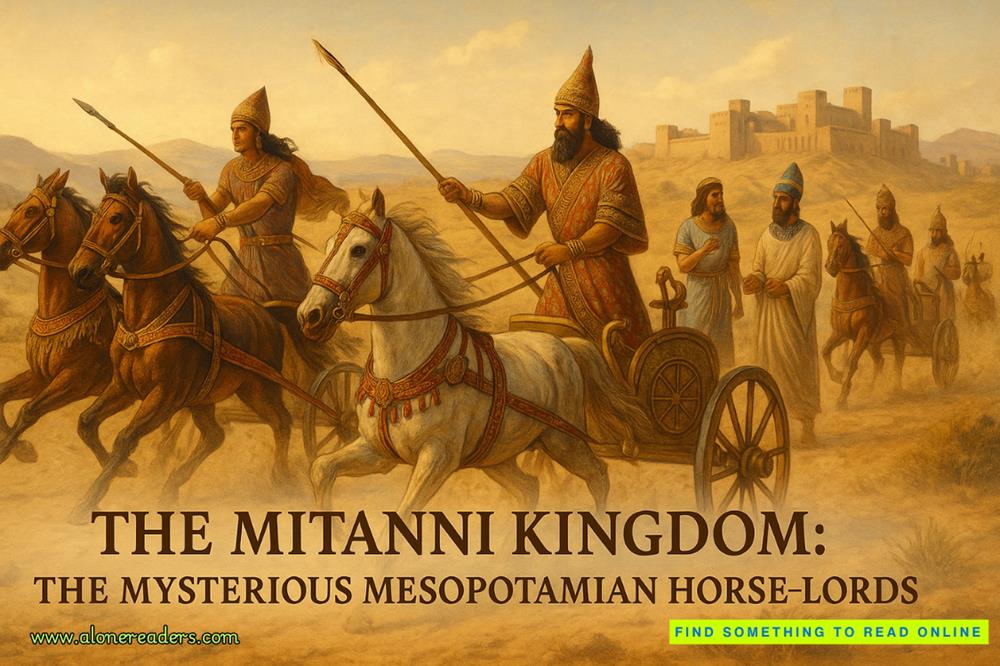
The Mitanni Kingdom remains one of the most enigmatic and fascinating civilizations of the Late Bronze Age, occupying a powerful yet often overshadowed place in the history of ancient Mesopotamia. Emerging sometime around the mid-second millennium BCE, the Mitanni built a kingdom that stretched across northern Mesopotamia, northern Syria, and southeastern Anatolia. Their empire was not only geographically significant but also culturally exceptional, representing a rare fusion of Hurrian traditions and Indo-Aryan elite culture. Despite this unique identity, they disappeared so thoroughly from the historical stage that only scattered inscriptions, foreign archives, and archaeological traces reveal their once-formidable presence. Yet, the story that can be reconstructed is one of remarkable influence—especially in warfare, diplomacy, and horse training—fields in which the Mitanni became nothing short of legendary.
From the beginning, the Mitanni Kingdom positioned itself as a regional superpower. Their territory served as a strategic corridor, connecting the trade routes of Mesopotamia with the Mediterranean coast and Anatolia. But geography alone did not secure their dominance. What truly elevated them was their mastery of horses. The Mitanni rulers and aristocracy earned a reputation as the finest charioteers and horse-masters of the ancient world, a distinction that shaped both their culture and their political relationships. So revered were their training methods that even Egypt’s great pharaohs sought their expertise. The knowledge preserved in these ancient treatises provides rare insight into the statecraft and military philosophy of a kingdom that understood the horse not merely as an animal but as a key to imperial power.
The Mitanni political system was anchored by an elite known as the maryannu, a class of chariot-borne warriors who formed the core of their military and aristocratic structure. Their title itself reflects Indo-Aryan linguistic roots, underscoring how the arrival of Indo-Aryan groups helped shape Mitanni identity. This elite class lived by a strict warrior code, valuing speed, precision, and ritualized martial discipline. Chariots were designed to be lightweight, agile, and technologically advanced for their time. This gave Mitanni armies a devastating advantage in open-field warfare, where mobility and coordinated maneuvers determined victory. The presence of Indo-Aryan elements in Mitanni royal names, deities, and specialized vocabulary hints at a ruling class that preserved elements of their ancestral heritage while seamlessly integrating with the broader Hurrian population.
One of the most intriguing aspects of Mitanni civilization lies in their religious and linguistic duality. While the general population spoke Hurrian, the royal court and military elite preserved Indo-Aryan names and concepts. This unique blend appears nowhere else in the ancient Near East. Even their treaty documents include references to Indo-Aryan gods akin to those later found in the Vedic tradition. This suggests that the Mitanni represent an early and rare hybrid culture that carried migratory traditions into the heart of the Mesopotamian world, leaving linguistic fingerprints that are still studied today. The presence of these deities in diplomatic agreements highlights the solemnity with which the Mitanni regarded divine authority, and also shows how deeply intertwined religion and politics were in the governance of their state.
Diplomacy played a crucial role in the rise of the Mitanni Kingdom. As Egypt, the Hittites, and Babylonia expanded their ambitions across the Near East, the Mitanni emerged as a strategic counterweight. They forged alliances with powerful neighbors, most notably Egypt, during a period of intense regional competition. Royal marriages between Mitanni princesses and Egyptian pharaohs were common, symbolizing not only political harmony but also mutual respect at the highest levels of power. These marriages brought luxury goods, fine horses, and diplomatic expertise into the Egyptian court, while strengthening Mitanni influence abroad. It is a testament to their prestige that the Egyptian rulers considered them equals worthy of royal intermarriage, alongside the Hittites and Babylonians.
The political landscape of the Late Bronze Age was turbulent, and the Mitanni were no strangers to conflict. Their greatest rivals were the expanding Hittite Empire to the northwest. The struggle between the Hittites and the Mitanni shaped the geopolitics of the entire region. Initially, the Mitanni held the upper hand, pushing Hittite influence back toward central Anatolia. However, over time, internal succession crises weakened the kingdom. Disputes among royal factions opened the door for their enemies to exploit division. The Hittites, recognizing the opportunity, dealt a series of strategic blows that gradually undermined Mitanni dominance. The rise of the Assyrians further tightened the noose around Mitannian territory, as the region became a battleground for control over fertile lands and key trade routes.
Despite their political decline, the cultural legacy of the Mitanni endured—particularly in the field of horsemanship. One of the most remarkable artifacts attributed to the Mitanni is a detailed training manual written by a master horse trainer. This text outlines precise methods for conditioning horses, feeding schedules, harness construction, and step-by-step chariot training techniques. It reads like an ancient military field manual, demonstrating not only technical sophistication but also a nearly scientific approach to horse care. The text reveals a deep understanding of animal behavior and physiology, proving that the Mitanni were pioneers in equestrian science long before the classical world formalized its own techniques. Through these writings, the Mitanni asserted themselves as the intellectual authorities on horses and chariots, influencing neighboring civilizations for generations.
The social organization of the Mitanni Kingdom further highlights their complexity. Their administrative system relied on local governors, vassal rulers, and regional centers, each playing a role in maintaining cohesion across their widespread territories. Cities such as Washukanni, their elusive capital, were hubs of political authority and economic power. Although the location of Washukanni remains unconfirmed, archaeological evidence suggests it must have been a prosperous and fortified center. The scarcity of direct records from the Mitanni themselves adds a layer of mystery to their story, as much of what is known comes from archives of rival kingdoms. This absence invites speculation about their record-keeping traditions and the fragility of ancient archives in regions prone to warfare and environmental destruction.
The Mitanni were also skilled diplomats who understood the importance of balancing power among their neighbors. Their interactions with Egypt reflect a sophisticated awareness of military strategy and international relations. In periods of Hittite aggression, Mitanni kings secured Egyptian support through treaties and exchanges of gifts. Letters preserved in foreign archives describe negotiations filled with careful wording, displays of royal etiquette, and assertions of equal status between kings. These documents reveal that Mitanni rulers were not merely warriors but also crafty statesmen, adept at navigating a world where alliances shifted as rapidly as military fortunes.
Their eventual decline, however, was swift and irreversible. Repeated conflicts with the Hittites drained their resources, and the rise of a powerful and militaristic Assyrian state further eroded their independence. Assyria absorbed their core territories, transforming former Mitanni lands into provinces under firm imperial control. Within a few generations, the distinctive cultural and political identity of the Mitanni disappeared, leaving little behind but traces of vocabulary, scattered mentions in diplomatic correspondence, and archaeological remains from vassal cities.
Yet, in the broad tapestry of ancient history, the Mitanni stand out for their extraordinary fusion of cultures, their unmatched expertise in horsemanship, and their influential role in shaping international politics during one of the most dynamic periods of the ancient Near East. Their legacy endures not through monumental inscriptions or vast architectural remains but through the techniques they pioneered and the alliances they forged. They represent a civilization whose influence outlived its political existence, carried forward through the horses they trained, the treaties they negotiated, and the cultural innovations they spread across continents.
The story of the Mitanni Kingdom remains a reminder that even civilizations without vast stone monuments or extensive written archives can have a profound impact on world history. Their mastery of chariot warfare reshaped the battlefield. Their Indo-Aryan linguistic traces offer clues into ancient migrations. Their diplomacy influenced the balance of power among empires. And their disappearance adds an air of mystery that continues to captivate historians today. In many ways, the Mitanni are the quintessential forgotten ancient civilization—one that shaped the world in ways far greater than the fragments they left behind would suggest, living on through the legacy of their horses, their warriors, and their enduring cultural imprint on Mesopotamia and beyond.



 The Hundred Days Offensive: How the Allies Defeated Germany in World War I
 The Second Battle of the Marne: The Turning Point of World War I in 1918
 The Spring Offensive of 1918: Germany's Final Gamble to Win World War I
 The Treaty of Brest-Litovsk: How Russia Left World War I
 The Russian Revolution and World War I: How War Brought Down the Tsar
 The Zimmermann Telegram Explained: Germany's Secret Offer to Mexico in World War I










