The Olmec civilization, flourishing between roughly 1500 BCE and 400 BCE along the humid lowlands of modern-day Veracruz and Tabasco, stands as one of the most enigmatic and foundational cultures in the ancient Americas. Often regarded as Mesoamerica’s first major civilization, the Olmecs crafted a complex world of monumental art, sophisticated belief systems, and early state-level sociopolitical structures long before the rise of the Maya, Zapotec, or Aztec. Though their legacy is partially shrouded in the veiled mists of time, what survives paints a picture of a remarkably advanced society whose influence radiated across centuries. Their cities, symbols, and artistic achievements formed a cultural blueprint that countless later civilizations adapted, reinterpreted, and expanded.
The heartlands of the Olmecs—dense rainforests, winding rivers, and fertile floodplains—provided both abundance and challenge. These landscapes sustained agricultural surpluses that allowed societal growth, while waterways facilitated commerce and cultural exchange. The environment shaped the Olmecs just as they shaped it, prompting them to develop extensive irrigation, raised field systems, and settlement planning that maximized natural advantages. This ecological mastery helped them create centers like San Lorenzo, La Venta, and Tres Zapotes—sites that became ideological and political capitals of the early Mesoamerican world. In these cities, the Olmecs built some of the earliest ceremonial complexes, featuring earthen pyramids, plazas, colossal sculptures, and ritual spaces arranged with astronomical precision, hinting at a profound understanding of the cosmos.
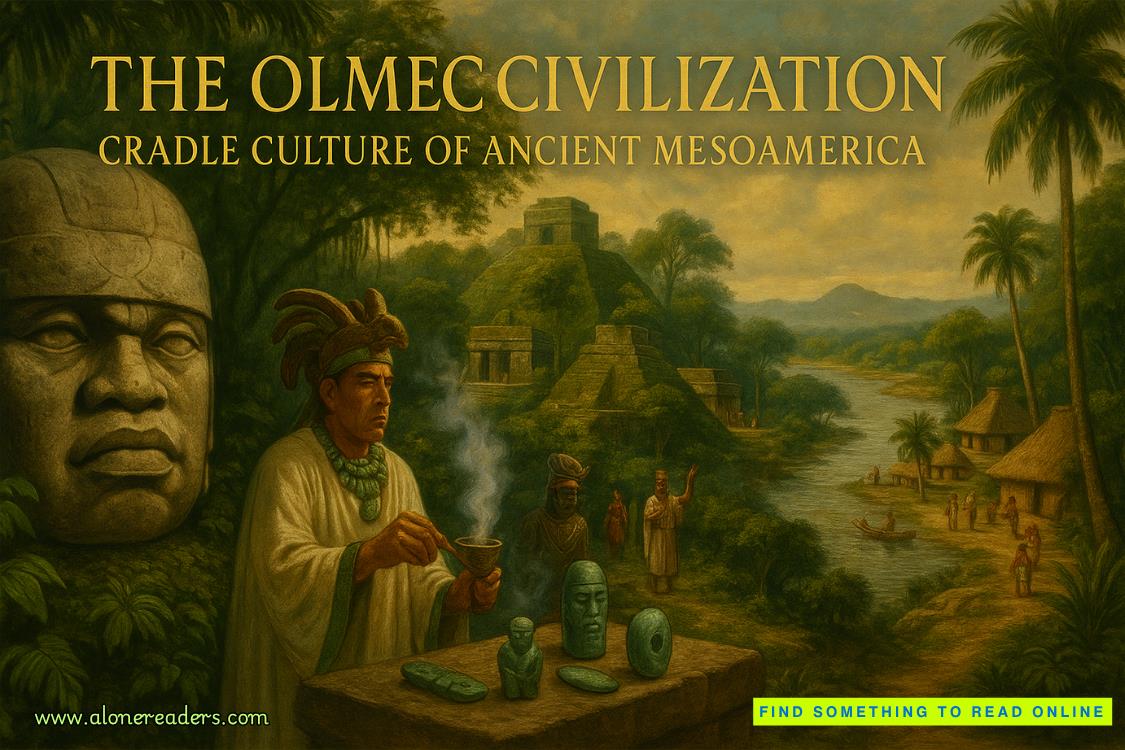
Among the most iconic products of Olmec imagery are the colossal basalt heads, each weighing several tons and carved with extraordinary realism. These massive portraits, believed to represent rulers or elite warriors, embody the Olmecs’ technical mastery and political sophistication. Transporting such stones across great distances required not only physical coordination but also centralized authority and skilled labor organization. Every head displays individualized features—helmet-like headdresses, stern expressions, and intricate facial details—suggesting that Olmec leadership was personalized, charismatic, and likely semi-divine. The artistry behind these heads, combined with the sheer effort involved in their creation, portrays a society deeply invested in ritualized rulership and symbolic power.
Beyond monumental stone sculpture, the Olmecs achieved remarkable refinement in small-scale artistry, crafting jade figurines, ceramics, polished mirrors, and intricately carved axes and ornaments. Jade, with its luminous green tones, held spiritual significance and was associated with fertility, water, and life. Many figurines depict human–animal hybrids, crouching shamans, or stylized supernatural beings with almond-shaped eyes and downturned mouths—the so-called “Olmec baby-face.” These forms hint at a worldview in which transformation, ritual power, and the blending of earthly and spiritual realms played central roles. The presence of such artifacts across distant regions indicates that the Olmecs participated in extensive trade networks, exchanging jade, obsidian, magnetite, rubber, cacao, and exotic feathers with neighbors near and far. Their sphere of influence stretched across modern-day Mexico and beyond, positioning them as early cultural unifiers of Mesoamerica.
Religious life in the Olmec world revolved around cosmic balance, fertility, and the interplay between natural and supernatural domains. Scholars believe the Olmecs were among the first in Mesoamerica to institutionalize ritual practices involving sacred landscapes, shamanic transformation, bloodletting, and perhaps early forms of ballgame ceremonialism. Many artifacts depict serpents, jaguars, birds of prey, and hybrid creatures, suggesting a pantheon of powerful deities who embodied elemental forces. Central among these is the enigmatic Olmec jaguar, a symbol representing strength, fertility, and the mystical connection between rulers and the divine. The idea that rulers were intermediaries between gods and people possibly originated in Olmec ideology, laying the groundwork for the divine kingship traditions that the Maya and Aztec later expanded.
The city of La Venta, flourishing after the decline of San Lorenzo, became one of the most impressive ceremonial centers ever constructed in early Mesoamerica. Its Great Pyramid—an immense clay mound rising above the jungle canopy—served as both a spiritual beacon and a political emblem. The city’s layout appears to follow cardinal directions, indicating careful planning and astronomical alignment. Buried offerings of serpentine tiles, mosaics arranged in symbolic patterns, and large caches of jade objects reveal a society heavily invested in ritual performance and public display. The deliberate interment of thousands of high-value objects beneath plazas hints at complex ceremonies meant to renew cosmic order, legitimize rulers, or honor deities. These rituals would serve as prototypes for the grand sacrificial and renewal ceremonies that later Mesoamerican cultures institutionalized.
The Olmecs also developed early writing and calendrical systems. Although fragmentary, evidence such as the Cascajal Block suggests that the Olmecs experimented with one of the earliest writing systems in the Americas, possibly used for elite communication or religious notation. Similarly, symbols thought to represent early calendar elements indicate their interest in temporal cycles, agricultural planning, and celestial observation. These innovations predate the well-known Maya calendar by centuries, underscoring the Olmecs’ foundational role in shaping intellectual life in the region. Their ability to encode symbols, track time, and standardize ritual activities marks them as pioneers of structured knowledge.
Every aspect of Olmec society—from their monumental architecture to their smallest artifact—reveals an enduring fascination with duality and transformation. Many motifs show humans merging with animals, shamans shifting between spiritual planes, and cosmic forces interacting with earthly life. This worldview encouraged a flexible interpretation of reality, where rulers and priests could embody multiple roles: political leaders, spiritual mediators, warriors, and cosmic actors. Such ideological versatility may explain the civilization’s resilience and adaptability, allowing them to thrive in a challenging environment while maintaining extensive regional influence.
Agriculture formed the economic backbone of Olmec life. They cultivated maize, beans, squash, cacao, and various root crops using both riverine and rainforest agricultural methods. The abundance of fertile land supported population growth, specialization of labor, and the rise of elites who coordinated construction projects and long-distance trade. The Olmecs’ position along major rivers also enabled them to move goods, people, and ideas with relative ease. This geographic advantage turned their homeland into a cultural crossroads, where innovations traveled outward and external influences were absorbed.
Despite their achievements, the Olmec civilization experienced significant transformations and eventual decline around 400 BCE. Environmental shifts, volcanic activity, resource depletion, and social upheaval are all possible factors. Yet their disappearance was not an extinction of culture but a diffusion. As major centers faded, Olmec ideas, symbols, and artistic styles spread into emerging regions. The Epi-Olmec culture, the Maya, and the peoples of central Mexico adopted, adapted, and integrated Olmec elements into their own traditions. This diffusion is why historians often refer to the Olmecs as a "mother culture", though some scholars favor the term "sister culture" to emphasize mutual exchange rather than one-way inheritance. Regardless of terminology, the Olmecs undeniably shaped the intellectual and cultural foundations of later Mesoamerican civilizations.
One of the most compelling aspects of the Olmecs is the aura of mystery surrounding them. Without extensive written records or surviving historical narratives, the Olmecs emerge primarily through their material remains. Their skillful craftsmanship, symbolic icons, and architectural feats provide tantalizing clues about their identity but leave room for interpretation. This combination of sophistication and ambiguity has captivated researchers for decades, encouraging new archaeological methods, environmental studies, and artistic analyses to uncover deeper layers of their story. The Olmecs are a reminder that ancient civilizations can be both profoundly influential and partially obscured by the erosion of time.
The modern perception of the Olmecs is shaped by both scientific discovery and cultural imagination. As excavations continue, new findings challenge old assumptions. Some discoveries reveal advanced hydraulic systems and settlement patterns that indicate much larger populations than previously thought. Others provide evidence of ritual spaces connected by causeways or trade routes integrated into broader Mesoamerican networks. Each discovery adds nuance to the portrayal of the Olmecs not merely as artistic innovators but as architects of a far more expansive cultural and political world.
Despite their early timeline, the Olmecs mastered the art of creating ideological symbols that remained relevant for over a millennium. Their representations of supernatural beings influenced Maya iconography; their ceremonial architecture prefigured platforms and pyramids at Teotihuacan; their concepts of sacred rulership informed later empires. Even their ballgame—a ritual sport tied to cosmic narratives of life, death, and rebirth—may trace some of its earliest ceremonial traditions to the Olmec world. This cultural continuity emphasizes how deeply their achievements resonated across time.
In understanding the Olmecs, we gain insight not only into an ancient civilization but into the origins of Mesoamerican identity itself. The Olmecs were innovators of art, religion, architecture, and sociopolitical ideology, whose contributions formed the bedrock upon which later societies built their cultural landscapes. Their legacy endures through the languages, symbols, and myths of the region, reminding us that even civilizations without written histories can shape the future in profound ways. The Olmecs represent a civilization both forgotten in their specifics and yet immortal in their influence—a culture whose echoes still resonate through the jungles and mountains of Mexico, whispering stories of the first great architects of Mesoamerican grandeur.
Their achievements compel us to reexamine what it means to be a “cradle culture,” for the Olmecs were not merely the earliest known complex society in Mesoamerica—they were visionaries whose ideas transcended their own era. Through their monumental heads, jade sculptures, sacred landscapes, and enduring symbols, the Olmecs shaped a cultural memory that outlived their cities. Their civilization stands as a testament to humanity’s capacity for innovation, spirituality, and artistic expression, even in the earliest chapters of history. The story of the Olmecs is one of profound creativity, resilience, and mystery—a story that continues to evolve as new discoveries emerge from the soil, revealing ever more about the people who laid the first stones of ancient Mesoamerican civilization.



 The Hundred Days Offensive: How the Allies Defeated Germany in World War I
 The Second Battle of the Marne: The Turning Point of World War I in 1918
 The Spring Offensive of 1918: Germany's Final Gamble to Win World War I
 The Treaty of Brest-Litovsk: How Russia Left World War I
 The Russian Revolution and World War I: How War Brought Down the Tsar
 The Zimmermann Telegram Explained: Germany's Secret Offer to Mexico in World War I