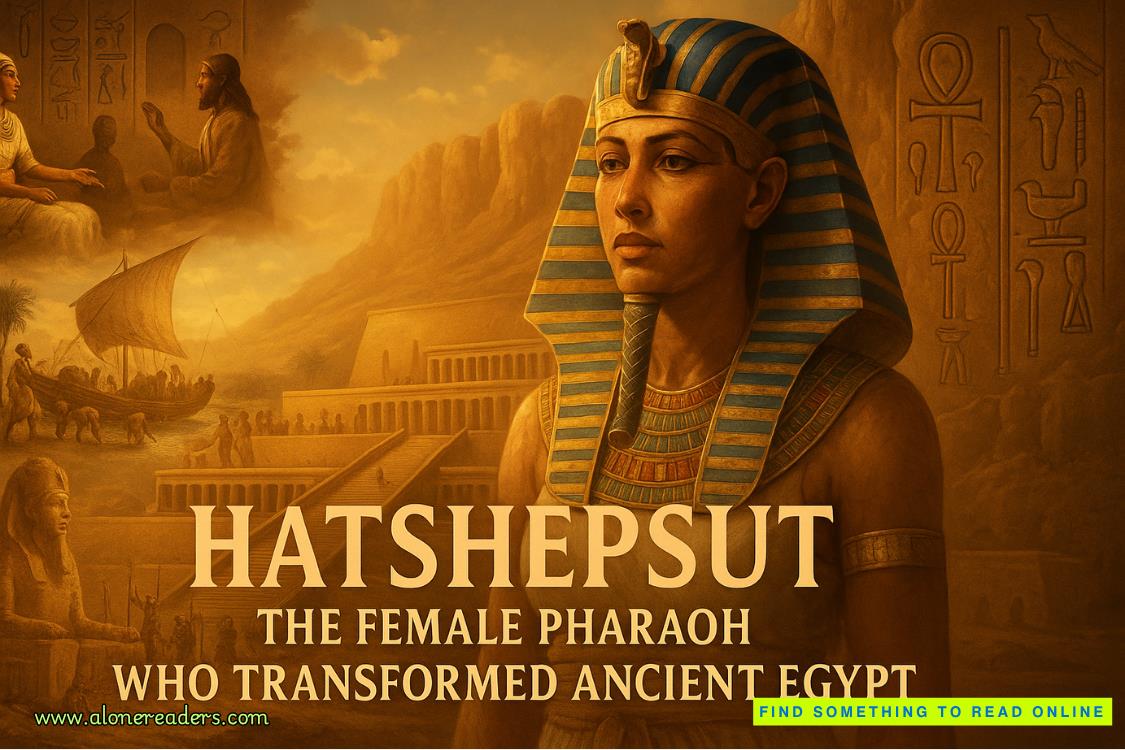
Among the long line of Egyptian rulers who shaped the Nile Valley’s destiny, Hatshepsut stands as one of the most extraordinary and misunderstood figures in world history, a woman who claimed a throne traditionally reserved for men and redefined the concept of kingship itself. Her reign during the Eighteenth Dynasty marked a period of immense prosperity, architectural innovation, and political stability. Yet for centuries, her legacy lay in ruins—quite literally—because later rulers attempted to erase her image, name, and memory from monuments across Egypt. Despite this, the traces she left behind are so monumental, so intellectually sophisticated, and so politically groundbreaking that modern scholars now recognize her as one of the most influential leaders of the ancient world. Her story is not simply about a woman on the throne; it is about a visionary who reshaped the foundations of Egyptian statecraft, religion, and culture.
Hatshepsut was born into a world of immense privilege and immense responsibility. As the daughter of Thutmose I, she belonged to a royal bloodline that linked her directly to the ruling elite of Egypt’s New Kingdom. From childhood, she was groomed in political rituals, religious traditions, and the art of leadership. She served initially as God’s Wife of Amun, one of the highest religious roles available to a woman, granting her economic power, land, servants, and influence within the priesthood. When her father died, she became queen-consort by marrying her half-brother Thutmose II, following dynastic customs meant to preserve the purity of royal blood. But her life’s turning point came when Thutmose II died young, leaving behind an infant son, Thutmose III, who was far too young to rule independently. Egypt needed stability, and Hatshepsut provided it—but in a way no one expected.
Initially, she served as regent, ruling on behalf of the child king. But as court politics grew complex and religious symbolism favored her rising authority, Hatshepsut took a step unprecedented for a royal woman: she declared herself Pharaoh, adopting full royal titulary, wearing the nemes headdress, and even donning the ceremonial false beard associated with kingship. In doing so, she did not reject her identity as a woman; instead, she fused masculine and feminine roles to embody a hybrid form of kingship that legitimized her rule in the eyes of priests, administrators, and the public. This delicate balancing act required immense political intelligence, because Egypt’s monarchy was seen not merely as a political institution but as a divine one. Hatshepsut understood that to rule, she must embody divine order, or ma’at, and she crafted a narrative that positioned her ascent as the will of the gods.
Under Hatshepsut’s reign, Egypt experienced one of its most stable and prosperous periods. She pursued a style of governance that emphasized economic expansion, diplomatic alliances, and monumental architecture, rather than constant warfare. Her foreign policy reveals a leader who valued long-term prosperity more than military glory. Perhaps the most famous example of her economic strategy was the expedition to Punt, an ancient trading partner located along the Red Sea or Horn of Africa. The mission brought back gold, ivory, ebony, exotic animals, and most notably frankincense and myrrh—valuable resins used in religious rituals. The expedition was so important that she had it carved in exquisite detail on the walls of her mortuary temple, illustrating the wealth and prestige it brought to Egypt. In an era when power was often measured by conquest, Hatshepsut demonstrated that trade could be a greater engine of national greatness than war.
Another defining feature of Hatshepsut’s rule was her ambitious building program, which surpassed that of many male rulers before her. She understood that monuments were not merely structures but tools of political communication, physical manifestations of divine favor, and permanent records of legitimacy. Her greatest architectural triumph was the Mortuary Temple at Deir el-Bahari, a terraced marvel rising dramatically against the limestone cliffs of western Thebes. Designed with symmetry, symbolism, and celestial alignment in mind, it represents one of the most elegant achievements in ancient architecture. Every relief, column, statue, and courtyard was part of a visual narrative that celebrated her divine birth, her relationship to the god Amun, her achievements as pharaoh, and her sophisticated vision for Egypt’s future.
Beyond Deir el-Bahari, she restored temples, erected obelisks at Karnak, and commissioned statues that depicted her in various forms—sometimes as a woman, sometimes as a traditional male king, and sometimes as a hybrid figure that transcended gender norms. These artistic choices were not attempts to hide her femininity; rather, they were deliberate expressions of her unique political identity. The concept of Egyptian kingship was tied to cosmic order, and Hatshepsut had to redefine that order in a way that included her without undermining centuries of tradition. Her solution—embodying both genders in her representations—was innovative, strategic, and deeply symbolic, demonstrating an intuitive understanding of how imagery shapes authority.
One of the most fascinating aspects of Hatshepsut’s reign is the nature of her relationship with Thutmose III, the child-king she initially ruled beside. Contrary to popular belief, there is no evidence that they were enemies during her lifetime. In fact, many scholars argue that Thutmose III continued to serve as an important military commander and respected co-ruler. Only after her death did he initiate a systematic erasure of her images and name, chiseling her out of reliefs and smashing her statues. This destruction was not necessarily driven by hatred or revenge but likely by a desire to restore traditional male succession lines and prevent future women from attempting similar claims to power. Ironically, the very act meant to erase her ensured that her story survived; the architectural scars record the extent of her impact.
Despite these attempts to suppress her memory, modern archaeology has restored Hatshepsut’s place in history. Her mummy, discovered in 2007, offered physical proof of her existence and insights into her final years. More importantly, her buildings, inscriptions, and policies reveal a leader whose intellect, ambition, and creativity shaped Egypt in profound ways. She demonstrated that effective governance does not always require brute force; instead, it can arise from diplomacy, economic strategy, religious patronage, and visionary planning. Under her leadership, Egypt enjoyed peace, prosperity, and cultural flourishing—conditions that laid the foundation for the empire’s later expansion under Thutmose III.
What makes Hatshepsut especially compelling today is how she navigated a patriarchal system without rejecting it. She understood that power depended on tradition, and tradition depended on symbolism. Instead of challenging those symbols head-on, she transformed them from within. She embraced male regalia not to obscure her identity but to claim authority in a language her society understood. Her reign reveals an extraordinary ability to blend pragmatism with ideology, innovation with continuity, and personal ambition with national stability. These qualities make her one of the most fascinating rulers in world history and a powerful example of how women have shaped civilizations even when their contributions were later erased or minimized.
Hatshepsut’s story is also a reminder of how history itself is shaped—by those who write it, those who destroy parts of it, and those who rediscover it centuries later. Her legacy survived not because she was remembered but because her achievements were too monumental to disappear completely. Her temple still stands, her obelisks still rise toward the sky, and her inscriptions—though damaged—still speak of a woman who claimed the right to rule and did so with unmatched brilliance. Her story compels us to broaden our understanding of leadership, gender, and power, and to recognize the hidden figures who shaped human civilization.
In the broader narrative of ancient Egypt, Hatshepsut represents a golden moment of creativity, prosperity, and political clarity, driven by a ruler whose vision extended far beyond her own lifetime. Her reign is a testament to the transformative potential of leadership rooted in intelligence, diplomacy, and artistic ambition rather than sheer military conquest. As modern readers look back on her life, they see not merely a woman who became king but a leader who redefined what kingship could be. And in doing so, Hatshepsut established a legacy that continues to fascinate, inspire, and expand our understanding of the ancient world.
Her story is not only the story of a queen; it is the story of a nation reshaped by a woman who dared to imagine a different kind of Egypt—and succeeded.



 The Hundred Days Offensive: How the Allies Defeated Germany in World War I
 The Second Battle of the Marne: The Turning Point of World War I in 1918
 The Spring Offensive of 1918: Germany's Final Gamble to Win World War I
 The Treaty of Brest-Litovsk: How Russia Left World War I
 The Russian Revolution and World War I: How War Brought Down the Tsar
 The Zimmermann Telegram Explained: Germany's Secret Offer to Mexico in World War I