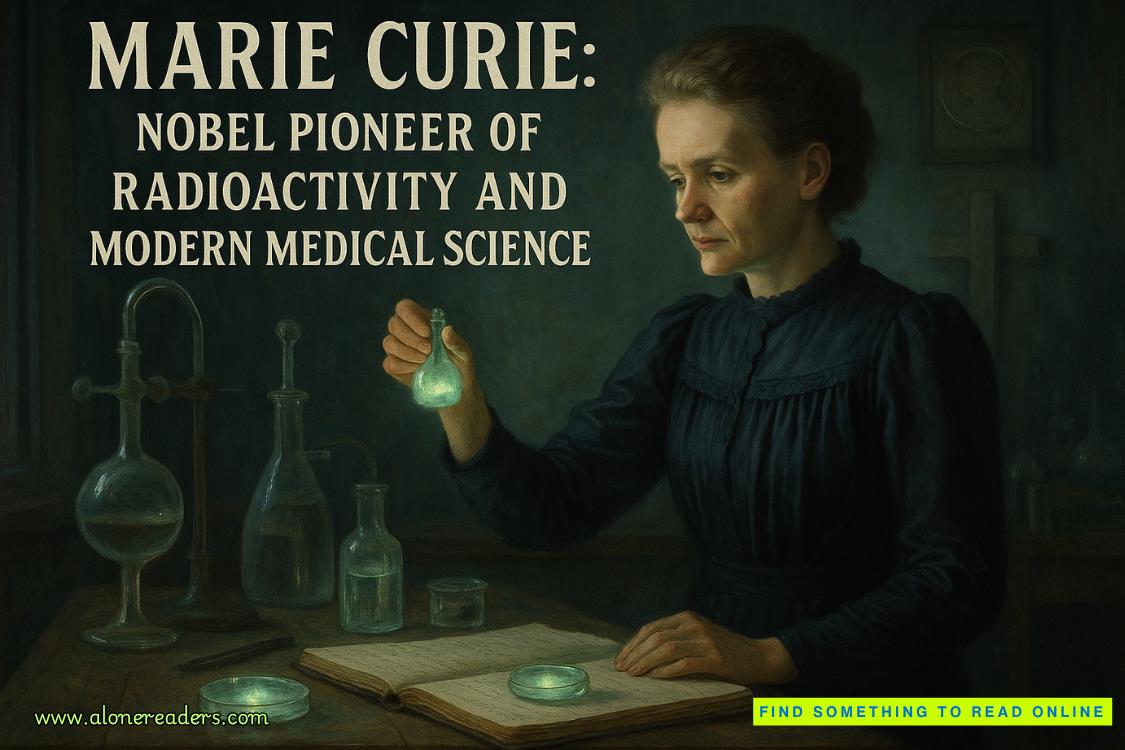
Marie Curie remains one of the most enduring symbols of scientific brilliance, intellectual courage, and unwavering perseverance in the face of adversity. Her life, shaped by political repression in her homeland and systemic barriers in the male-dominated scientific world, stands as a testament to the extraordinary heights that determination and curiosity can reach. Long after her discoveries transformed the foundations of physics, chemistry, and medical science, her story continues to embody the essence of human progress. It is difficult to overstate the magnitude of her contributions, especially considering that she worked in an era when the very idea of a woman leading cutting-edge scientific research was considered almost unthinkable. Yet Marie Curie not only broke boundaries—she redefined them. Her pioneering work on radioactivity established an entirely new scientific field and altered the trajectory of twentieth-century medicine, enabling innovations that today save millions of lives.
Born Maria Skłodowska in Warsaw in 1867, her early life unfolded under the shadow of Russian occupation, where Polish culture and intellectual expression were actively suppressed. Her family, committed to the preservation of Polish identity and education, instilled in her a deep respect for knowledge and scientific inquiry. Although gifted with an extraordinary intellect, she faced limited opportunities in her homeland, as higher education institutions barred women. This forced her to seek unconventional paths, including the clandestine Flying University, an underground network that secretly educated Polish youth banned from formal learning. Even at this early stage, her resilience and adaptability became defining traits, foreshadowing the tenacity that would later fuel her groundbreaking discoveries.
Unable to pursue science fully in Warsaw, she left for Paris in 1891 to study at the University of Paris, or Sorbonne, where she adopted the name “Marie.” Her years in Paris were marked by both intellectual awakening and physical hardship. She lived in unheated rooms, often sacrificing meals to afford textbooks, yet she excelled academically with exceptional distinction. Her brilliance quickly caught the attention of leading scientists, including Pierre Curie, with whom she formed both a powerful intellectual partnership and a deep personal bond. Their marriage in 1895 became the foundation of a scientific collaboration that forever altered modern understanding of matter and energy.
Marie’s journey toward her monumental discovery began when she sought a subject for her doctoral research. Inspired by Henri Becquerel’s accidental finding that uranium emitted mysterious penetrating rays, she undertook a systematic study to determine whether this was unique to uranium or present in other elements. Through meticulous experimentation, she made the stunning revelation that the intensity of the rays depended solely on the amount of the element present, not its chemical form—thus suggesting that this phenomenon originated from the atom itself. She named this phenomenon radioactivity, giving the world not only a new word but an entirely new scientific concept that redefined the fundamental nature of matter.
Working in crude, makeshift laboratories, often under physically exhausting conditions, Marie and Pierre Curie began to investigate minerals such as pitchblende, which emitted far stronger radiation than uranium alone could account for. Through painstaking chemical separation, they derived evidence of two previously unknown elements. In 1898, they announced the discovery of polonium, named after Marie’s beloved homeland, followed months later by the discovery of radium. The latter, with its luminous glow and extraordinarily powerful radioactive properties, quickly became one of the most fascinating substances known to science.
The extraction of radium was, however, a Herculean task. The Curie team processed tons of pitchblende in a leaky wooden shed, laboriously boiling, stirring, filtering, and crystallizing materials with nothing more than iron cauldrons and primitive tools. Marie often worked alone late into the night, stirring cauldrons over open flames in freezing weather, her hands chapped and her clothing soaked with chemicals. Yet she described this period as among the happiest of her life, recalling the “fairy-like glow” of the radium samples as a source of both inspiration and validation. Few scientists have ever demonstrated such a combination of intellectual intensity and physical endurance.
Her extraordinary achievements earned her the 1903 Nobel Prize in Physics, shared with Pierre Curie and Henri Becquerel. Marie became the first woman in history to receive a Nobel Prize, and even then, her contributions were nearly overlooked due to institutional prejudice. It required intervention by Pierre and supportive colleagues to ensure that her name was included on the nomination. This moment symbolized not only a triumph for scientific progress but a significant milestone in women’s intellectual history, proving that women could contribute at the highest levels of scientific discovery.
Tragedy struck in 1906 when Pierre Curie died in a sudden accident, leaving Marie devastated personally and professionally. Yet, in a remarkable display of resilience, she stepped into his university professorship, becoming the first woman to teach at the Sorbonne. She continued her research with unbroken determination, refining the purification of radium and expanding her groundbreaking work on radioactivity. Her persistence culminated in a second Nobel Prize—this time in Chemistry—in 1911, awarded solely to her for isolating pure radium and defining its atomic properties. This made her the first and only person in history to win Nobel Prizes in two different scientific fields, a distinction that remains unmatched more than a century later.
Beyond her profound impact on theoretical science, Marie Curie’s legacy extends deeply into the realm of medicine. Her discovery that radioactive elements could target diseased tissue revolutionized early cancer treatments. Radium therapy, though primitive by modern standards, represented a revolutionary step toward non-surgical cancer intervention. Marie’s insights laid the foundation for radiotherapy, one of the most important medical innovations of the twentieth century, fundamentally altering the prognosis of countless patients worldwide.
Her contributions expanded further during the First World War. Recognizing that X-ray imaging could drastically reduce battlefield deaths by allowing surgeons to locate bullets and shrapnel with precision, she mobilized her knowledge of radiation to create mobile radiology units. These vehicles, equipped with portable X-ray machines and powered by generators, became known as “Little Curies.” Marie personally trained military doctors and radiology technicians, and even drove the vehicles to the front lines herself, demonstrating astonishing bravery. Her daughter Irène, who would later become a Nobel laureate in her own right, assisted her in these lifesaving efforts. It is estimated that over a million soldiers benefited from the diagnostic power of these mobile radiology units. Marie Curie’s wartime work illustrates a profound truth: her scientific genius was matched by an equally powerful commitment to humanity.
Despite her many achievements, she lived with humility and a steadfast devotion to science. She did not patent the process of radium isolation, believing that scientific knowledge should benefit all humankind rather than generate personal profit. Had she done so, she would likely have become one of the wealthiest individuals of her era. Instead, she dedicated her resources to building research institutes, training new generations of scientists, and advancing applied medical research. Her laboratories eventually evolved into world-leading centers for nuclear science and oncology, ensuring that her intellectual lineage endured far beyond her lifetime.
Tragically, Marie Curie’s work with radioactive materials—conducted without the protective knowledge or equipment available today—took a devastating toll on her health. Decades of exposure damaged her bone marrow and immune system, ultimately leading to aplastic anemia, the condition that claimed her life in 1934. She never fully recognized the dangers, as the harmful effects of radiation were still poorly understood. Her notebooks, preserved today, remain so radioactive that they must be handled with protective gear. Her death, though heartbreaking, serves as a sober reminder of the profound risks borne by scientific pioneers who illuminate the unknown.
Marie Curie’s influence reshaped the trajectory of science and medicine in ways that continue to resonate today. Her discoveries opened pathways to nuclear physics, atomic theory, particle research, and medical imaging. Modern radiotherapy, PET scans, and countless diagnostic techniques owe their conceptual origins to the principles she established. Moreover, her story has inspired generations of women in STEM fields, breaking down gender barriers and proving that intellectual brilliance knows no gender.
More importantly, her legacy transcends science itself. She stands as an enduring symbol of perseverance against overwhelming odds, a reminder that courage, curiosity, and an unwavering devotion to truth can change the world. In many ways, her life captures the essence of scientific discovery: relentless questioning, meticulous experimentation, and the willingness to walk into the unknown with nothing but determination and a belief in the transformative power of knowledge.
Today, Marie Curie’s name is synonymous with pioneering spirit. Her work not only revealed the hidden structure of matter but also illuminated new ways to heal the human body. Her dual Nobel Prizes represent far more than historic achievements—they embody a lifetime of sacrifice, relentless dedication, and unwavering ambition to serve humanity. The influence of radioactivity on modern physics, medicine, and technology is immeasurable, and at its foundation stands a woman whose brilliance changed the world.
More than a century after her greatest discoveries, Marie Curie continues to inspire scientists, historians, and everyday people alike. Her life demonstrates that transformative breakthroughs often come from those who defy expectations and push beyond the boundaries imposed upon them. Her courage and genius are woven into the fabric of modern science, standing as a powerful reminder that even in the most challenging circumstances, the pursuit of knowledge can reshape the future. Marie Curie remains not merely a historical figure but a living force in global scientific imagination—a testament to the extraordinary potential of the human mind when guided by curiosity, resilience, and an unbreakable commitment to truth.




 The Hundred Days Offensive: How the Allies Defeated Germany in World War I
 The Second Battle of the Marne: The Turning Point of World War I in 1918
 The Spring Offensive of 1918: Germany's Final Gamble to Win World War I
 The Treaty of Brest-Litovsk: How Russia Left World War I
 The Russian Revolution and World War I: How War Brought Down the Tsar
 The Zimmermann Telegram Explained: Germany's Secret Offer to Mexico in World War I