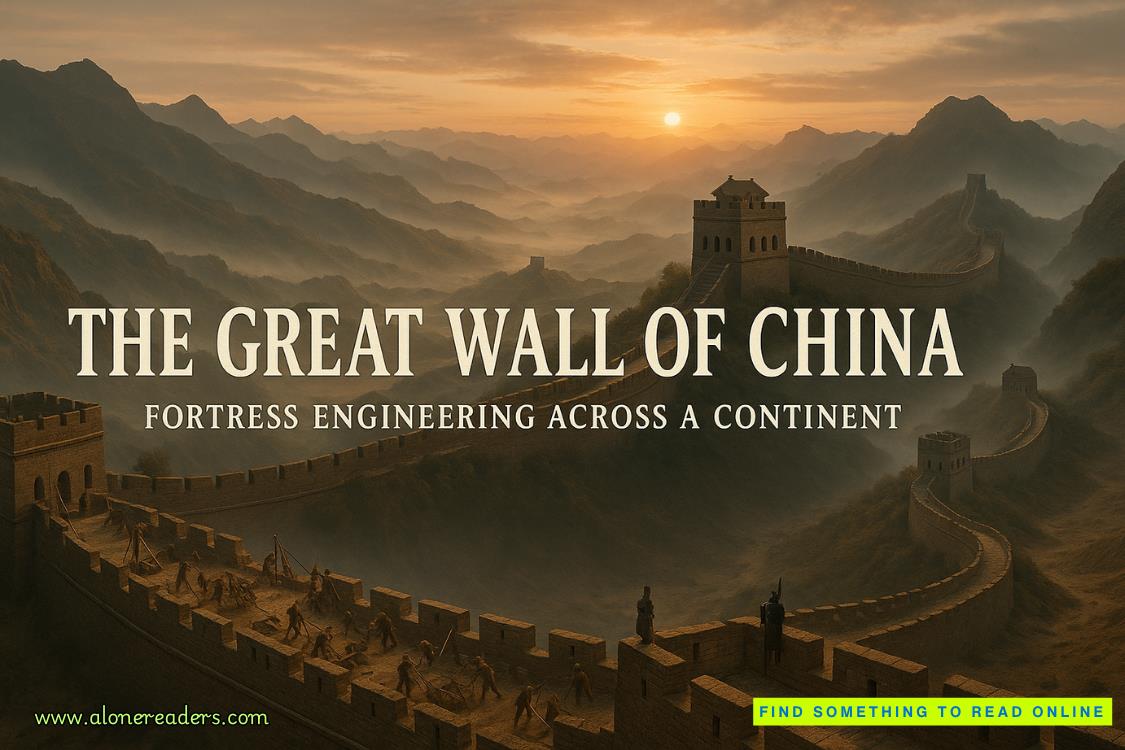
The Great Wall of China is one of humanity’s most extraordinary feats of engineering, stretching thousands of kilometers across mountains, deserts, rivers, and valleys. It is not merely a wall but a military defense network, an expression of centralized imperial power, and a symbol of national endurance. The wall represents over 2,000 years of construction and reconstruction, involving dozens of dynasties, countless laborers, vast logistical planning, and innovative engineering tailored to the varied landscapes of northern China. To truly understand the Great Wall, one must explore it not as a single structure but as a complex system of fortifications, reacting to geopolitical threats and evolving with technological advances in warfare.
The early foundations of the wall date back to the Warring States period (475–221 BCE), when competing kingdoms built defensive barriers to shield themselves from rival states and northern nomadic tribes. These early structures were crude, made mostly from rammed earth mixed with wood and stones. Yet, they established the basis for what would later become a monumental imperial project. When Emperor Qin Shi Huang unified China in 221 BCE, he ordered the linking of these fragmented walls to create a unified defense line. This project marked the beginning of a centralized approach to border security, connecting separate fortifications into what could be considered the first large-scale intercontinental engineering effort in human history.
During the Han Dynasty, the Great Wall expanded significantly, stretching over 10,000 kilometers to protect the Silk Road trade routes. Here, the wall had dual functions: it acted as a military defense and a customs checkpoint for merchants traveling between East and West. Soldiers stationed at the wall collected taxes, inspected goods, and protected caravans from bandits. This demonstrates that the wall was not just a physical barrier; it was a strategic economic infrastructure, shaping international commerce and diplomacy. The wall also featured beacon towers, allowing soldiers to signal across long distances using smoke during the day and fire at night—an early form of long-range communication vital for quick response to raids.
However, the most iconic sections of the wall—those built with stone and brick—were constructed during the Ming Dynasty (1368–1644). The Mongol Empire had previously conquered China, and the Ming rulers were determined to prevent another invasion. To do so, they transformed the wall using far more advanced engineering techniques. Unlike earlier dynasties that relied mostly on tamped earth, the Ming used massive stone foundations, kiln-fired bricks, lime mortar, and granite blocks on exposed summits. This approach made the wall both stronger and more permanent, enabling it to withstand artillery and heavy winds across rugged mountain terrain. The Ming also added thousands of watchtowers, each placed strategically to cover visibility gaps and hold defensive troops, weapons, and supplies.
The difficulty of building such immense structures across diverse landscapes was immense. In mountainous areas, laborers had to transport stone blocks up steep cliffs using ropes, pulleys, oxen, and human chains. In deserts, stone was scarce, so builders used tamped earth reinforced with reeds and gravel to form sturdy walls. Some sections were built in modular form, meaning that wall components were prefabricated and then assembled on-site to speed up construction. This reflects a level of logistical planning and engineering foresight rarely seen in other ancient projects. The wall adapted to the terrain—it was not built in straight lines but followed the contours of natural obstacles, maximizing both defensive advantage and structural stability.
The human cost, however, was immense. It is estimated that hundreds of thousands of laborers worked on the wall—soldiers, peasants, prisoners, and conscripted workers. Many died from exhaustion, accidents, extreme weather, and starvation. Some sections were so remote that supply routes were nearly impossible to maintain. Workers built makeshift camps near construction zones, relying on limited food and water transported from villages miles away. In popular memory, the wall earned a tragic reputation: “The Great Wall consumes life but stands eternal.” Some rumors suggested that dead workers were buried inside the wall to reinforce its strength, though this remains more legend than confirmed fact. Yet it highlights the enormous sacrifice behind this engineering marvel.
One of the most impressive aspects of the Great Wall is the integration of defense strategy and architecture. Each watchtower was carefully positioned to provide full visibility of the landscape. Garrison towns were established near critical points to house troops, store grain, and repair weapons. Passes, such as the famous Juyongguan and Shanhaiguan, were heavily fortified with gates, moats, and inner defensive walls. These passes controlled major trade routes and served as checkpoints for travelers entering imperial territory. In times of conflict, the wall could hold tens of thousands of soldiers across multiple stations, acting as a massive, synchronized security network. This made the wall not just a linear barrier, but a three-dimensional defensive system capable of housing soldiers, storing supplies, and enabling tactical movement.
The wall also influenced military innovation. With the introduction of gunpowder weapons, some towers were adapted to support cannons and arquebuses, proving that the wall was not static but evolved as warfare changed. The Ming Dynasty even established signal systems combining smoke, fire, flags, drums, and gunfire, allowing a military alert to travel over 500 kilometers within a single day. This shows how the Great Wall acted as an ancient information highway, a precursor to modern communication systems used in warfare.
Beyond military purpose, the wall represented administrative control and political symbolism. Emperors used its construction and maintenance to demonstrate authority over the country’s borders and project power to the world. The wall was an engineering system, but it was equally a political message carved into the land—a message of unity, strength, and resistance against external threats. It marked a boundary not only between China and nomadic tribes but also between agricultural societies and steppe cultures, embodying the historical tension between settled civilizations and migratory empires.
As dynasties rose and fell, the wall’s role transformed. After the Qing Dynasty conquered the Ming in the 17th century, the Great Wall lost much of its military importance because China’s borders shifted far beyond its line. Without constant maintenance, many sections decayed, eroded by wind and time. But its symbolic value only grew stronger. In the 20th century, the wall became a national icon, celebrated in literature, propaganda, and education as the symbol of Chinese perseverance. Today, it attracts millions of visitors annually, and although only a fraction of its full length is preserved, it remains a global emblem of ancient engineering brilliance.
Modern engineering studies reveal that certain Ming wall sections still maintain structural stability after over 400 years, proving the effectiveness of stone-brick construction combined with lime mortar and drainage systems. In some areas, drainage outlets were built every few meters to prevent internal pressure from heavy rains—an advanced technique that shows awareness of structural physics and hydrology. Engineers today acknowledge that constructing such a massive network across varied terrains, with limited tools, minimal machinery, and almost no scientific equipment, required extraordinary ingenuity and planning. The Great Wall demonstrates not only brute force labor, but intelligent resource management, environmental adaptation, and material engineering.
The Great Wall remains one of the clearest testimonies to human resilience. It was built not in a single era but through centuries of continuous adaptation, embodying the idea that engineering is as much about surviving time as it is about surviving war. From watchtowers on misty mountain peaks to lonely stretches deep in desert sands, the wall carries the memory of every dynasty, every battle, and every anonymous laborer who helped shape one of the most remarkable structures ever built. Its legacy is not just physical—it is philosophical. It reminds us that great engineering demands more than knowledge; it demands vision, sacrifice, and an unbreakable belief that a structure can outlast fear itself.
Today, the Great Wall stands as a bridge between past and present, a monumental record of ingenuity written in stone and earth. It embodies the power of ancient engineering to shape geography and destiny, proving that mankind is capable of transforming landscapes on a continental scale. It is not simply a wall—it is a legacy of endurance, an engineering project so vast that it became a historical narrative in itself. To walk upon it is to walk through centuries of innovation, conflict, sacrifice, and human ambition. The Great Wall of China is not just an engineering marvel—it is a testament to the belief that a civilization can defend its future by building greatness into its very foundations.




 The Hundred Days Offensive: How the Allies Defeated Germany in World War I
 The Second Battle of the Marne: The Turning Point of World War I in 1918
 The Spring Offensive of 1918: Germany's Final Gamble to Win World War I
 The Treaty of Brest-Litovsk: How Russia Left World War I
 The Russian Revolution and World War I: How War Brought Down the Tsar
 The Zimmermann Telegram Explained: Germany's Secret Offer to Mexico in World War I