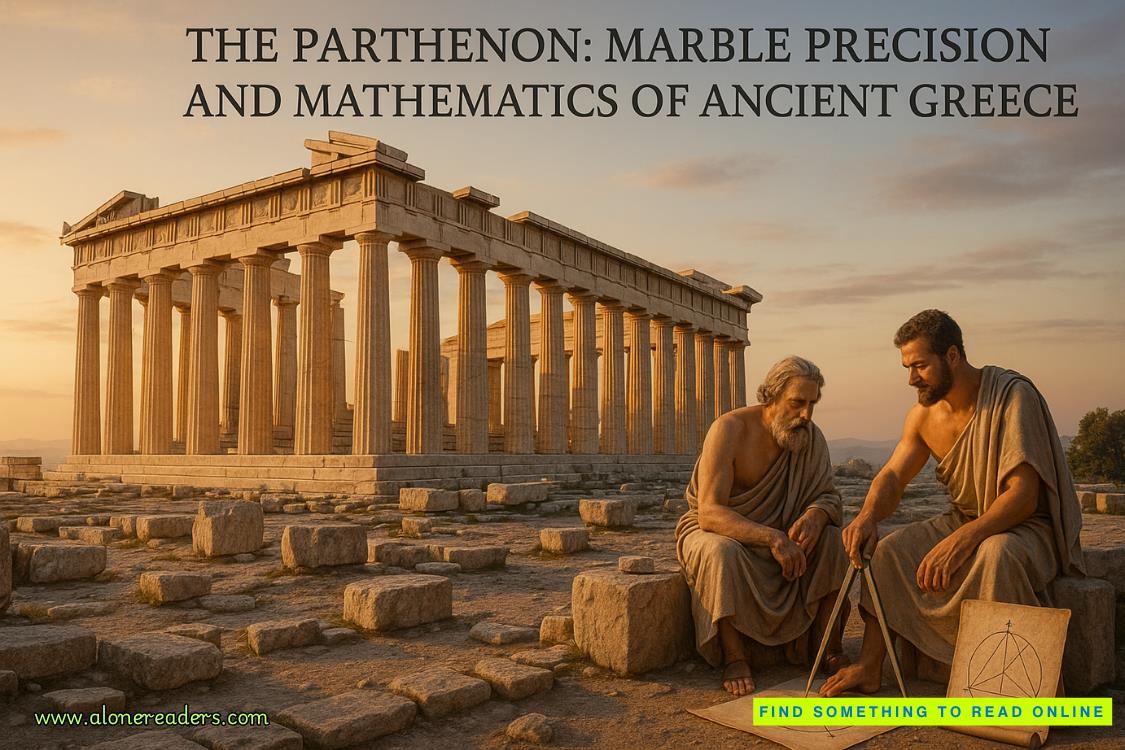
The Parthenon stands on the Acropolis of Athens not merely as a monument of devotion to Athena, but as one of the greatest achievements of precision engineering and mathematical mastery in human history. To the casual observer, it may appear as a symmetrical stone temple—but beneath its seemingly simple structure lies a sophisticated system of purposeful distortions, geometrical adjustments, and optical refinements designed to create the illusion of absolute perfection. Built between 447 and 432 BCE during the rule of Pericles, the Parthenon represents the apex of ancient Greek engineering knowledge—where mathematics, aesthetics, and philosophy fused into marble. Every stone, every column, and every proportion was crafted with deliberate logic to achieve visual harmony from every angle. It is not merely a building—it is a mathematical statement carved in stone.
Although the Parthenon is made of heavy Pentelic marble, the architects Ictinus and Callicrates did not treat it as a static object. Instead, they engineered it as a dynamic visual experience. The building was meant to be perceived as alive, responding to the shifting eyes of the viewer. For instance, the stylobate—the platform on which the columns stand—was not built flat. It is subtly curved, rising in the center by several centimeters to counteract optical sagging and create the appearance of perfect straightness. Nothing in the Parthenon is truly straight or perfectly parallel. Every line is adjusted with intentional deviation to appear correct to the human eye. This understanding of visual psychology and perception-based geometry was centuries ahead of its time and shows the Greeks’ mastery of both logic and beauty.
The Doric columns—those towering marble pillars—are a masterpiece of optical and structural engineering. Each column features a bulge known as entasis, where the shaft slightly swells at one-third of its height. This was not accidental. A perfectly straight column would appear thinner in the middle to the observer. So, the architects added this swelling to correct the illusion and convey strength and vitality. These columns are not equally spaced either—corner columns were placed slightly closer together, as wider spacing would visually appear weaker at the edges. Thus, Greek architects ensured harmony through controlled irregularity. These precise calculations were not written on modern blueprints—they were executed by master craftsmen using rope measurements, proportional ratios, and geometric intuition that required generations to perfect.
Greek architects followed mathematical ratios almost like a sacred doctrine. The proportions of the Parthenon reflect a harmony based on the Golden Ratio (1:1.618), a mathematical expression believed to represent ideal beauty. The relationship between width and height, number of columns, column spacing, and even the frieze panels corresponds to a deeply embedded numerical rhythm. The exterior follows the pattern 8 columns by 17, and this 8:17 ratio appears in other dimensions as well, reinforcing the idea that architecture should obey the same mathematical order found in nature. The Greeks believed that beauty exists where mathematics aligns with human sensibility—and the Parthenon is a living expression of that belief.
The precision of the marble cutting was simply astonishing. Each marble block was custom-shaped for its specific position—there were no interchangeable pieces. Every stone had markings, reference lines, and carved indicators showing how it would fit into the puzzle. The joints between blocks are so tight that a modern razor blade cannot pass between them. And all of this was accomplished without modern cranes, steel tools, or electric machinery. Stones weighing several tons were moved several kilometers from Mount Pentelikon and positioned using wooden cranes, ropes, ramps, counterweights, and sheer mathematical planning. The very fact that this was possible demonstrates a knowledge of applied mechanics, load distribution, and geometric calculation that rivals early modern engineering.
Perhaps the most revealing indication of Greek mathematical genius lies in the Parthenon’s optical refinements. When viewed from below, perfectly parallel lines appear to curve downward. To counteract this, Greek architects curved the lines intentionally, adding what is known as intentional visual correction. Straight lines do not exist in the Parthenon—every component follows a subtle curve or angle. Vertical columns lean inward slightly, so that if extended infinitely upward, they would converge at a point. The entire structure is designed as though the viewer is constantly moving, which means the building interacts dynamically with perception. This level of sophistication would not be fully understood again until the Renaissance—almost two thousand years later.
Beyond mathematics, the Parthenon was a symbol of political strength, economic power, and cultural identity. Athens had emerged victorious from battles with Persia, and Pericles envisioned a monument that would embody the ideals of democracy, rational thought, and civic unity. The temple became a physical representation of the humanistic philosophy at the core of Greek life. Its beauty was not accidental—it was a statement. The Greeks believed that beauty was a form of truth, and mathematics was the language of that truth. Standing before the Parthenon meant witnessing the logic of the universe expressed in marble.
Inside the temple once stood the majestic statue of Athena Parthenos, crafted by the sculptor Phidias. This statue—over twelve meters tall—was made of wood, gold, and ivory, and required precise weight distribution calculations to avoid collapse. Even the interior columns were mathematically spaced to create a sense of divine grandeur, guiding the viewer’s gaze upward, symbolizing the ascension of reason and spirit. Every visual element—from the sculpted metopes to the frieze panels—respected proportions of balance, telling mythological stories while still preserving structural clarity. Ornamentation never overpowered engineering—each supported the other in mathematical harmony.
Even in decay, the Parthenon continues to teach. Earthquakes, explosions, wars, and time have damaged it, yet its engineering principles still endure. Modern architects and engineers study its proportions to understand how human vision interacts with space. Digital reconstructions have revealed astonishing precision: optical corrections of a few millimeters repeated consistently across dozens of components. These were not accidental patterns—they were blueprints of intelligence. Today, advanced laser scans reveal just how deliberate every incline, angle, and deviation was. Ancient Greek craftsmanship was not a lost art—it was an evolved science.
The Parthenon’s legacy survives not just in ruins but in concepts. The entasis of columns inspired Roman architecture, Renaissance cathedrals, and even modern government buildings. Its proportional systems influenced Le Corbusier, Palladio, and classical revivalists in later centuries. But more importantly, its philosophy survives: that beauty must be built on logic and that mathematics is the bridge between nature and human creativity. The Parthenon did not simply stand for Athena—it stood for intellectual courage, for the belief that knowledge can shape stone, and that stone can express ideas eternal to the human spirit.
Perhaps this is why, after thousands of years, people still ascend the Acropolis hill and gaze upon its marble silhouette in awe. Its stones do not speak—but they calculate. Its columns do not move—but they respond. Its proportions do not change—but they inspire. The Parthenon stands not merely as an ancient temple—but as a theorem made visible, a philosophy in pure geometry, a testament to human precision, and a victory of mind over matter. In its silent perfection, it carries a message across the ages: that the pursuit of beauty is also the pursuit of truth, and truth is written most clearly in the language of mathematics.





 The Hundred Days Offensive: How the Allies Defeated Germany in World War I
 The Second Battle of the Marne: The Turning Point of World War I in 1918
 The Spring Offensive of 1918: Germany's Final Gamble to Win World War I
 The Treaty of Brest-Litovsk: How Russia Left World War I
 The Russian Revolution and World War I: How War Brought Down the Tsar
 The Zimmermann Telegram Explained: Germany's Secret Offer to Mexico in World War I










