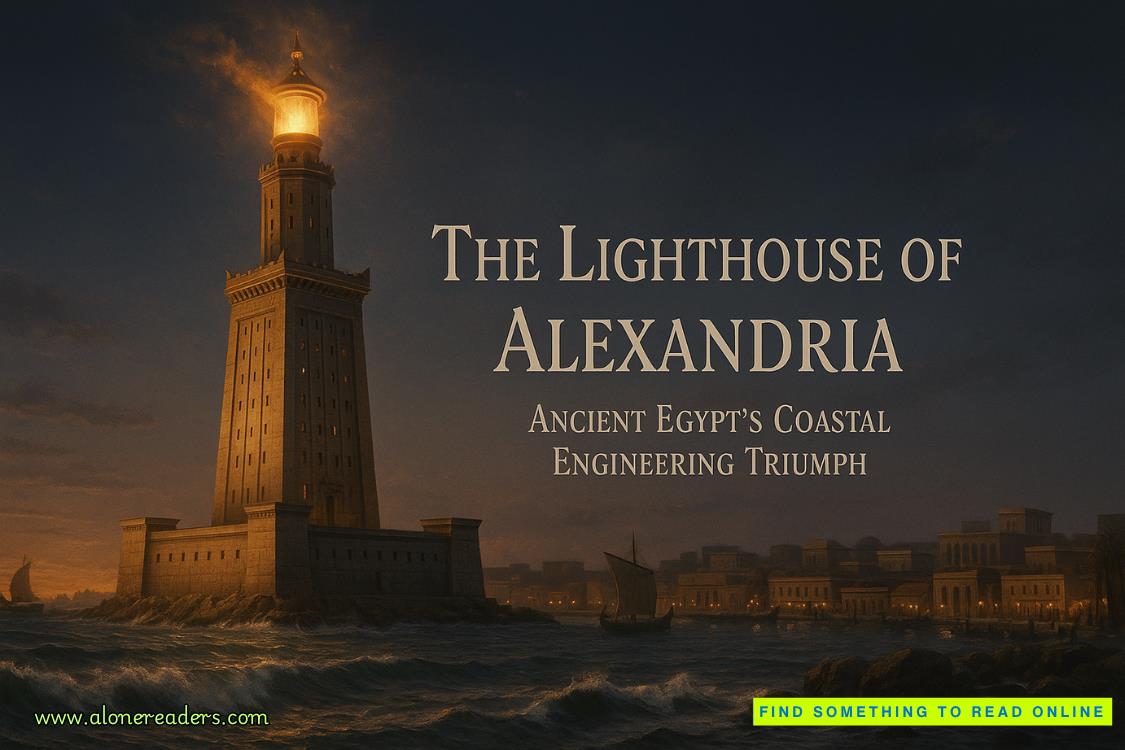
The Lighthouse of Alexandria, also known as the Pharos of Alexandria, was not merely a guiding tower for ships but a monumental statement of human capability. It stood as a beacon of innovation, maritime power, and engineering mastery along the coast of ancient Egypt. Rising to an estimated height of 100 to 130 meters, it was among the tallest man-made structures of antiquity, surpassed only by the Great Pyramid of Giza. Its towering form over the Mediterranean Sea made it the world’s first known purpose-built navigational structure, and for centuries, it served as both a symbol of Alexandria’s glory and a technological triumph of coastal engineering.
The conception of the lighthouse emerged from a fundamental need—to secure maritime trade and protect sailors navigating the treacherous waters near the Egyptian coast. Alexandria, founded by Alexander the Great in 331 BCE, was destined to become a cosmopolitan trading port and intellectual center. However, the shallow reefs and unpredictable currents near the coastline posed grave danger to vessels arriving by sea. Recognizing the importance of safe naval access, the engineers of the era proposed an ambitious structure—a lighthouse so tall and so bright that it could be seen from miles away. This idea would become reality during the reign of Ptolemy I Soter and his successor Ptolemy II Philadelphus, a moment that would mark one of the greatest engineering achievements in ancient history.
What made the Lighthouse of Alexandria truly remarkable was its layered architecture and its fusion of aesthetics with function. The structure comprised three main sections: a massive square base to ensure stability against coastal winds and earthquakes; a cylindrical mid-section rising elegantly toward the sky; and a smaller, third tier crowned with a beacon platform. At the very top stood a giant bronze statue, believed to be either Zeus or Poseidon, symbolizing power over land and sea. What added to the technological brilliance was the system used to project light. Historical accounts suggest that a powerful flame burned continuously, and its light was magnified by an enormous polished mirror, directing a focused beam across the Mediterranean. This was not only a marvel of engineering, but possibly a precursor to optical technology centuries ahead of its time.
The lighthouse was built using solid limestone blocks and white marble, materials chosen not only for durability but for their ability to reflect sunlight during the day. In many ways, the lighthouse functioned as a daylight beacon as well—its gleaming surfaces helped sailors orient themselves even under a bright sky. The use of hydraulic tools, lifting machines, ramp constructions, and highly organized logistics showcased the sophistication of ancient Egyptian engineering. Skilled architects likely used advanced mathematical calculations to design the lighthouse, as errors in proportions would have led to structural failure. It is believed that construction took over a decade, employing hundreds of workers, planners, artisans, and maritime specialists who understood the dangers of the coastline intimately.
Its strategic location on the island of Pharos, just off the coast of Alexandria, allowed the lighthouse to illuminate the entrance of the Great Harbor, where countless ships from Greece, Africa, Asia, and the Mediterranean arrived. This geographic positioning transformed Alexandria into a major hub of commercial and cultural exchange. The lighthouse effectively reduced maritime accidents, increased trade efficiency, and strengthened Egypt’s economic and geopolitical influence. The maritime world recognized it not just as a helpful guide, but as a symbol of mastery over nature—a victory over darkness, uncertainty, and danger.
One fascinating aspect that historians emphasize is the effectiveness of the lighthouse during storms and fog, conditions that were particularly hazardous for ancient sailors. The architect’s decision to elevate the flame high above sea level ensured that even in poor visibility, the light could break through haze and guide ships safely. This was revolutionary. Coastal engineering in the ancient world rarely addressed environmental conditions with such foresight. The Lighthouse of Alexandria thus can be seen as an early example of environmental engineering—considering wind force, sea spray, atmospheric moisture, and tidal patterns to design a structure that could withstand both time and nature.
The lighthouse also had significant cultural and psychological importance. It provided assurance to sailors that civilization—and therefore safety—was close. To many, it was a symbol of hope and survival, a visual guarantee that they were nearing refuge. Ancient writers described it as a “miracle of technology,” while travelers recalled emotional relief as soon as they spotted its light on the horizon. It shaped the identity of Alexandria so profoundly that the very word “pharos” became synonymous with “lighthouse” in multiple languages across Europe and the Mediterranean world.
Sadly, despite its grandeur, the Pharos could not escape the forces of nature forever. Between the 10th and 14th centuries, a series of powerful earthquakes progressively damaged the structure. Eventually, it collapsed beyond repair, and by the late medieval period, only fragments remained. Yet, even in ruins, its legacy lived on. Stone blocks from the lighthouse were later used in the construction of the Citadel of Qaitbay, a fort that still stands today in Alexandria—proof that the materials of this engineering masterpiece remained valuable long after its destruction.
Archaeological exploration in recent decades has uncovered submerged remains of massive stone blocks and sculptures believed to have once been part of the lighthouse. These underwater findings confirm that the engineering methods used were advanced and precise, revealing strong architectural planning, reinforced foundations, and sophisticated stone-cutting techniques. Researchers now believe that the construction involved early techniques of earthquake resistance, making it a marvel not only of maritime engineering but of structural engineering as well.
The influence of the Lighthouse of Alexandria did not vanish with its stones. Throughout history, it inspired countless coastal structures across the world, from Renaissance watchtowers to modern harbor lighthouses. Many design elements—tiered construction, elevated beacon platforms, orientation toward cardinal directions—were adapted by later civilizations. The lighthouse had indirectly created a global standard of maritime safety, a blueprint for navigation infrastructure that endures to this day. Even contemporary engineers study ancient accounts of the Pharos to understand how ancient builders manipulated light, weight distribution, symmetry, and coastal positioning to achieve stability and visibility.
Perhaps the greatest testament to its legacy is its classification as one of the Seven Wonders of the Ancient World. But unlike pyramids or temples, it was not built to honor a king or god. It served a practical purpose—to save lives, enhance trade, and conquer uncertainty at sea. In this sense, it was a wonder born not from religious devotion or royal vanity, but from functional genius and humanitarian vision. This makes it one of the most human-centered marvels in ancient history.
Modern interpretations of the lighthouse highlight its symbolism of knowledge, direction, and clarity. Philosophers of antiquity associated it with the search for truth and enlightenment, connecting maritime guidance with intellectual illumination. Located near the famous Library of Alexandria, it formed a partnership between knowledge and navigation: one guided the mind, the other guided the ship. Together, they made Alexandria a capital of learning and exploration, where ideas and trade intersected.
Today, despite being physically lost, the Lighthouse of Alexandria remains vivid in historical memory. Its story is a reminder that engineering is not only about construction—it is about solving human problems with creativity and courage. The lighthouse stood because a civilization refused to accept danger as destiny. It rose from a coastline that demanded safety and from a city that demanded progress. Though waves and quakes finally brought it down, its impact still shines through history like its flame once shone across the sea.
In many ways, the Lighthouse of Alexandria was not destroyed—it transformed. It lives in every safe harbor, every navigational beacon, every maritime map, and every engineering innovation that aims to protect life. Its light may have faded, but its brilliance never truly disappeared. It stands as proof that ancient civilizations were capable of remarkable creativity—and that sometimes, the brightest flame is not the one we see, but the one that survives in human memory.



 The Hundred Days Offensive: How the Allies Defeated Germany in World War I
 The Second Battle of the Marne: The Turning Point of World War I in 1918
 The Spring Offensive of 1918: Germany's Final Gamble to Win World War I
 The Treaty of Brest-Litovsk: How Russia Left World War I
 The Russian Revolution and World War I: How War Brought Down the Tsar
 The Zimmermann Telegram Explained: Germany's Secret Offer to Mexico in World War I










