The story of King John’s lost treasure is one of the most enduring mysteries in English history—a tale woven with political turmoil, royal paranoia, natural disaster, and centuries of speculation. It is not simply the legend of a mislaid fortune but a window into a collapsing dynasty, a desperate king, and a medieval world where superstition and power were tightly bound. The treasure has never been found, and its disappearance in 1216 still fuels debates among historians, treasure hunters, and archaeologists who continue to search for clues buried beneath the shifting sands of the English coastline.
King John, ruler of England from 1199 to 1216, was a monarch plagued by conflict. His reign was defined by rebellion, financial ruin, and strained relations with the nobility. To fund his wars and suppress uprisings, he imposed harsh taxes and seized wealth from the church and barons. His authority constantly relied on military strength and intimidation. As a result, he accumulated a vast royal treasury that contained precious jewels, silver plate, gold coins, religious relics, illuminated manuscripts, and items inherited from previous monarchs—especially his powerful father, Henry II, and his legendary brother, Richard the Lionheart.
By 1216, King John was at his weakest. The barons had forced him to sign the Magna Carta, civil war erupted, and Prince Louis of France had landed in England, attempting to claim the throne. Trapped between rebellion and invasion, King John fled north for safety—taking his entire treasury with him. He believed that his wealth was the key to maintaining control. But fate had other plans.
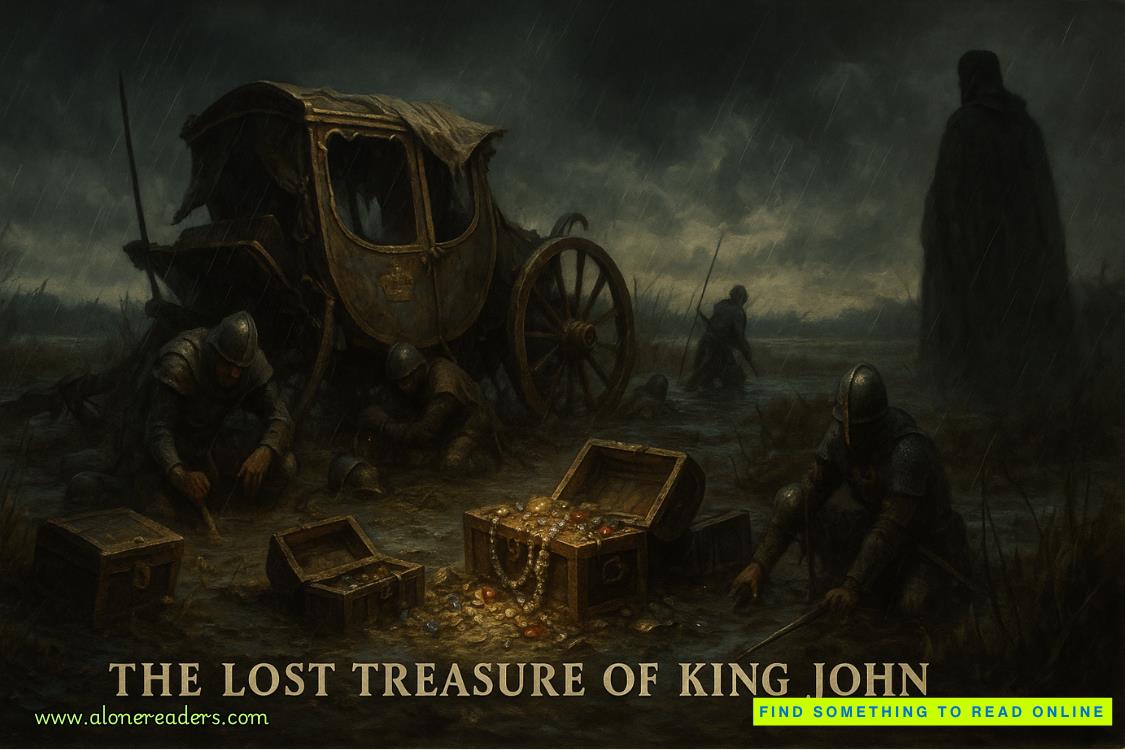
In October 1216, King John traveled from King’s Lynn toward Lincolnshire. His route crossed an area known as The Wash, a vast coastal estuary of mudflats and shifting sands that was notoriously dangerous during high tide. According to historical accounts, King John himself took the safer land route, but his baggage train—carrying the treasure—attempted to cross The Wash directly. It was a grave mistake. The tides were rising faster than expected, and the carts, horses, and guards became trapped in the wet sands and powerful currents. Entire wagons sank. Men and animals perished. The treasure that represented years of royal wealth was swallowed by the landscape, never to be seen again. King John’s health declined rapidly afterward, and within days, he died—some believed from dysentery, others suspected poisoning. His death cemented the treasure’s fate as a legend.
The contents of the lost treasure remain uncertain. No official inventory survived, but historians believe it included royal regalia, rare jewels, personal gifts from European rulers, sacred relics taken from monasteries, and golden goblets used in coronations. There are theories that the treasure contained a fragment of the True Cross, possibly acquired during the Crusades. Some believe manuscripts from the royal archive were lost as well—documents that may have revealed political secrets or land disputes. If those records vanished, their absence may have reshaped English politics for generations. The disappearance of such valuable items raises the question of whether the loss was accidental—or intentionally concealed.
Though the traditional story places the loss in The Wash, alternative theories have emerged. Some scholars argue that the treasure was never lost at all—they believe King John may have staged the event to hide the treasure from his enemies. Others think the local nobles or monks recovered parts of it before the tide came in and secretly distributed it. There are accounts of unusual wealth appearing in certain noble families shortly after 1216, suggesting that parts of the treasure may have quietly resurfaced in private hands. Folklore also claims villagers found gold goblets over the centuries but never dared to reveal them for fear of royal punishment.
Modern technology has brought renewed interest in the mystery. Historians and archaeologists study medieval tidal patterns, erosion maps, and ground-penetrating data to estimate where the treasure could be buried. The Wash has changed dramatically over the past 800 years, making it increasingly difficult to pinpoint any precise location. Some sections have been covered by new layers of sediment; others have eroded away entirely. What might have once been a dry crossing in 1216 could now be several meters beneath water or land. Ground-penetrating radar and LIDAR surveys have been used, but large portions of the area are legally protected wetlands, meaning full excavations are often restricted. The treasure may indeed still be there—but nature continues to guard it.
The psychological impact of losing the treasury was immense. King John was already deeply mistrusted, and the loss made him appear cursed or divinely punished. Some medieval writers claimed the event was God’s judgment for his cruelty and broken promises. Others believed the land itself rejected the king, swallowing his fortune as a warning to future rulers. His death shortly after the disaster only strengthened the myth. Even his burial at Worcester Cathedral could not erase the image of a failed king whose treasure vanished into the earth.
Curiously, the disappearance of the treasure may have shaped England’s future in another way. Without access to the royal wealth, the new leaders following King John had to compromise with the barons. This helped solidify the principles of the Magna Carta, bringing greater accountability to the monarchy. In an indirect sense, the loss of treasure contributed to strengthening English law and limiting royal power. Ironically, what seemed like a disaster for the crown may have cleared the path toward more structured governance.
Today, treasure hunters still dream of uncovering the lost riches. Metal detectors, drones, and satellite imaging are all used in the search. However, no definitive evidence has ever surfaced. Some researchers believe the treasure has decayed or been dispersed into microscopic fragments; others argue that it may still remain untouched beneath layers of silt, perfectly preserved. The Wash continues to shift with every tide, hiding its secrets anew. Each year, amateur explorers request permission to search specific areas, but few gain access. Locals claim strange metallic sounds sometimes echo from underground—but whether this is machinery, natural acoustics, or something else, no one can say for sure.
The lost treasure of King John is far more than a missing fortune. It is a historical puzzle, a cautionary tale, and a symbol of decline. It represents the risks of absolute power, the fragility of leadership, and the unpredictability of nature. Whether it lies beneath the sands or was secretly recovered centuries ago, its true value may no longer be material. It lives as a story—an enduring mystery that enriches the imagination more than any jewel ever could.
Perhaps the treasure is still out there, beneath tidal mud and centuries of silence. Or perhaps it exists only in memory, scattered across legends like fragments of a kingdom that once believed wealth could hold history together. Until the sands give up their secrets, the lost treasure of King John will remain one of England’s most compelling unsolved mysteries—a reminder that power, like gold, can disappear in an instant.



 The Hundred Days Offensive: How the Allies Defeated Germany in World War I
 The Second Battle of the Marne: The Turning Point of World War I in 1918
 The Spring Offensive of 1918: Germany's Final Gamble to Win World War I
 The Treaty of Brest-Litovsk: How Russia Left World War I
 The Russian Revolution and World War I: How War Brought Down the Tsar
 The Zimmermann Telegram Explained: Germany's Secret Offer to Mexico in World War I