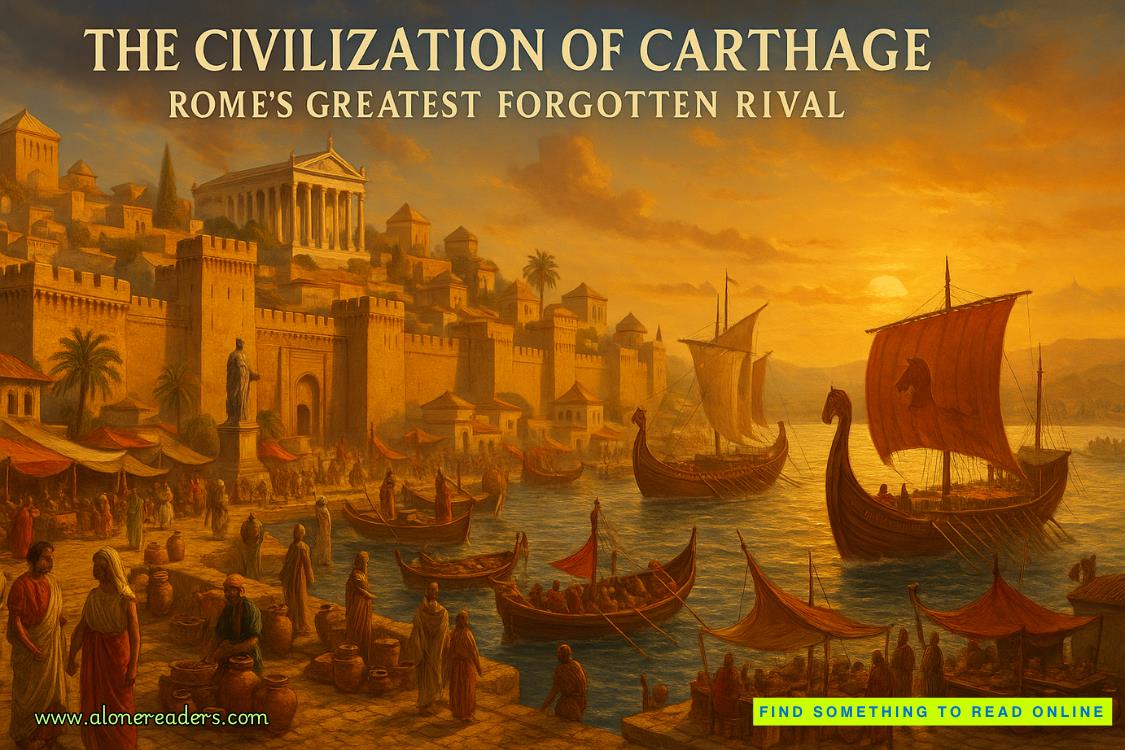
The civilization of Carthage remains one of history’s most powerful yet misunderstood empires, overshadowed by the narratives of ancient Rome. Located in present-day Tunisia, Carthage emerged as a maritime giant and commercial superpower whose influence extended across the Mediterranean. Founded by Phoenician settlers from Tyre, this North African civilization swiftly grew from a trading colony into a dominant state that challenged Greek traders, controlled vast naval routes, and eventually became Rome’s most formidable adversary. Yet despite its significance, Carthage is often remembered only for its defeat. To understand Carthage is to uncover the story of a civilization whose innovations, economy, and military strategy shaped ancient history, only to be almost entirely erased after its destruction.
Carthage was built on seafaring excellence, and its economy revolved around maritime commerce, ship design, and coastal control. Strategically positioned along major trade routes, its harbor became a hub that connected North Africa, Iberia, Sicily, and the Eastern Mediterranean. Archaeological reconstructions of Carthage’s naval power reveal a unique circular military harbor, capable of housing hundreds of ships—something unparalleled in the ancient world. This engineering marvel reflected not only military ambition but also economic sophistication, as Carthaginian traders built business networks with Iberian silver mines, Egyptian grain producers, and Greek artisans. Their shipbuilding methods allowed them to mass-produce vessels rapidly, giving them a strategic advantage during times of war, especially against Rome.
Carthaginian society combined Phoenician traditions with local North African influences, resulting in a complex cultural identity. Their religion was deeply spiritual and revolved around deities such as Baal Hammon and Tanit, representing fertility, prosperity, and protection. Carthaginians believed that the strength of their empire depended on divine favor, and their priests held significant political authority. Rituals were carried out in open-air sanctuaries, and spiritual symbols could be found engraved on everyday items. Their unique funerary practices, terracotta urns, and symbolic amulets reveal a world where religion guided law, trade, family structure, and warfare. Rather than a monolithic state, Carthage was a diverse and culturally adaptive civilization, interacting with Greek, Berber, and Iberian traditions.
Politically, Carthage was not ruled by kings but by a republican-style system that included elected officials, a council of elders, and powerful merchant families. This structure allowed for calculated leadership, particularly in military decisions. Carthage was not a land empire in its early centuries; instead, it mastered economic dominance, preferring trade over territory. However, as Greek city-states and later Rome began to assert dominance, Carthage adapted by developing professional armies and mercenary forces, often hiring Iberians, Berbers, Gauls, and Numidians. This reliance on multicultural military units became both a strength and a vulnerability, especially when loyalty was tested during long campaigns.
The great turning point in Carthage’s history was its conflict with Rome. The Punic Wars, a series of three brutal conflicts, changed the course of Mediterranean history. The First Punic War began as a struggle over Sicily, but it evolved into a naval contest between two rising powers. Rome, inexperienced at sea, rapidly copied Carthaginian ship designs and introduced the corvus, a boarding device that transformed naval warfare into infantry combat—where Romans excelled. Still, Carthage’s maritime experience allowed it to maintain strong resistance. The Second Punic War, however, would immortalize Carthage in history through Hannibal Barca, one of the greatest military strategists the world has ever seen.
Hannibal’s campaign against Rome became legendary for its audacity and tactical brilliance. Crossing the Alps with war elephants and a multicultural army, Hannibal won decisive battles such as Trebia, Lake Trasimene, and the devastating clash at Cannae. At that moment, Rome stood on the brink of collapse. Hannibal employed psychological warfare, maneuver tactics, and knowledge of terrain in ways that baffled Roman generals for years. But despite his genius, Carthage failed to send adequate reinforcements, partly due to political hesitation and logistical limits. Rome eventually adapted, leveraging its vast manpower and resources to repel Hannibal—and ultimately defeat Carthage.
The Third Punic War sealed Carthage’s fate. Rome, driven by economic envy and political fear, launched a final campaign that ended with the complete destruction of Carthage in 146 BCE. The city was burned, its walls demolished, and—according to ancient accounts—the land was symbolically cursed. Though modern scholars doubt the legend of salt being spread over its soil, there is no doubt that Rome attempted to erase Carthage from history. The surviving population was enslaved, libraries were destroyed, and references to Carthaginian achievements were replaced with Roman propaganda. A civilization that once dominated the seas vanished almost entirely from historical memory, preserved mainly through Roman writings that portrayed it as a villainous adversary.
Yet Carthage did not fully disappear. The Romans eventually rebuilt the city as a provincial capital, recognizing its strategic location and agricultural potential. Carthage became an important production center for olive oil, grain, and ceramics. It flourished once again under Roman rule and later became a center of early Christianity in North Africa. This second life of Carthage reveals a crucial truth: the city's foundations were so strong that even its conquerors could not ignore its importance. The spirit of Carthage lived on, shaping trade, governance, and culture in subtle but lasting ways.
Modern research has shed new light on Carthaginian achievements, revealing advanced agricultural systems, hydraulic engineering, urban planning, and metallurgy. Their methods of terracing hillsides and storing rainwater inspired later innovations in Roman and Islamic agriculture. Their glasswork, dyes, and metal tools demonstrate high craftsmanship. Their harbor design influenced naval architecture for centuries. Though Roman writers depicted Carthage as cruel and uncivilized, ongoing archaeology paints a different picture—one of efficiency, innovation, and adaptability.
Perhaps the greatest lesson of Carthage is how powerful civilizations can be erased—not because they failed, but because they were defeated by a superior narrative. Rome not only conquered Carthage militarily but also shaped how future generations would remember it. History is not just about events; it is about storytellers. Carthage stood as a shining example of maritime power, commercial ingenuity, cultural diversity, and strategic thinking—yet its legacy was buried beneath the triumph of Rome. Today, as historians revisit forgotten civilizations, Carthage emerges once more as a critical force in shaping antiquity, proving that forgotten rivals often hold the keys to understanding the greatness of their conquerors.
The civilization of Carthage deserves recognition not only as Rome’s adversary but as a pioneer of Mediterranean commerce, naval strategy, and political governance. Its downfall reminds us that even the most powerful societies can be erased if their story is left untold. To study Carthage is to rediscover a world that shaped empires, altered warfare, expanded trade, and influenced the cultures that followed. Through renewed understanding, Carthage can finally return from the shadows of history—no longer as a defeated enemy, but as a civilization whose brilliance demanded respect, whose legacy influenced the ancient world, and whose spirit remains alive in the foundations of modern Mediterranean culture.
In the end, Carthage was not merely Rome’s enemy. It was Rome’s greatest mirror—reflecting its fears, ambitions, and emerging power. And in that mirror, we see the true measure of Carthage—not as a forgotten civilization, but as one whose memory continues to shape our understanding of empire, legacy, and human resilience.



 The Hundred Days Offensive: How the Allies Defeated Germany in World War I
 The Second Battle of the Marne: The Turning Point of World War I in 1918
 The Spring Offensive of 1918: Germany's Final Gamble to Win World War I
 The Treaty of Brest-Litovsk: How Russia Left World War I
 The Russian Revolution and World War I: How War Brought Down the Tsar
 The Zimmermann Telegram Explained: Germany's Secret Offer to Mexico in World War I










