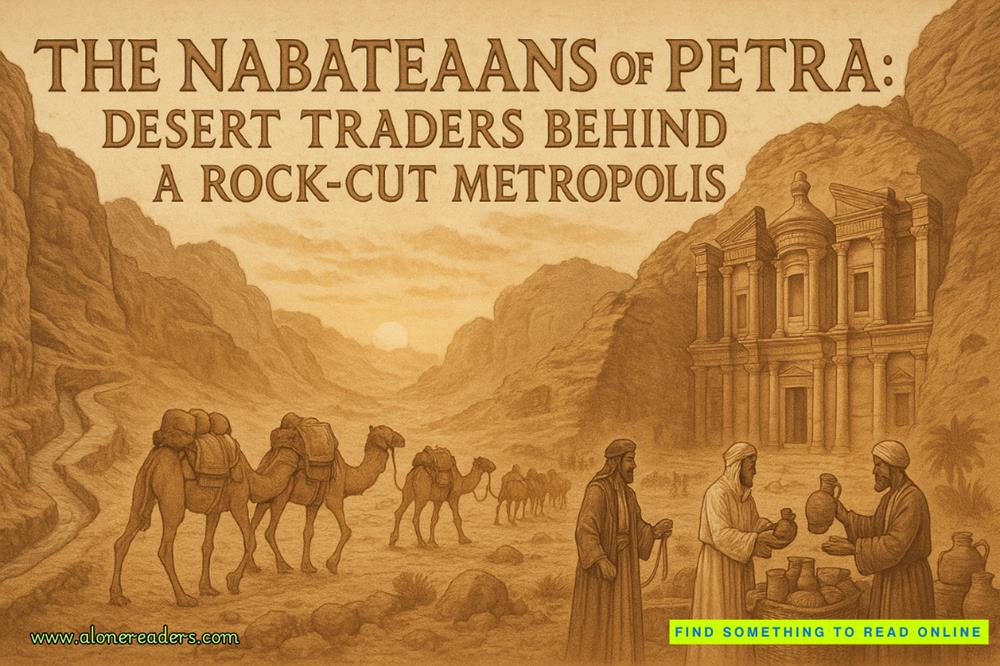
The ancient city of Petra rises dramatically from the sands of southern Jordan, its colossal monuments carved directly into rose-red cliffs. Behind this extraordinary site stood the Nabataeans—a brilliant yet mysterious civilization that transformed a barren desert into a thriving commercial powerhouse. Known for their ability to harness water in one of the driest regions on Earth and to dominate global trade routes, these people built a rock-cut metropolis that dazzled travelers for centuries. Yet today, their story is largely forgotten, and only silent sandstone walls remain to speak for them. The Nabataeans were not just builders; they were strategists, merchants, engineers, and cultural mediators between the great civilizations of their time. The story of Petra is not simply architectural—it is the tale of how trade, geography, and ingenuity shaped a desert empire.
The origins of the Nabataeans are wrapped in uncertainty, but historians believe they were nomadic Arab tribes who migrated north from the Arabian Peninsula around the 6th century BCE. Unlike typical nomads, they adapted quickly to the harsh desert environment and mastered the art of mobility and survival. Petra, nestled within a maze of mountains and accessible only through narrow gorges like the Siq, was the perfect natural fortress. It allowed the Nabataeans to remain discreet and secure while controlling major trade routes that linked Arabia, Egypt, Mesopotamia, and the Mediterranean. They knew that power did not always come from armies—it could also come from controlling resources and connections. Their rise was not based on conquest but on economic intelligence. They saw opportunity in the desert where others saw desolation.
The Nabataeans became extremely wealthy by dominating commerce in valuable goods such as frankincense, myrrh, spices, textiles, bitumen, and precious metals. Caravans of camels traveled thousands of kilometers across dangerous terrains, guided by Nabataean expertise. Petra was not merely a city—it was a hub where cultures met, deals were struck, and taxes were collected. The Nabataeans perfected the art of trade diplomacy, establishing agreements with neighboring powers and ensuring that their merchants remained safe. Instead of building armies, they built alliances. Instead of invading nations, they connected them. Their influence stretched far beyond their borders, and their control over trade made them indispensable to the ancient world.
However, wealth alone could not sustain Petra. Survival in the desert demanded mastery of water, the most precious commodity of all. The Nabataeans developed an astonishing water management system that modern engineers still admire. They carved channels into cliffs, created ceramic pipelines, and designed terraced catchment systems to gather rainwater. They built covered cisterns to prevent evaporation and even directed floodwaters into reservoirs for future use. Through a mixture of gravity and precision engineering, they ensured that their city flourished even during droughts. Their understanding of hydraulics was not primitive—it was advanced science adapted to nature. Petra was not simply carved into rock; it was crafted to endure.
Their architectural achievements reflect an impressive fusion of cultural influences. Walking through Petra is like traversing a gallery of ancient civilizations. One can see Hellenistic façades, Egyptian motifs, Mesopotamian symbolism, and Arabian artistic traditions—all blended into a unique Nabataean identity. The most iconic structure is Al-Khazneh, the Treasury, which soars 40 meters high and features Corinthian columns, sculpted friezes, and intricate details carved directly into sandstone. Yet behind the beauty lies symbolism: this was not merely decoration, but a statement of political and economic confidence. Nearby, towering tombs, ceremonial halls, and possibly a royal palace demonstrate that Petra was not a hidden settlement—it was meant to impress visitors and intimidate rivals.
Religion in Nabataean society was equally intriguing. Their chief deity, Dushara, was often represented not by human form but by simple stone blocks, indicating an abstract spiritual philosophy rather than anthropomorphic gods. They also worshipped al-‘Uzza, a goddess linked to fertility and protection. Religious spaces were often aligned with astronomical markers, suggesting a deeper relationship between spirituality and celestial observation. Their temples were not just places of worship—they were astronomical instruments, calendars, and centers of community life. In some ways, the Nabataeans were spiritual engineers, shaping belief with architecture.
Despite their prosperity, the Nabataeans were rarely militarily aggressive. Their strategy relied on invisibility and adaptability. When empires clashed around them, they remained neutral and profitable. This flexible diplomacy helped them survive for centuries. Yet eventually, Rome took notice. In 106 CE, the Nabataean Kingdom was peacefully annexed by the Roman Empire under Emperor Trajan. Petra continued to prosper for some time, but slowly, Rome built alternative trade routes, particularly sea routes that bypassed Petra entirely. As commerce shifted away from the desert, Petra’s lifeline began to fade. The city grew quieter, its economy weakened, and eventually, its people dispersed. The once-bustling rock metropolis was abandoned.
A powerful yet tragic mystery then emerged: Why did the Nabataeans vanish so suddenly? Some suggest that earthquakes damaged water systems, while others argue that the decline in trade destroyed the economy. Another theory proposes gradual assimilation into Roman society. Yet the most haunting possibility is that the Nabataeans left deliberately, dissolving back into nomadic life. Their disappearance is not marked by war or destruction—it is marked by silence. Nature reclaimed their stone city, and the winds of the desert erased their footprints.
Today, Petra stands as a monumental paradox: simultaneously known and unknown, preserved yet abandoned, magnificent yet silent. Millions visit every year, but few understand the genius behind its creation. The Nabataeans did not merely build a city; they designed a thriving ecosystem within one of the harshest environments on Earth. They demonstrated that knowledge of trade, mastery of water, and control of geography could be as powerful as any army. Their civilization proves that power does not always roar—it can whisper through stone.
What makes the Nabataeans truly extraordinary is not just their engineering or diplomacy, but their mindset. They embraced flexibility over rigidity, cooperation over conflict, and adaptation over domination. They flourished not by conquering others but by understanding them. Their civilization did not die violently; it faded when the world around them changed. Yet their imprint on history remains profound, carved into rock and preserved by desert winds.
The legacy of the Nabataeans teaches us that empires can rise from the sand—not through force, but through intelligence. Petra stands as a testament to human adaptability, creativity, and strategic brilliance. Though they vanished, their achievements remain alive in the crimson stone of southern Jordan, where sunlight paints the cliffs in gold at dawn, and silence carries the memory of a people who turned desert into destiny. The Nabataeans may be gone, but their rock-cut city still speaks—to anyone who listens—not of collapse, but of extraordinary resilience and ingenuity.



 The Hundred Days Offensive: How the Allies Defeated Germany in World War I
 The Second Battle of the Marne: The Turning Point of World War I in 1918
 The Spring Offensive of 1918: Germany's Final Gamble to Win World War I
 The Treaty of Brest-Litovsk: How Russia Left World War I
 The Russian Revolution and World War I: How War Brought Down the Tsar
 The Zimmermann Telegram Explained: Germany's Secret Offer to Mexico in World War I










