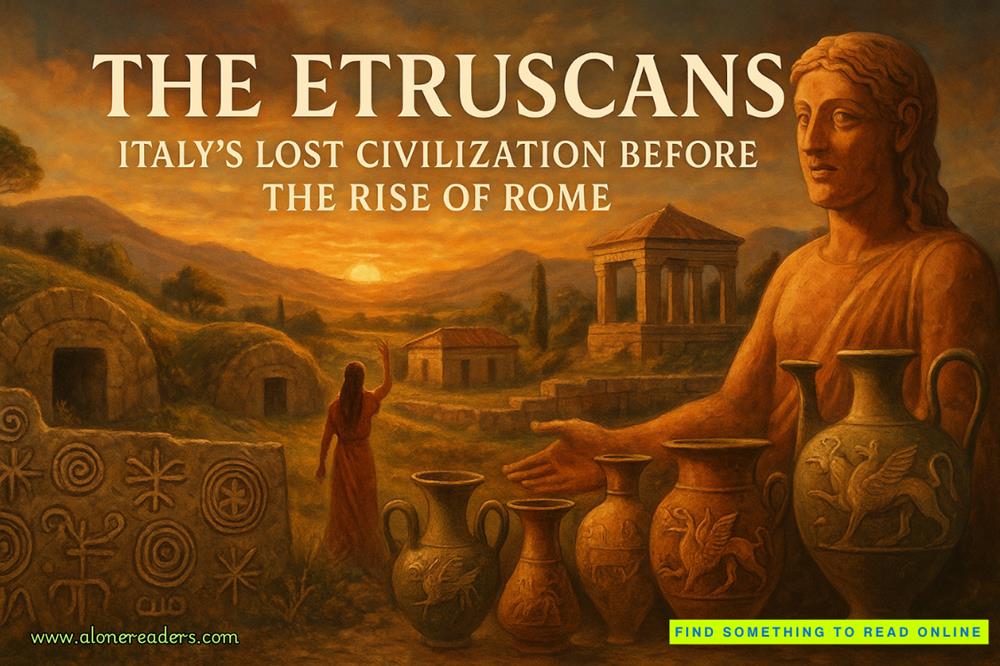
The history of ancient Italy is often told through the grandeur of Rome, yet before Rome’s ascent, a powerful and sophisticated civilization shaped the land—the Etruscans. Emerging around the 8th century BCE, the Etruscans built a thriving culture that influenced Roman religion, engineering, politics, and art. Their achievements were vast, but their legacy was nearly erased after Rome absorbed their territories. What remains, however, is a civilization shrouded in mystery, innovation, and cultural brilliance, often described as Italy’s lost civilization. The question that continues to fascinate historians is not only who they were—but how such a remarkable society vanished from history.
The Etruscans lived in a region known as Etruria, covering much of modern-day Tuscany, parts of Umbria, and northern Lazio. Their cities developed independently yet shared a cultural identity rooted in spirituality, engineering skill, and artistic refinement. They were not primitive tribes; rather, they established planned urban settlements, complex trade networks, advanced metallurgy, and elaborate religious rituals. Long before Rome rose to power, the Etruscans dominated central Italy and even formed political alliances known as the Etruscan League—a federation of twelve influential city-states cooperating on religion and governance.
One of the most debated questions is the origin of the Etruscans. Some theories suggest they migrated from Asia Minor, while others propose that they were indigenous to Italy. Their language remains partially undeciphered, unlike Latin or Greek, contributing to the aura of mystery surrounding their civilization. Their inscriptions reveal fragments of their identity, but scholars still struggle to reconstruct a full understanding of their grammar and vocabulary. This linguistic barrier is one of the main reasons why the Etruscans are often called Europe’s most enigmatic ancient culture.
Trade and economy played essential roles in Etruscan expansion. They were master sailors, navigating the Mediterranean to trade with Greeks, Phoenicians, and Carthaginians. Their land was rich in iron, copper, and precious minerals, enabling them to develop exceptional metalworking techniques. Etruscan artisans produced high-quality bronze mirrors, jewelry, ceremonial weapons, and pottery, which were highly valued across ancient Europe. Their maritime strength was not merely commercial—it was also strategic. For decades, they controlled crucial ports and coastlines, making Etruria a dominant economic power.
A striking feature of Etruscan society was its class structure and social sophistication. Unlike many contemporary civilizations, Etruscan women enjoyed high social status. They participated in banquets, owned property, and appeared alongside men in public artistic depictions—something completely foreign to Greek and early Roman customs. The concept of family, lineage, and ancestry was deeply respected, with tomb inscriptions often preserving the names of both parents, signaling a society with strong family identity and rights.
Perhaps the most enduring legacy of the Etruscans lies in their religious system, which profoundly shaped later Roman beliefs. They believed the universe was governed by divine signs—lightning, bird movements, omens—all of which could be interpreted by trained priests called haruspices. These priests examined animal organs, especially the liver, to predict the will of the gods. This practice was later adopted by the Romans and became central to state decision-making. The Roman Senate itself used Etruscan religious methods before wars, political decisions, and major infrastructure projects. The Etruscan worldview was deeply spiritual, seeing the natural world as a living matrix of divine messages. It is no exaggeration to say that Rome learned to speak to the gods through the Etruscans.
The architecture and engineering of the Etruscans also laid foundations for Roman urban development. They mastered arch construction, hydraulic engineering, city planning, and underground drainage systems. The famed Roman arch—later used in aqueducts, bridges, and monumental architecture—was first perfected by the Etruscans. Their tombs, carved into rock or constructed as monumental underground chambers, reveal their engineering prowess. These tombs were not simple graves; they were houses for the dead, complete with beds, dining areas, and murals depicting daily life. Their burial practices demonstrate how the Etruscans viewed death not as an end but a transition into another realm.
Religion and politics were often intertwined. Etruscan city-states were governed by kings and later by magistrates, but nearly every political decision involved ritual consultation. Their cities were often positioned on elevated ground, both for defense and religious reasons. The sacred boundaries of a city—known as templum—influenced later Roman urban planning. Even the Roman concept of the augur, the priest who observed birds to interpret the will of the gods, originates from Etruscan tradition. In this way, Etruscan belief systems became the spiritual backbone of Roman civilization.
However, the rise of Rome marked the gradual decline of Etruscan power. By the 4th century BCE, Roman expansion began to erode Etruscan dominance. One by one, their cities were absorbed, their language replaced, and their customs adapted to Roman culture. Yet much of early Roman royalty was heavily influenced by Etruscan norms. Several early Roman kings—such as Tarquinius Priscus and Tarquinius Superbus—were of Etruscan descent. These rulers introduced political symbolism, military organization, and construction methods that later became core features of Roman civilization. In many ways, Rome did not defeat the Etruscans—it became their successor.
The Etruscans also left a legacy in art. Their frescoes, bronze sculptures, and pottery often depicted lively banquets, dancers, athletes, and mythological scenes. They portrayed humans with expressive features, capturing emotion and everyday life in a way that prefigured later Roman realism. Their tomb paintings, particularly in Tarquinia, reveal not only artistic talent but emotional depth. Rather than depicting death as frightening, they illustrated joy, music, and feasting—suggesting a culture that embraced life while honoring death.
Despite their disappearance, evidence of their civilization remains scattered beneath Italian soil. Archaeological discoveries from Volterra, Cerveteri, Tarquinia, and Veii reveal a world that was socially advanced, religiously complex, and artistically brilliant. Nonetheless, much remains unknown, especially due to the loss of their literature. They likely produced historical accounts, ritual manuals, and philosophical works, but almost all have vanished. We know the Romans preserved fragments of Etruscan religious texts, but their broader intellectual contributions faded as Latin took dominance.
Why did such a powerful culture collapse? Several reasons appear likely. First, the rise of Rome—militarily and politically—slowly absorbed their cities. Second, internal competition among the city-states weakened unity. Third, the lack of a strong centralized government made it difficult to resist Rome’s structured expansion. And finally, cultural assimilation played a major role, as Etruscan elites gradually adopted Roman customs to maintain influence, ultimately dissolving their identity into the Roman world.
Yet, the Etruscans were never truly forgotten. Rome carried their legacy forward in law, religion, architecture, and urban planning. Even today, Italian place names, family symbols, and local customs echo Etruscan traditions. While their language may remain largely undeciphered, the impact of their civilization is embedded in the foundations of Italy itself. Their world may have faded, but their influence endured in the very empire that replaced them.
The story of the Etruscans is not simply one of disappearance—it is one of transformation. They may not have survived as a distinct civilization, but their spirit lived on through Rome, and through Rome, shaped the Western world. Understanding the Etruscans allows us to see ancient Italy not only as the land of Roman power, but as a cradle of innovation where a remarkable civilization quietly set the stage for one of history’s greatest empires. The Etruscans were not just Italy’s past—they are its hidden foundation, waiting to be rediscovered beneath the soil, in the stones, and in the echoes of forgotten rituals.
In the end, their disappearance remains one of history’s intriguing puzzles, but their achievements still speak. The Etruscans remind us that great civilizations can vanish—yet leave behind legacies that shape the future in ways they never imagined.



 The Hundred Days Offensive: How the Allies Defeated Germany in World War I
 The Second Battle of the Marne: The Turning Point of World War I in 1918
 The Spring Offensive of 1918: Germany's Final Gamble to Win World War I
 The Treaty of Brest-Litovsk: How Russia Left World War I
 The Russian Revolution and World War I: How War Brought Down the Tsar
 The Zimmermann Telegram Explained: Germany's Secret Offer to Mexico in World War I










