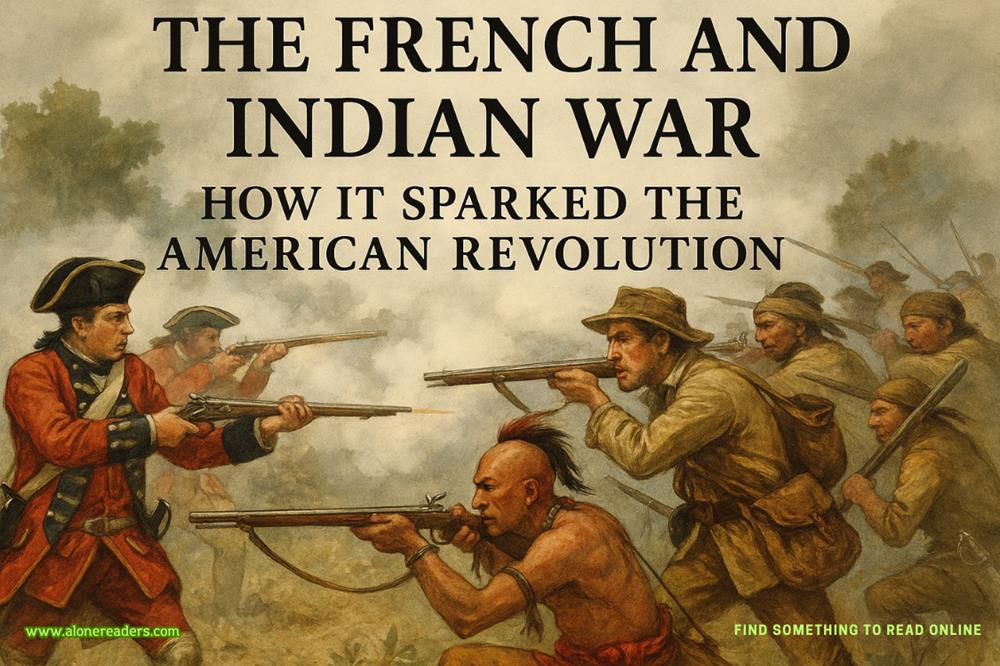
The French and Indian War, fought between 1754 and 1763, was not just a struggle for territory between Britain and France—it was the event that laid the foundation for the American Revolution. Known globally as part of the Seven Years’ War, this North American conflict pitted British and colonial forces against the French and their Native American allies. Although the British emerged victorious, the consequences of this war extended far beyond the battlefield, influencing the political, economic, and social conditions that would push the American colonies toward independence.
The war began over disputed claims in the Ohio River Valley, an area rich in resources and strategically vital for expansion. Both Britain and France sought to control the lucrative fur trade and secure military dominance in the region. The French built a series of forts to defend their territory, while British colonial interests, backed by settlers and land speculators, moved aggressively westward. Clashes quickly escalated into open warfare, with young George Washington’s failed expedition in 1754 marking one of the first major incidents.
For much of the early fighting, the French had the advantage. Their alliances with Native American tribes, such as the Huron and Algonquin, gave them crucial knowledge of the terrain and effective guerrilla warfare tactics. The British, by contrast, initially struggled due to rigid European military strategies unsuited for North American conditions. However, the tide began to turn after 1757 when William Pitt, Britain’s Secretary of State, shifted resources and strategy, focusing heavily on the North American front and committing substantial military support.
Key victories, such as the capture of Louisbourg in 1758 and the decisive Battle of Quebec in 1759, broke French resistance. By 1763, the Treaty of Paris ended the war, forcing France to cede most of its North American holdings to Britain. Britain gained control of Canada and Florida, while France transferred Louisiana to Spain. At first glance, this was an overwhelming British triumph, yet the cost of victory would sow the seeds of discontent in the colonies.
The war had been expensive—so costly, in fact, that Britain’s national debt nearly doubled. To recoup expenses, London looked to the American colonies, reasoning that they had directly benefited from the war and should share the burden of its costs. The British Parliament began imposing taxes and trade regulations, such as the Sugar Act of 1764 and the Stamp Act of 1765. While these measures were intended to raise revenue, they provoked intense colonial opposition. The slogan “No taxation without representation” emerged as a rallying cry, reflecting resentment over laws passed in a distant Parliament where colonists had no elected voice.
The war also transformed colonial attitudes. Before the conflict, many colonists identified strongly as British subjects, proud to be part of the empire. The shared struggle against the French, however, exposed tensions between British regulars and colonial militias. British officers often viewed colonial troops as poorly disciplined, while colonists resented the condescension of British commanders. The Proclamation of 1763, issued after the war to prevent further conflict with Native Americans, forbade settlement west of the Appalachian Mountains. For colonists eager to expand into newly acquired lands, this was seen as a betrayal of the sacrifices they had made during the war.
Additionally, the removal of the French threat changed the colonies’ relationship with Britain. For decades, British colonial policy had been loosely enforced, allowing a degree of self-governance. With France gone, many colonists questioned the need for a strong British military presence or heavy-handed control. This sense of autonomy clashed with Britain’s post-war efforts to tighten imperial administration, setting the stage for a political showdown.
The war also had significant consequences for Native American nations. The balance of power that had existed between European powers and indigenous tribes collapsed with the French defeat. Without French support, many Native groups faced increasing pressure from British settlers and land-hungry colonists. Pontiac’s Rebellion in 1763 was one direct result—a widespread uprising by Native Americans determined to resist British encroachment. Although ultimately suppressed, it prompted the British to maintain a standing army in America, further inflaming colonial suspicion.
In the broader Atlantic world, the French and Indian War shifted the geopolitical balance. France’s loss in North America weakened its global influence, but the desire for revenge against Britain would later inspire French support for the American Revolution. Spain’s acquisition of Louisiana provided a temporary buffer against British expansion, but it too would eventually clash with British interests.
By the 1770s, the echoes of the war could be heard in every colonial grievance. The economic strain, political disputes, and social changes unleashed by the French and Indian War had fundamentally altered the relationship between Britain and its colonies. What began as a battle over frontier territory had evolved into a profound struggle over the meaning of British liberty and the rights of colonists.
When the first shots of the American Revolution were fired in 1775, they were the culmination of more than a decade of mounting tensions—tensions rooted directly in the outcomes of the French and Indian War. The war had expanded the British Empire to unprecedented size, but it had also exposed fault lines that could not be easily repaired. By reshaping the map of North America and redefining the bonds of empire, the French and Indian War truly was the prelude to revolution.



 The Hundred Days Offensive: How the Allies Defeated Germany in World War I
 The Second Battle of the Marne: The Turning Point of World War I in 1918
 The Spring Offensive of 1918: Germany's Final Gamble to Win World War I
 The Treaty of Brest-Litovsk: How Russia Left World War I
 The Russian Revolution and World War I: How War Brought Down the Tsar
 The Zimmermann Telegram Explained: Germany's Secret Offer to Mexico in World War I