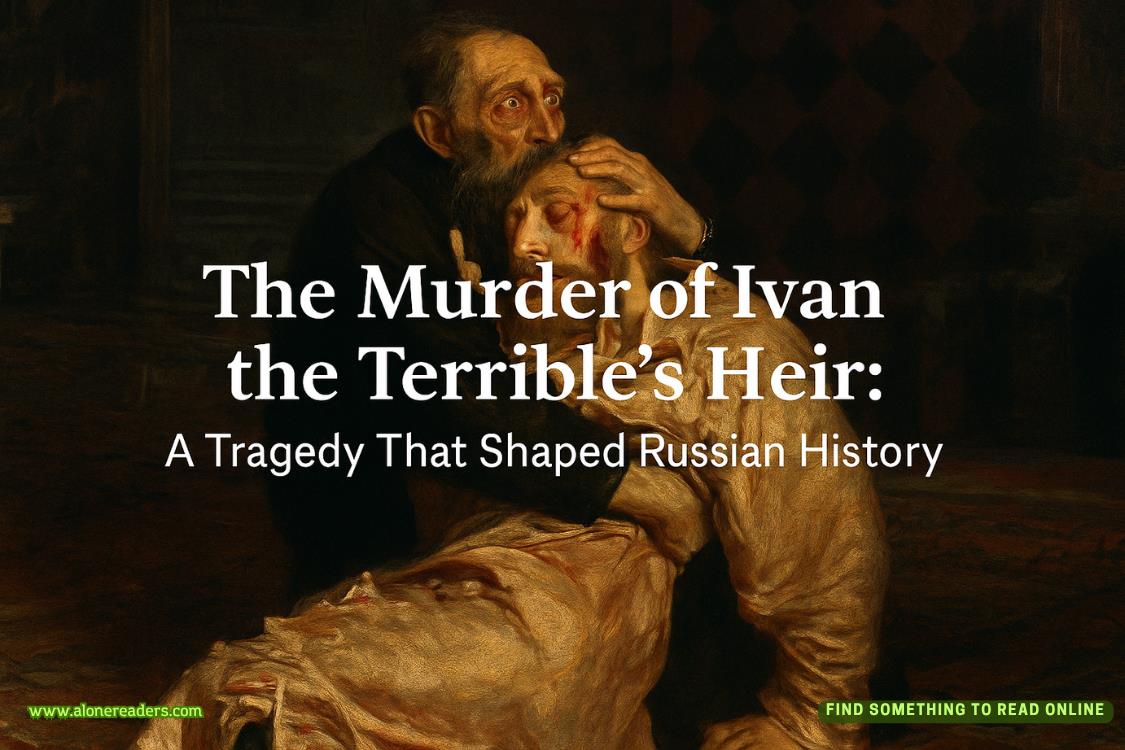
The death of Tsarevich Ivan Ivanovich, the eldest son and heir of Ivan IV Vasilyevich—better known as Ivan the Terrible—remains one of the most infamous tragedies in Russian history. Occurring in November 1581, this event not only extinguished the direct line of succession to the Russian throne but also marked the beginning of a national crisis that would shape the fate of Russia for generations. Historians continue to debate whether the young tsarevich’s death was accidental or the result of his father’s violent temper. What is certain is that this moment of royal bloodshed fundamentally altered the course of Russian statehood.
Ivan IV, Russia’s first crowned Tsar, was a ruler of extremes—both visionary and tyrant. His early years were marked by reforms, centralization of power, and expansion of the Russian state. However, his later reign descended into paranoia, cruelty, and terror. The establishment of the Oprichnina, a separate administrative and military force loyal only to him, unleashed waves of repression, executions, and massacres. Under his rule, thousands were tortured or killed as he sought to root out perceived traitors among nobles and commoners alike. By the 1570s, Ivan was isolated, consumed by suspicion, and increasingly unstable—a ruler who saw betrayal even within his own family.
The tsarevich, Ivan Ivanovich, born in 1554, was a figure of promise and tragedy. Intelligent, pious, and admired by foreign diplomats for his composure and intellect, he represented the best hope for Russia’s future. He shared his father’s zeal for governance and often served as his deputy in military affairs. However, the relationship between father and son was strained by the elder Ivan’s growing paranoia. The tsar’s suspicion extended even to those closest to him, and as the young prince matured into a confident and popular leader, Ivan the Terrible began to perceive him as a potential rival rather than an heir.
The fatal incident that ended the tsarevich’s life reportedly took place in the Kremlin in 1581. According to most contemporary accounts, Ivan the Terrible struck his son in a fit of rage, causing a mortal head wound. The event was triggered by a violent argument concerning the tsarevich’s pregnant wife, Yelena Sheremeteva. She had been found wearing “immodest” clothing by Ivan IV, who, furious at what he perceived as indecency in the royal household, beat her brutally—causing her to miscarry. When the tsarevich confronted his father and reproached him for his cruelty, Ivan’s fury erupted. In the heat of the moment, the tsar struck his son on the head with his heavy iron-tipped staff. Horrified by what he had done, Ivan reportedly tried to stop the bleeding and called for doctors, but the wound was fatal. The tsarevich died a few days later, leaving his father devastated.
Eyewitness accounts of the event come primarily from foreign sources, especially the papal legate Antonio Possevino, who was in Moscow at the time. Possevino described the tsar’s anguish and remorse, noting that Ivan wept over his son’s body, crying, “I have killed my son! I have destroyed my heir!” Yet, the reliability of these accounts has long been debated. Russian chronicles from the period are sparse and heavily influenced by censorship, and some historians suggest the story was exaggerated or mythologized over time to emphasize the tsar’s brutality. Nonetheless, the emotional power of the tale—and its political implications—cannot be overstated.
Whether accidental or deliberate, the death of Ivan Ivanovich left Russia in a precarious position. The tsarevich’s younger brother, Feodor Ivanovich, became heir to the throne, but he was weak in both health and leadership. Feodor’s reign (1584–1598) marked the formal end of the Rurik dynasty that had ruled Russia for over seven centuries. Childless and passive, Feodor delegated most state affairs to his brother-in-law, Boris Godunov. After Feodor’s death, Godunov seized the throne, but his rule ushered in instability and rebellion, leading eventually to the Time of Troubles—a period of civil war, famine, and foreign invasion. It was a national nightmare that stemmed directly from the fateful blow Ivan the Terrible delivered to his own bloodline.
The story of the tsarevich’s murder became one of the most potent symbols of autocratic madness in European history. Western chroniclers seized on the tale to portray Ivan IV as the epitome of tyranny and savagery, contrasting the violence of Muscovite rule with the supposed civility of Western monarchies. For Russian thinkers and artists, the event became a haunting meditation on guilt, power, and divine punishment. The most famous artistic interpretation came centuries later in Ilya Repin’s 1885 painting Ivan the Terrible and His Son Ivan on November 16, 1581. The painting depicts the tsar cradling his dying son, his eyes wide with horror and grief, the bloody wound still fresh. The intensity of the image captured the tragedy’s enduring psychological depth and served as a powerful critique of unchecked authority.
Repin’s painting itself was controversial. When first exhibited, it was attacked by conservative critics who saw it as an insult to the Russian monarchy. Tsar Alexander III even banned it temporarily, fearing it would incite anti-autocratic sentiment. Yet, for many Russians, the image symbolized the destructive nature of tyranny and the human cost of absolute power. In the centuries since, it has become an enduring cultural icon—a representation of both personal and national tragedy.
Modern historians have revisited the story with a more critical eye. Some have suggested that Ivan Ivanovich might have died from illness rather than violence, pointing to inconsistencies in early sources and the lack of definitive forensic evidence. Others note that Ivan the Terrible’s relationship with his son, while tense, was not uniquely hostile by the standards of sixteenth-century monarchies, where violent tempers were not uncommon. Yet, even if the literal truth remains uncertain, the symbolic truth endures: the death of the heir encapsulates the collapse of a dynasty and the psychological unraveling of a ruler who had once sought to elevate Russia to greatness.
Psychological interpretations of the event highlight the tragic duality of Ivan IV’s personality. He was a man torn between genuine religious devotion and uncontrollable fury. His letters to monasteries reveal a tormented conscience, haunted by the belief that his violent acts were sins against God. In killing his own son, Ivan seemed to fulfill a prophecy of self-destruction—a ruler consumed by the same terror he unleashed upon his nation. His grief after the event was profound. Witnesses describe him as aging rapidly, retreating into solitude and spiritual despair. His death just three years later, in 1584, seemed the final act of a life defined by both divine ambition and human failure.
The murder—or alleged murder—of Ivan the Terrible’s heir thus stands as a turning point in Russian history, where the personal tragedy of a royal family became inseparable from the destiny of an empire. It revealed the fragility of autocracy, the perils of absolute power, and the devastating consequences of rule driven by paranoia rather than wisdom. In many ways, Russia’s subsequent centuries of political turmoil—from the Time of Troubles to the revolutions of the twentieth century—echoed this primal wound in its national memory: a ruler who destroyed his own legacy with his own hands.
Even today, the story resonates as a cautionary tale about the corrupting effects of fear and control. It reminds us that history’s most tragic moments are often born not from hatred but from love twisted by power. In Ivan the Terrible’s blow against his son, we see both the brutality of a tyrant and the anguish of a father—a moment where human weakness altered the destiny of a nation.



 The Hundred Days Offensive: How the Allies Defeated Germany in World War I
 The Second Battle of the Marne: The Turning Point of World War I in 1918
 The Spring Offensive of 1918: Germany's Final Gamble to Win World War I
 The Treaty of Brest-Litovsk: How Russia Left World War I
 The Russian Revolution and World War I: How War Brought Down the Tsar
 The Zimmermann Telegram Explained: Germany's Secret Offer to Mexico in World War I