Humanity’s timeline has always been drawn around agriculture. The shift from mobile foragers to settled farmers is often called the dawn of civilization, a transformation believed to have birthed religion, art, and architecture. Yet in the dusty plains of southeastern Turkey, near the ancient city of Şanlıurfa, stands an archaeological site that shattered this narrative. Göbekli Tepe—the “Potbelly Hill”—is not only one of the oldest known human-made religious complexes in the world but also a monument that pre-dates agriculture by nearly 6,000 years. Built at around 9600 BCE, during the transition from the Paleolithic to the Neolithic age, Göbekli Tepe defies every assumption about the developmental order of civilization. It was constructed not by farmers, but by hunter-gatherers—people still dependent on wild game and foraging. This discovery has forced archaeologists to completely rethink what human societies were capable of before the rise of agriculture.
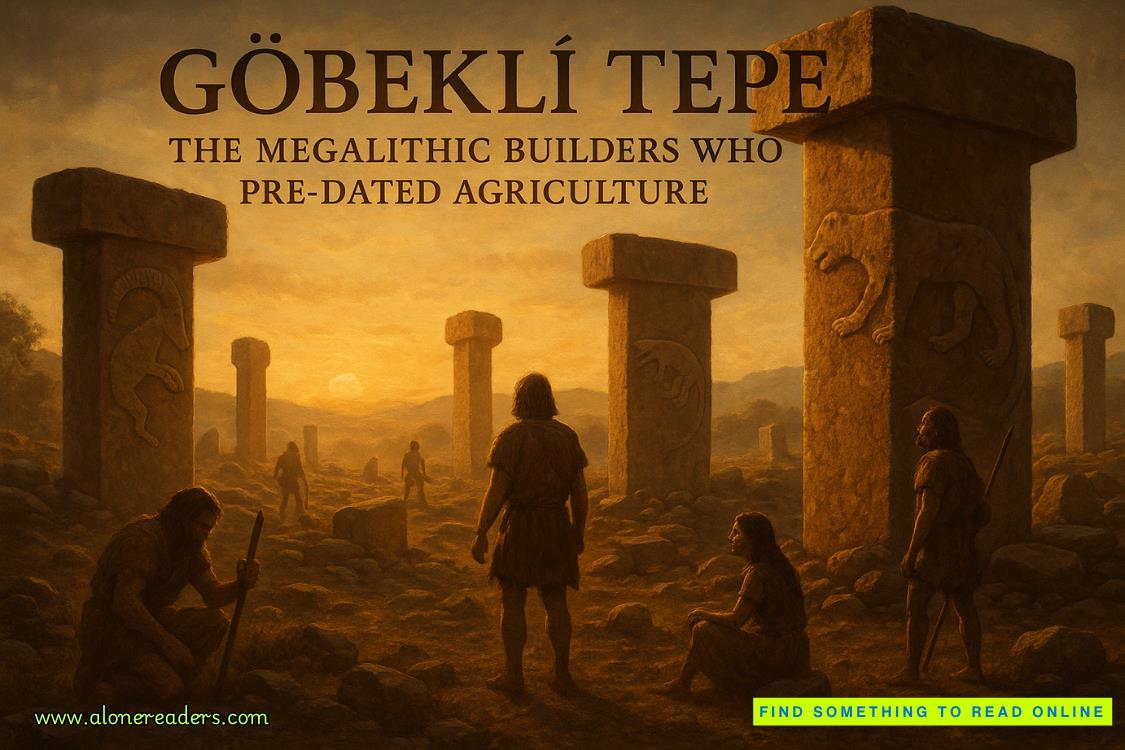
When excavations began in the mid-1990s, the team expected to uncover a modest village or a Neolithic settlement. Instead, they found vast stone enclosures buried deliberately beneath the earth. The architecture was monumental: circular enclosures spanning up to 20 meters across, lined with towering, T-shaped limestone pillars weighing between 10 and 20 tons each. Each pillar was shaped with precision and often carved with bas-reliefs of snakes, foxes, boars, vultures, and scorpions. Some of these carvings seemed to tell symbolic or even mythological stories, weaving animals and abstract signs into a ritualistic language of their own. The sophistication was staggering for a community that had not yet domesticated animals or cultivated crops. The builders of Göbekli Tepe were still living in a pre-agricultural world, yet they mobilized immense labor forces to create temples of extraordinary complexity.
The enigma of Göbekli Tepe’s builders centers on the question: why did hunter-gatherers build something so vast, with such clear ritual significance? Archaeologists believe the site functioned as a ceremonial or religious center—a communal space where scattered bands of foragers gathered for sacred rites, social exchange, and cooperation. The monumental scale and artistic expression suggest that spiritual beliefs united different groups under a shared vision, possibly tied to death, the afterlife, or seasonal cycles. This spiritual impulse may have been the catalyst for civilization itself. In other words, religion might have preceded agriculture, not the other way around. The desire to create sacred architecture could have motivated the organization and social cooperation that later gave birth to farming.
The builders of Göbekli Tepe operated in a world entirely different from the one agriculture later shaped. The region around modern Şanlıurfa during the tenth millennium BCE was fertile, teeming with gazelles, wild wheat, and barley. It is plausible that these hunter-gatherers took advantage of abundant natural resources to sustain large gatherings. Thousands of people likely participated in feasts and rituals held on this sacred plateau. Evidence of large quantities of animal bones, particularly from wild game, suggests that these gatherings involved elaborate communal ceremonies where meat, drink, and mysticism mingled. This social glue, formed around shared rituals, might have been the engine that first drove social complexity in human history.
What makes Göbekli Tepe even more perplexing is the level of craftsmanship displayed in each architectural detail. The limestone blocks were quarried using simple stone tools, yet cut with astonishing precision. The T-shaped pillars, often anthropomorphic in design, bear finely engraved hands, belts, and loincloths, implying they represented stylized human figures—perhaps ancestors, deities, or mythological beings. The symbolism is potent. The upright stones facing inward toward each other in pairs appear to form ritual spaces meant for specific ceremonies, possibly organized around cosmological beliefs. This deliberate orientation and pairing evoke a world that already understood symbolism, ritual, and meaning long before written language existed.
Burial practices add further depth to the site’s spiritual aura. Beneath some pillars, archaeologists found fragments of human skulls, seemingly modified and displayed during rituals. This suggests the presence of complex belief systems involving ancestor worship or a form of skull cult, a feature shared with contemporaneous Levantine sites. The concept of decorating or preserving skulls likely symbolized a connection with the dead—acknowledging lineage, memory, and perhaps divine mediation. The pillars standing around these remains symbolically anchored the living and the dead in the same sacred space, merging humanity and eternity in stone.
Perhaps the most astonishing feature of Göbekli Tepe, however, is that it was intentionally buried after centuries of use. Around 8000 BCE, its enclosures were methodically filled with earth, animal bones, and debris. This act of burial was not the result of destruction or abandonment but appears to have been a deliberate ceremonial act—an ending ritual marking closure. The site’s builders may have covered their temples out of reverence, transferring their traditions elsewhere, or consciously sealing a cycle of rituals that had defined their age. This purposeful burial ensured the site’s preservation across millennia, protecting its limestone sanctuaries from erosion and looting until modern times unearthed them again.
Göbekli Tepe’s discovery has rippled far beyond archaeology. It has upended nearly every model of social evolution. For decades, textbooks maintained that humans only developed stable social structures and monumental religious architecture after they began farming—that economic surplus led to civilization. Göbekli Tepe, however, presents the polar opposite scenario: organized religion, art, and social cooperation emerged among people still living off wild resources. It hints that belief, not need, may have driven humans to gather, invent, and eventually cultivate. Religion may have been humanity’s first architecture—the scaffolding of cooperation upon which everything else was built.
These implications extend deeply into the origins of agriculture itself. Some scholars propose that the construction of Göbekli Tepe required such sustained effort and coordination that it may have indirectly caused early groups to experiment with domesticating plants and animals. Feeding hundreds of workers at such a site repeatedly would necessitate reliable food sources, prompting experimental cultivation. In this theory, religion created agriculture, reversing millennia of assumed causality. The temple, not the farm, was humanity’s first great project.
The cultural sphere that produced Göbekli Tepe was not isolated. Nearby sites such as Nevali Çori, Karahan Tepe, and Sefer Tepe share architectural similarities—T-shaped pillars, iconography, and ceremonial layouts—suggesting a wider shared religious tradition spreading across southeastern Anatolia during the Pre-Pottery Neolithic period. Göbekli Tepe, however, stands as the most elaborate example, possibly serving as the central sanctuary for a regional cult network. It may have hosted seasonal pilgrimages from distant groups, solidifying its status as a prehistoric Mecca long before cities like Uruk or Thebes rose from the dust.
The artistic language of the stone reliefs reveals more about the consciousness of these people than any text could. Animals dominate the carvings—foxes symbolize cunning; vultures likely represent death and spiritual transcendence; snakes embody danger and renewal. There are no depictions of gods or humans in direct form, yet the anthropomorphic pillars themselves act as deified beings. This abstraction shows the dawn of symbolic thought—early humans externalizing ideas of power, fear, nature, and the divine in a visual vocabulary that would echo across millennia into later Mesopotamian and Anatolian mythologies. Göbekli Tepe was, in essence, the birth of story in stone.
Understanding the builders’ worldview means recognizing the blend of pragmatism and spirituality that defined their existence. They lived in a period of climatic stability at the end of the Ice Age, when environmental abundance might have afforded them leisure and mobility to engage in monumental projects. They crafted an ideology that transcended daily survival—a belief that meaning could be carved from the landscape itself. This act transformed their relationship with nature: no longer were humans merely part of the ecosystem; they had become its interpreters, transforming raw stone into symbols of cosmic order.
From a technological perspective, the engineering achievements at Göbekli Tepe are remarkable. The quarrying, shaping, and erecting of multi-ton pillars without metal tools or domesticated animals required remarkable ingenuity. Archaeologists suspect the builders used lever systems, wooden sledges, and earthen ramps, mobilizing collective human strength. The site’s organization evidences planning and leadership—concepts often attributed to much later societies. Each enclosure appears to have followed a predetermined plan, suggesting not spontaneous effort but a structured, long-term vision passed through oral tradition.
The most haunting aspect of Göbekli Tepe lies in its mystery. It existed for nearly two thousand years and then was buried, as if the builders willingly let their creation sink into the soil of history. No legends or oral traditions remain to recount their purpose. Their descendants moved on—perhaps spreading agricultural knowledge, perhaps founding new sanctuaries elsewhere—but the memory of Göbekli Tepe’s spiritual origins faded. Only the stones remained, silent yet eloquent, carrying encoded within them the story of humanity’s first awakening to the sacred.
Today, Göbekli Tepe stands as a bridge between myth and archaeology. It reminds us that civilization did not begin only with farming or writing but with imagination and faith—with the human urge to connect with something greater than survival. The builders, nameless and forgotten, carved both the landscape and the human spirit into lasting form. Their temple was not a product of wealth or kingship. It was born from human collaboration, reverence, and vision—the same forces that would later shape cities, empires, and religions.
What Göbekli Tepe teaches most profoundly is that history’s true origin point lies not in the plow or the city wall but in the mind’s ability to dream beyond necessity. These prehistoric architects, standing beneath open skies, envisioned a world filled with symbols, ancestors, and divine order. They gave us the earliest monument to belief itself, and in doing so, they built the foundation for civilization’s future. Long before agricultural fields spread across the Fertile Crescent, the megalithic builders of Göbekli Tepe had already planted the first seeds—of faith, creativity, and the collective human soul.



 The Hundred Days Offensive: How the Allies Defeated Germany in World War I
 The Second Battle of the Marne: The Turning Point of World War I in 1918
 The Spring Offensive of 1918: Germany's Final Gamble to Win World War I
 The Treaty of Brest-Litovsk: How Russia Left World War I
 The Russian Revolution and World War I: How War Brought Down the Tsar
 The Zimmermann Telegram Explained: Germany's Secret Offer to Mexico in World War I