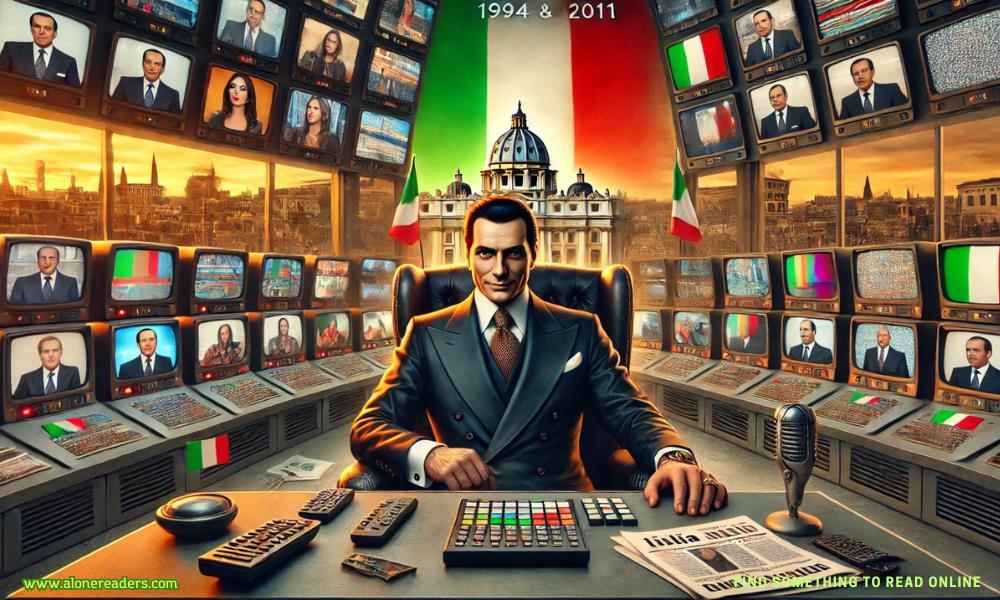
Silvio Berlusconi’s political career cannot be examined without understanding his control of media and how this control shaped Italian public opinion between 1994 and 2011. As a billionaire media mogul turned prime minister, Berlusconi represented a unique convergence of business, entertainment, and politics. His rise to political prominence was not just aided by his media holdings—it was powered by them. The period from 1994, when he first assumed office, to 2011, when he resigned for the last time, stands as a critical chapter in the history of media manipulation in modern democracies.
Berlusconi founded Mediaset, a broadcasting empire that rapidly became Italy’s dominant private television network. Before entering politics, he already owned three of the most-watched channels in the country—Canale 5, Italia 1, and Rete 4—giving him the ability to shape the narratives consumed by millions of Italians daily. These networks did not merely report the news; they built a brand of infotainment that blurred the lines between fact and entertainment, leveraging emotional storytelling, tabloid-style presentation, and celebrity culture. Once in power, Berlusconi’s influence extended beyond private networks to the state-run RAI (Radiotelevisione Italiana), effectively giving him control over nearly 90% of national television audiences.
His tenure as prime minister allowed him to appoint political allies to key roles within RAI, further consolidating his grip over information dissemination. Programming content, news editorial lines, and hiring practices often mirrored the interests of Berlusconi and his political party, Forza Italia (later The People of Freedom). Journalists who resisted political pressure or criticized government policies faced professional marginalization, contract non-renewal, or public smear campaigns. This climate fostered widespread self-censorship and eroded journalistic independence.
One of the most striking features of Berlusconi’s media strategy was the personalization of news. His media outlets routinely celebrated his persona, presenting him as a charismatic, humorous, and competent leader, even amid scandal and criticism. News coverage was not simply biased; it became a sustained public relations campaign that suppressed dissent and amplified favorable stories. In this context, even criminal allegations—including charges of tax fraud, bribery, and corruption—were framed as political vendettas rather than legitimate legal issues.
Berlusconi’s government also enacted legislation that safeguarded his media interests. The so-called "Mammì Law" of 1990, and later the "Gasparri Law" of 2004, protected his television assets from antitrust restrictions and consolidated his dominance over the Italian broadcasting market. These laws weakened regulatory oversight and prevented meaningful competition from emerging. Although Italy's Constitutional Court occasionally intervened, such rulings were often circumvented through legal loopholes or political maneuvering.
Another key element of Berlusconi’s media control was the reduction of pluralism. While Italy has a long tradition of a vibrant print press, television has always been the most influential medium in the country. During Berlusconi’s reign, critical newspapers such as La Repubblica and Il Fatto Quotidiano played an increasingly oppositional role, but their reach was limited compared to the television-dominated landscape. His media strategy, therefore, capitalized on the average Italian’s reliance on TV as a primary news source, ensuring that large segments of the population were exposed to filtered, pro-government narratives.
Public trust in journalism declined significantly during these years, as many Italians began to see mainstream news outlets as mouthpieces for political agendas. This erosion of trust contributed to increased political polarization and apathy. Berlusconi’s manipulation of media didn't just distort the truth—it distorted the mechanisms by which society interprets truth. Democratic discourse weakened under the weight of personality cults, biased reporting, and entertainment-driven politics.
Internationally, Berlusconi’s media control drew concern from watchdogs and human rights organizations. Reporters Without Borders frequently ranked Italy lower in press freedom during his terms in office, noting the lack of safeguards against conflicts of interest and the use of defamation laws to intimidate critics. The European Union also raised concerns about Italy’s media pluralism, although concrete interventions remained limited.
Yet despite mounting scandals, frequent gaffes, and deepening economic crises, Berlusconi remained a popular figure for many years. His control over how he was portrayed on television played a central role in this resilience. In a sense, his political career became a case study in how media dominance can prolong the survival of leadership even when faced with widespread criticism and failing governance. In the process, Italy became a testbed for what media theorist Antonio Gramsci might have called "cultural hegemony"—a situation where power is maintained not just through coercion, but through the shaping of consent and public perception.
Berlusconi’s eventual resignation in 2011, amid financial turmoil and dwindling parliamentary support, marked the end of an era, but the effects of his media domination linger. The normalization of politicized news, the use of entertainment as a political tool, and the subjugation of public broadcasters to government influence are all trends that found root during his administration. These legacies continue to shape Italian media and politics today.
Moreover, Berlusconi’s model inspired other political figures worldwide—most notably Donald Trump in the United States—who recognized the value of controlling or bypassing traditional media through television and later social platforms. This influence raises broader questions about democracy’s vulnerability in the age of mass media. When a leader can control the conversation, marginalize dissent, and recast scandals as spectacles, accountability becomes a secondary concern.
In retrospect, the Berlusconi era was more than a political phase in Italy’s history—it was a media revolution that challenged the foundation of democratic transparency. It demonstrated how the concentration of media ownership in the hands of a politician can corrode democratic institutions from within, not through overt authoritarianism, but through the soft power of spectacle and persuasion. The years 1994 to 2011 will remain a critical reference point in discussions of media ethics, press freedom, and political influence, not only in Italy but in democracies across the globe.



 Top 10 Highest-Paid Professions in the United States (2025): Salaries, Roles, and Career Paths
 Top 10 Largest U.S. Companies by Revenue in 2025 (Fortune 500 Analysis)
 Top 10 Highest-Earning Global Tech Companies in 2025: Revenue, Strategy, and Market Power
 Top 10 Highest-Earning Mobile Apps in 2025: Revenue, Monetization, and Market Dominance
 ZombieAgent: Inside the Zero-Click AI Attack That Turns ChatGPT Agents into Persistent Data-Leaking Zombies
 China’s Urban Air Is a Hidden Plastic Reservoir: Inside the Microplastic Clouds Over Megacities