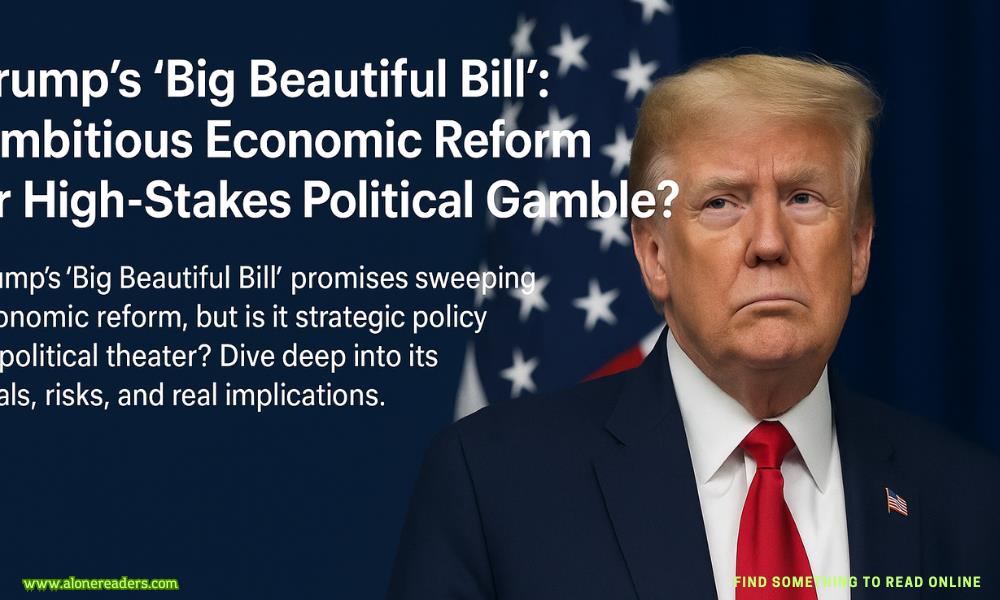
Donald Trump’s political stagecraft is nothing if not theatrical. With the unveiling of what he dubs the "Big Beautiful Bill," the former president—now the Republican nominee for 2024 and a front-runner in many swing states—is attempting to reshape the economic narrative heading into a potential second term. The bill, positioned as a sweeping reform package aimed at boosting economic growth, reducing regulation, and revisiting taxation, carries both ideological ambition and political risk. But is it truly a roadmap for prosperity or a strategic maneuver to regain control of the nation’s economic messaging?
This article breaks down the key components of the bill, evaluates its fiscal rationale, and explores whether it’s sound policy or a calculated gamble in an election year.
The origin and branding
The term “Big Beautiful Bill” is vintage Trump: bombastic branding designed for maximum media replay. Despite its vague name, the bill is reportedly a dense, multi-pronged legislative proposal covering tax reform, deregulation, energy expansion, and spending cuts. The title appeals to populist sentiments, conjuring the same rhetorical spirit as Trump’s “big beautiful wall.”
Core themes of the bill
While some of these components mirror Trump’s 2017 Tax Cuts and Jobs Act (TCJA), the new proposal pushes even further in scale and scope.
Corporate tax rollback
At the heart of the bill is a proposed reduction in the corporate tax rate from 21% to 15%. Supporters argue this will make American businesses more competitive globally and attract foreign investment. Critics contend it will significantly reduce federal revenues without a guaranteed return in job creation or wage growth.
Capital gains and individual tax benefits
The bill includes provisions to reduce long-term capital gains tax rates and reinstate the full deductibility of state and local taxes (SALT) for high earners—something Trump previously opposed. There’s also an effort to reintroduce faster depreciation for capital equipment, aimed at incentivizing private sector reinvestment.
Who benefits most?
While middle-income earners may see modest relief through standard deduction hikes and child tax credits, the lion’s share of the benefits clearly tilts toward top earners and corporations. This raises concerns about exacerbating wealth inequality—an issue that became more pronounced during and after Trump’s first term.
Rollback of environmental and labor protections
The bill proposes eliminating many of the Biden-era regulations on emissions, workplace safety, and financial disclosure. Trump argues these rules “strangle” small businesses and slow down innovation. The energy sector, in particular, stands to benefit, with promised fast-track approvals for pipelines and drilling permits.
Potential consequences
While deregulation could accelerate certain industrial and infrastructure projects, it risks rolling back protections for consumers, workers, and the environment. Opponents warn that it could lead to a repeat of the 2008-style financial deregulation disaster or contribute to long-term ecological damage.
Focus on domestic energy production
The bill puts heavy emphasis on “American energy dominance,” reviving fossil fuel projects that were halted or restricted under the Biden administration. There are tax incentives for coal, oil, and gas companies and an explicit plan to reduce green energy subsidies.
Economic implications
Supporters argue that cheaper, domestic energy will lower inflation, reduce foreign dependence (especially on the Middle East and Russia), and create jobs. However, this approach sidelines the global shift toward renewable energy, potentially leaving the U.S. technologically and diplomatically isolated in the long run.
Climate and investor backlash
Environmental groups and ESG-minded investors are already gearing up for opposition campaigns. Reversing climate commitments could trigger backlash from international partners and increase economic friction, especially with Europe and the Global South, which are aligning more closely with green energy futures.
Trump’s tariff doctrine returns
The bill includes provisions for expanding tariffs on goods from China and other nations deemed to engage in “unfair trade practices.” Trump sees tariffs as leverage to bring back manufacturing jobs and protect American industries from what he views as foreign exploitation.
Impact on prices and consumers
Although designed to support domestic production, such tariffs often lead to higher prices for consumers. In Trump’s first term, the tariff war with China resulted in retaliatory tariffs that hit American agriculture and increased costs on electronics, machinery, and household goods.
Political calculation
By emphasizing "fair trade over free trade," the bill appeals to Rust Belt voters and small-town manufacturers. But it risks reigniting tensions with key trading partners, potentially harming export-driven sectors like agriculture and aerospace.
Revenue projections vs. spending cuts
The bill assumes that tax cuts will “pay for themselves” through increased economic activity—a theory widely debated among economists. Meanwhile, it proposes spending cuts in social welfare programs, federal grants, and certain healthcare initiatives.
Deficit danger
If growth projections fall short, the U.S. deficit could explode. Critics point out that the TCJA failed to meet its revenue-neutral goals, and this even more aggressive approach could deepen the debt crisis, especially as interest payments on existing debt continue to rise.
Rallying the base
From a political standpoint, the bill energizes Trump’s conservative base, especially the business lobby, energy sector, and anti-regulation factions. It serves as a clear contrast to Biden’s economic vision and gives Trump a campaign issue to hammer repeatedly.
Alienating moderates and independents
However, the bill could also alienate fiscally conservative moderates who are wary of ballooning deficits and centrists who support climate action. Trump’s strategic gamble lies in whether this bill motivates enough voters without repelling swing voters.
Congressional viability
Even if Trump wins a second term, the bill faces an uphill battle in Congress—especially if the Senate remains closely divided. Portions of it may pass through budget reconciliation, but the more controversial elements will likely be fiercely contested.
Trump’s “Big Beautiful Bill” is more than just a legislative proposal—it’s a political chess piece, a campaign rally cry, and a bold economic experiment all rolled into one. It offers a sharp pivot from Bidenomics and seeks to reestablish Trump as the master of the American economy. But whether it delivers real economic reform or ushers in fiscal instability and global isolation depends on more than slogans and stagecraft.
If enacted, the bill would represent one of the most radical shifts in American economic policy in modern history. The question for voters and policymakers alike is whether that shift represents necessary reform or a political gamble with high stakes and uncertain rewards.



 Top 10 Highest-Paid Professions in the United States (2025): Salaries, Roles, and Career Paths
 Top 10 Largest U.S. Companies by Revenue in 2025 (Fortune 500 Analysis)
 Top 10 Highest-Earning Global Tech Companies in 2025: Revenue, Strategy, and Market Power
 Top 10 Highest-Earning Mobile Apps in 2025: Revenue, Monetization, and Market Dominance
 ZombieAgent: Inside the Zero-Click AI Attack That Turns ChatGPT Agents into Persistent Data-Leaking Zombies
 China’s Urban Air Is a Hidden Plastic Reservoir: Inside the Microplastic Clouds Over Megacities