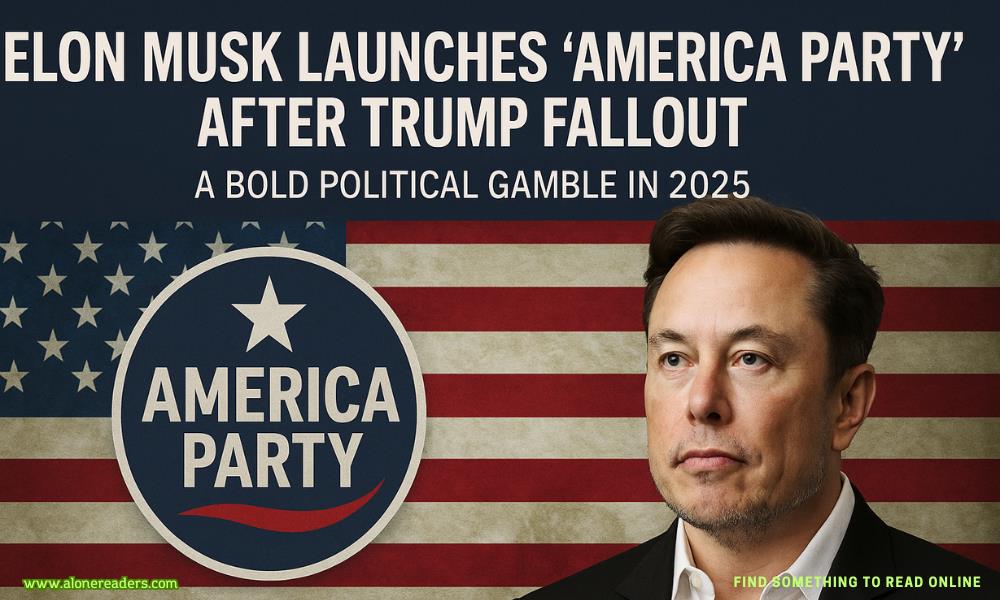
In a dramatic move that’s shaking up America’s political landscape, billionaire entrepreneur Elon Musk has officially launched a new political movement dubbed the “America Party.” The announcement comes in the wake of an escalating public fallout with former President Donald Trump, marking a pivotal split within America’s right-wing and libertarian-leaning factions. Musk’s entry into formal politics, long speculated but never confirmed until now, is sending tremors through both the Republican establishment and the tech world alike.
Background: How the Musk-Trump Alliance Fell Apart
At one point, Musk and Trump shared overlapping ideologies—opposition to environmental regulation, disdain for "woke" culture, and an aggressive economic nationalism. But their alliance, always more tactical than heartfelt, began to crack in late 2024 when Musk criticized Trump’s calls for nationwide censorship of TikTok alternatives and his hardline stance on AI regulation.
The breaking point came during a closed-door summit between conservative tech leaders and GOP figures in early 2025. According to insiders, Trump reportedly dismissed Musk’s concerns about entrepreneurial freedom and accused him of acting like a “Silicon Valley elitist.” Days later, Musk unfollowed Trump on X (formerly Twitter), and the digital war began—culminating in Musk’s declaration of political independence through the formation of the America Party.
Ideological Foundations
The America Party positions itself as a hybrid of classical libertarianism, technological optimism, and anti-corruption populism. According to Musk’s announcement, the party’s founding pillars include:
Unlike the traditional Republican or Democratic parties, the America Party lacks a deep-rooted ideological history. Musk claims this is by design—calling the new party a "modular political system that updates with reality."
Musk’s Position: Not a Candidate, But a Kingmaker?
Though speculation swirls about Musk himself running for office, he clarified in his launch interview on Joe Rogan’s podcast that he does not intend to run for President in 2028. Instead, he plans to act as a political force “to restore integrity and rationality in Washington.” Critics have called this coy positioning—suggesting he may still consider a candidacy if public support surges.
High-Profile Tech Allies
Several notable tech leaders have voiced cautious support or outright endorsement. Among them:
Grassroots Surge from Disillusioned Libertarians and Centrists
Beyond the tech elite, the America Party is rapidly gaining traction among younger voters and independent conservatives who feel alienated by both the MAGA movement and the progressive wing of the Democratic Party.
Online forums and Reddit communities are now flooded with grassroots organizing around the party. Memes comparing Musk to a modern-day George Washington are trending under hashtags like #NewFounders and #RebootDemocracy.
Electoral Strategy for 2026 Midterms
The America Party’s first real test will come in the 2026 midterm elections, where they plan to run a limited number of candidates in swing districts—particularly in Arizona, Texas, and Florida.
Musk has emphasized candidate quality over volume, using a decentralized vetting process powered by AI moderation and public scoring on integrity and policy fluency. This bold strategy, if successful, could introduce a new method of political recruitment entirely.
GOP’s Dilemma: Fight or Fold?
The Republican National Committee views the America Party as a threat, especially in districts where MAGA Republicans barely won in 2022 and 2024. Some Republican strategists fear that Musk could siphon off just enough support to hand seats to Democrats, while others are lobbying behind the scenes to bring him back into the fold.
Democratic Response: Watchful Skepticism
While Democrats publicly scoff at Musk’s ambitions—labeling him an oligarch seeking influence—they are privately aware of the danger his popularity poses, especially among young men, libertarian-leaning Hispanics, and disillusioned centrists.
There are whispers in Democratic circles of launching a “pro-democracy tech coalition” to neutralize Musk’s messaging on platforms like X and YouTube.
Advantages
Challenges
Musk’s America Party is more than a vanity project or protest movement. It signals a larger fracturing in America’s two-party system, driven by frustrations with institutional sclerosis and digital-age alienation.
If even a few America Party candidates win in 2026, it could open the door to broader realignments—especially if Musk’s approach to transparency and tech-first governance proves popular. Alternatively, if the party collapses under its own hype or splits the anti-establishment vote, it could hand greater power to entrenched political forces.
The launch of the America Party is a defining moment not just for Elon Musk, but for the future of alternative political movements in the United States. Whether it becomes a disruptive force or just another billionaire-fueled distraction remains to be seen.
What’s clear is this: Elon Musk has chosen to move from the edges of influence to the epicenter of America’s political battlefield. And with his unique blend of resources, reach, and radical ideas, he might just reshape that battlefield altogether.



 Top 10 Highest-Paid Professions in the United States (2025): Salaries, Roles, and Career Paths
 Top 10 Largest U.S. Companies by Revenue in 2025 (Fortune 500 Analysis)
 Top 10 Highest-Earning Global Tech Companies in 2025: Revenue, Strategy, and Market Power
 Top 10 Highest-Earning Mobile Apps in 2025: Revenue, Monetization, and Market Dominance
 ZombieAgent: Inside the Zero-Click AI Attack That Turns ChatGPT Agents into Persistent Data-Leaking Zombies
 China’s Urban Air Is a Hidden Plastic Reservoir: Inside the Microplastic Clouds Over Megacities










