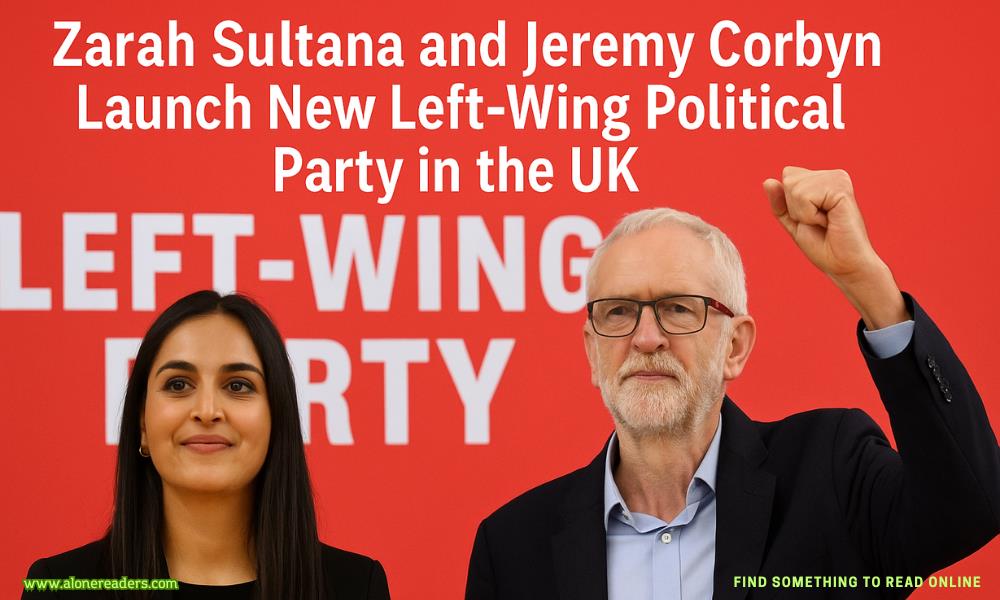
In a bold and unprecedented political development, former Labour MP Jeremy Corbyn and current MP Zarah Sultana have officially announced the formation of a new left-wing political party in the United Kingdom. This move is being heralded by supporters as a revival of grassroots socialism and a direct challenge to the increasingly centrist direction of the Labour Party under Sir Keir Starmer’s leadership. The new party, which is yet to be officially named, is expected to draw from a disillusioned base of Labour supporters, trade unionists, student activists, and long-time advocates of democratic socialism who feel increasingly alienated from mainstream British politics.
Zarah Sultana, one of the youngest members of Parliament and a vocal critic of austerity, imperialism, and climate inaction, has long been associated with the progressive wing of the Labour Party. Her decision to break ranks and collaborate with Corbyn signals a major rupture within the Labour left. Sultana, who has built a substantial following among younger voters, particularly from ethnically diverse urban communities, has consistently pushed for policies such as free university education, wealth taxes, rent controls, and a Green New Deal. Her involvement brings significant momentum and credibility to the fledgling political movement.
Jeremy Corbyn, whose leadership of the Labour Party between 2015 and 2020 sparked both enthusiastic support and fierce opposition, has remained a controversial and highly influential figure on the UK left. After being suspended from the Labour whip in 2020 and later barred from standing as a Labour candidate in future general elections, Corbyn increasingly appeared to be preparing for a post-Labour political project. His alliance with Sultana — a younger, still-sitting MP with broad social media reach and deep activist ties — has made that prospect a reality. Corbyn’s message remains focused on tackling inequality, ending privatization of public services, challenging the arms trade, and redistributing wealth through progressive taxation.
The new party’s emergence comes at a time of mounting public dissatisfaction with both the Conservative and Labour parties. With the Conservatives plagued by internal scandal, economic mismanagement, and leadership instability, and Labour viewed by many progressives as having abandoned its radical roots, a political vacuum has opened on the left. The Corbyn-Sultana project aims to fill that void with a platform rooted in anti-austerity economics, environmental justice, and anti-racist politics. Early drafts of the party’s policy commitments reportedly include renationalizing railways and energy utilities, introducing a universal basic income pilot, abolishing the House of Lords, and ending the UK's arms exports to conflict zones such as Yemen and Israel.
Initial reactions to the announcement have been mixed across the political spectrum. While Labour centrists have dismissed the new venture as a vanity project likely to split the left vote, many grassroots organizers, disaffected Labour members, and former Momentum activists have welcomed it as a long-overdue realignment. In recent years, left-wing movements in Europe — such as La France Insoumise in France and Podemos in Spain — have demonstrated that new political formations can quickly gain traction when traditional parties fail to represent public sentiment. Corbyn and Sultana appear to be drawing inspiration from these examples, positioning their party as a movement rather than just a traditional party apparatus.
Union response has also been cautiously optimistic. While major unions like Unite and UNISON have not formally endorsed the new initiative, senior union leaders have expressed growing concern over Labour’s dilution of worker-friendly policies. Some smaller and more radical trade unions — such as the Bakers’ Union and the IWGB — are rumored to be in early discussions about aligning themselves with the new party. These potential alliances could provide critical financial and logistical support, especially as the party seeks to build a national presence in time for the next general election.
One of the major challenges facing the new party will be the UK’s first-past-the-post electoral system, which tends to disadvantage smaller and newer parties. However, Corbyn and Sultana seem prepared to adopt a long-term strategy. Rather than focusing solely on Westminster seats, the party plans to build local networks, contest council elections, and galvanize support in student unions, community groups, and protest movements. This grassroots-first approach reflects a key lesson from Corbyn’s earlier leadership: the power of movements lies in mobilization, not just parliamentary arithmetic.
Already, dozens of local launch meetings are being organized in major cities such as London, Manchester, Birmingham, and Glasgow. These gatherings aim to gather input on the party’s founding charter, engage volunteers, and map out community-based campaigns. The new party is also exploring digital-first campaigning methods, including livestream town halls, participatory policy platforms, and crowdfunding drives to reduce reliance on large donors or corporate interests. Transparency and member democracy are expected to be central tenets of its governance model.
Media reactions have ranged from skeptical to alarmist. Right-wing tabloids have branded the initiative a “far-left vanity circus,” warning that it could embolden protest groups and destabilize British politics. Centrist commentators have argued that while the motivations may be noble, the fragmentation of the left could inadvertently benefit the Conservatives by splitting progressive votes. Nonetheless, supporters argue that real political change rarely happens without risk, and that the status quo has failed too many people for too long.
International leftist leaders such as Alexandria Ocasio-Cortez in the US and Jean-Luc Mélenchon in France have sent messages of solidarity, praising Sultana and Corbyn for their courage and moral clarity. These endorsements hint at a broader aspiration: to connect this new UK party with a global network of progressive forces pushing for climate action, wealth redistribution, and democratic reforms.
As the party prepares for its formal launch conference, likely to take place in early autumn, all eyes will be on how much popular momentum it can sustain. Both Sultana and Corbyn face enormous challenges — from media hostility and internal dissent to electoral obstacles and resource constraints. Yet, they also enter the arena with a dedicated activist base, a clearly articulated political vision, and the moral authority gained through years of principled opposition. Whether this new venture can break the mold of British politics or fade into the long list of failed third parties remains to be seen. What is clear, however, is that the landscape of UK politics has shifted — and a new battle for the soul of the left has begun.



 Top 10 Highest-Paid Professions in the United States (2025): Salaries, Roles, and Career Paths
 Top 10 Largest U.S. Companies by Revenue in 2025 (Fortune 500 Analysis)
 Top 10 Highest-Earning Global Tech Companies in 2025: Revenue, Strategy, and Market Power
 Top 10 Highest-Earning Mobile Apps in 2025: Revenue, Monetization, and Market Dominance
 ZombieAgent: Inside the Zero-Click AI Attack That Turns ChatGPT Agents into Persistent Data-Leaking Zombies
 China’s Urban Air Is a Hidden Plastic Reservoir: Inside the Microplastic Clouds Over Megacities










