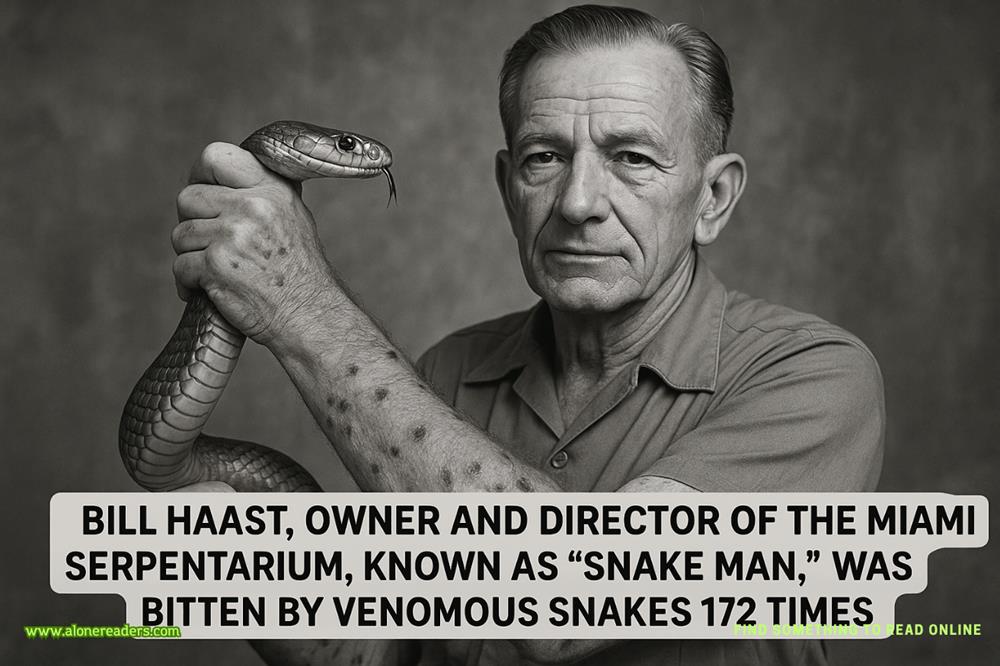
Bill Haast, often known as the “Snake Man,” was a remarkable figure in the world of herpetology whose life story reads like an adventure novel. As the owner and director of the Miami Serpentarium in Florida, he became famous not only for his fearless handling of venomous snakes but also for surviving an astonishing 172 venomous bites during his lifetime. His career spanned decades, and his contributions to snake venom research and antivenom development left an enduring legacy in both science and public education. What made Haast unique was not simply his survival against odds that would have killed almost anyone else, but the way he actively sought to understand and use snake venom for medical progress.
Born on December 30, 1910, in Paterson, New Jersey, Haast developed a fascination with snakes at an early age. By his teenage years, he was already catching and handling snakes, nurturing skills that would later define his entire career. After working briefly in aviation, his passion for reptiles pulled him into a life dedicated to studying venomous species. His dream materialized in 1947 when he opened the Miami Serpentarium, a combination zoo, research facility, and educational center. Visitors could watch him perform daring venom-milking demonstrations—extracting venom from deadly snakes right before their eyes. These shows, while thrilling for audiences, were not without risk. Over the years, Haast’s work brought him face-to-fang with species such as cobras, mambas, rattlesnakes, and kraits, each carrying venom that could kill within minutes.
The sheer number of bites Haast endured—172 documented instances—would be unthinkable for most. His survival was partly due to his unusual practice of self-immunization. Starting in the 1940s, he began injecting himself with diluted snake venom, believing that this would help his body build resistance. Over time, he developed immunity to a range of venoms from some of the deadliest snakes in the world. While controversial, this approach likely saved his life multiple times. On several occasions, he was bitten by snakes whose venom would have been fatal without immediate treatment, yet he survived with minimal symptoms thanks to his conditioned immunity. In fact, his blood became so valuable for producing antivenoms that hospitals sometimes flew it across the country to treat snakebite victims in emergencies.
Haast’s work was not solely about personal thrill or endurance; he had a genuine commitment to advancing medical science. He collaborated with researchers to explore the potential of snake venom in treating various diseases. Venom components were studied for their ability to lower blood pressure, prevent blood clots, and even combat polio symptoms. The Miami Serpentarium became a hub for venom research, supplying venom samples to laboratories worldwide. Haast was deeply convinced that snakes held untapped cures for human ailments, and he saw his own body as both a testing ground and proof of concept.
Despite his careful techniques, not every encounter ended well. Some bites left him severely ill, and he spent days in hospitals recovering from swelling, tissue damage, and nerve impairment. On one occasion, a king cobra bite sent him into paralysis, requiring intensive medical intervention. Yet each time, he returned to his work, often with bandages still visible, ready to face the next challenge. His determination and resilience became part of his legend, earning him admiration from scientists, animal enthusiasts, and the public alike.
The Miami Serpentarium operated for decades, attracting tourists, school groups, and scientists. Haast’s shows were both educational and gripping, blending entertainment with a powerful conservation message. He stressed the importance of respecting snakes, understanding their role in ecosystems, and learning how to avoid dangerous encounters. However, his work was not without criticism—animal welfare advocates questioned aspects of his handling and public shows, particularly involving crocodiles and alligators at the facility.
Haast officially retired from public shows in 1984, closing the Miami Serpentarium after a tragic accident involving a young visitor and a crocodile. Still, his commitment to venom research continued well into his later years. Even after moving his operations to Punta Gorda, Florida, he kept milking snakes into his 90s, providing venom for research institutions. His extraordinary physical resilience and mental focus allowed him to maintain a dangerous routine that would be impossible for most people half his age.
Beyond the numbers and dramatic anecdotes, Haast’s life underscores a unique blend of bravery, curiosity, and a belief in science’s power to turn nature’s dangers into life-saving medicine. He often said that his goal was to “leave the world a little better” through his work. For those who knew him, his life was a testament to the idea that passion and dedication can drive a person to extraordinary achievements—sometimes at great personal risk.
Bill Haast passed away on June 15, 2011, at the age of 100, leaving behind a legacy unmatched in the world of herpetology. Few, if any, will ever match his record of venomous snake encounters, and his role in pioneering self-immunization remains one of the most unusual chapters in medical and zoological history. To this day, he is remembered as a man who did not just live alongside danger—he embraced it, studied it, and used it to help save countless lives. His story serves as both a warning and an inspiration: a reminder of the fine line between risk and reward, and the extraordinary things that can happen when someone dedicates themselves wholly to a cause.



 Château de Vincennes: France’s Forgotten Royal Fortress and Medieval Stronghold
 Château de Carcassonne: Europe’s Greatest Medieval Citadel and Fortress
 Château de Chenonceau: The Castle Built by Remarkable Women
 Château de Chambord: France’s Magnificent Renaissance Castle and Architectural Wonder
 Tehri Dam: India's Tallest Dam and the Debate Behind It
 Bhakra Nangal Dam: India's Temple of Modern Development










