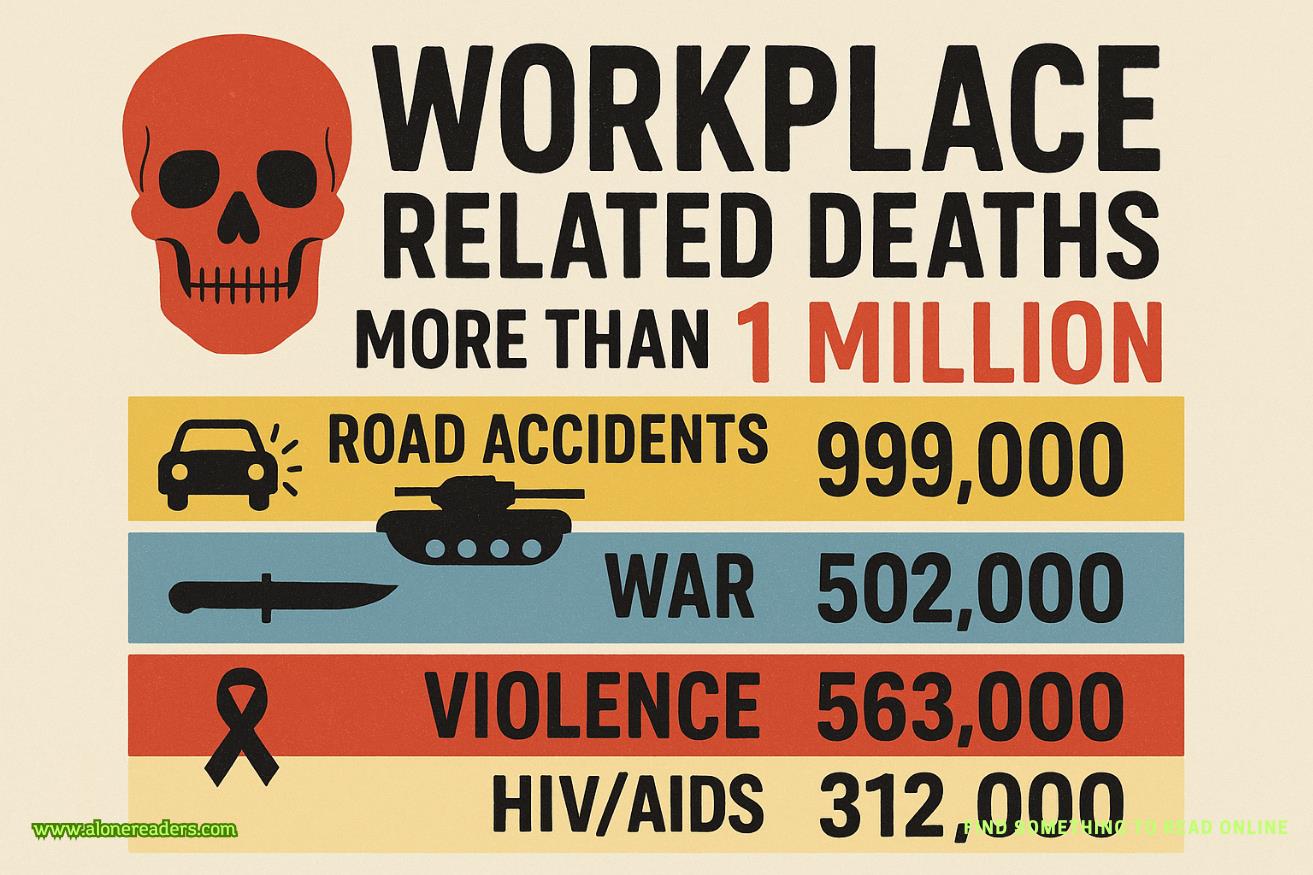
More than a million people die from workplace-related causes every single year—more than die in road crashes, modern wars, interpersonal violence, or from HIV/AIDS. That comparison sounds implausible until you look closely at how work kills. It isn’t just dramatic factory explosions or falls from scaffolding. It’s also the long, slow damage of toxic exposures, grinding schedules, extreme heat, and stress that trigger heart disease and stroke. Recent global estimates put the work‑related death toll at roughly 2.9 million people a year, a scale that indeed eclipses road traffic deaths (about 1.19 million annually), typical conflict battle deaths in recent years (roughly 120,000–160,000), the worldwide toll from intentional homicide (on the order of a few hundred thousand), and AIDS‑related deaths (about 630,000).
When we say “workplace‑related deaths,” we mean both injuries and diseases. The first joint global estimates from the World Health Organization and International Labour Organization found that in 2016 there were about 1.9 million deaths attributable to work, and that roughly four out of five were due to diseases rather than injuries. Those diseases often appear years after exposure—think of cancers from asbestos, silicosis from dust, respiratory and cardiovascular conditions aggravated by fumes and fine particles, and strokes or heart attacks linked to excessive hours. That last factor—long working hours—was estimated to account for about 750,000 deaths in 2016 alone, which shows how a seemingly “normal” work culture can become a lethal risk over time.
The scale also explains why the problem is so invisible. A road pileup is immediate and televised; a war’s front line is mapped in real time. Work, by contrast, harms in dispersed ways. A miner’s fatal lung disease arrives decades after dust exposures; a delivery driver’s fatal stroke may be blamed on “underlying conditions” rather than weeks of 70‑hour shifts. Even with conservative counting, work remains one of humanity’s deadliest daily activities. New ILO figures conclude that around 2.93 million workers die each year from work‑related causes, and nearly 400 million suffer a serious non‑fatal injury. That’s a sobering reminder that the “silent pandemic” of unsafe work is still with us.
The comparison to other headline causes helps put things in perspective, without trivializing any of them. Road traffic deaths are still a staggering 1.19 million a year, concentrated among pedestrians, cyclists and motorcyclists in rapidly motorizing countries. But work‑related causes outnumber them—often by more than double—because they include the global spread of hazardous chemicals, unsafe machinery, poorly ventilated worksites, and heat stress that now affects most of the world’s workforce. Meanwhile, even in recent years of intense conflict, battle‑related deaths have typically been far below the work‑related toll, despite tragic spikes in places like Ukraine, Gaza, Sudan, and Ethiopia. Intentional homicide remains a major public‑safety crisis worldwide, but the global count is hundreds of thousands, not millions. And despite huge progress against HIV, AIDS‑related deaths still claim hundreds of thousands of lives each year—but significantly fewer than work. The point isn’t to pit crises against each other; it’s to recognize that work belongs on the same front page.
Where do these deaths happen? Everywhere people work—but risk is not evenly distributed. Agriculture remains one of the most hazardous sectors due to heavy machinery, pesticides, and heat. Construction and mining combine physical hazards with dust and chemical exposures. Transport and logistics are dangerous by definition: long hours, road crashes, and sometimes violence. Informal and precarious work, where workers lack training, equipment, and legal protection, magnifies the danger. Migrant workers often face the highest risks and the weakest voice to demand safer conditions. In many countries, small and medium‑size enterprises struggle with compliance, not out of indifference but because they lack expertise and resources to implement systematic prevention. These patterns—sectoral concentration, informality, and power imbalances—help explain why the death toll remains high despite the technology and know‑how to reduce it.
The economics are eye‑watering. The global cost of work‑related injuries and diseases has been estimated at around 3.9% of world GDP—trillions of dollars lost each year to medical care, absenteeism, turnover, and productivity hits. For businesses, the costs show up as downtime, supply‑chain disruption, higher insurance premiums, reputational damage, and difficulty attracting talent. For families, the “cost” is heartbreaking: the permanent loss of income‑earners and caregivers, and all the compounding effects that follow.
There is good news: we already know what works, and much of it is common sense backed by strong evidence. Start with prevention, not reaction. The hierarchy of controls remains the gold standard: eliminate hazards where possible, substitute safer materials, engineer away risks with better ventilation and machine guards, organize work to minimize exposure, and reserve personal protective equipment as the last line of defense. Across all of this, worker participation is central; when frontline workers can identify hazards freely and without fear of retaliation, incidents drop. A living, learning safety culture—near‑miss reporting, just‑culture investigations, leadership walk‑arounds, and continuous improvement—beats a compliance mindset every time.
At the policy level, the world took a landmark step in 2022 when the International Labour Conference recognized a safe and healthy working environment as a fundamental principle and right at work. That decision elevated occupational safety and health to the same level as core labor rights like freedom of association and the elimination of forced and child labor. In practical terms, it places fresh obligations on governments and employers to build robust national systems, enforce standards, and enable workers to exercise their right to refuse unsafe work.
Standards help translate those principles into action. ISO 45001 provides a globally recognized framework for building an occupational health and safety management system that is integrated with other business processes. Organizations aren’t asked to be perfect overnight; they’re asked to identify their significant risks, set objectives, involve workers, and demonstrate improvement year over year. In 2024, ISO even updated the standard to better reflect climate‑related risk in safety management—recognition that heat, wildfire smoke, storms, and other climate impacts are increasingly “workplace” hazards. Whether you’re a global manufacturer or a growing services firm, adopting a structured management system makes safety less about slogans and more about results.
Given the numbers, where should governments and employers focus first? Target the big, preventable drivers of mortality. Long working hours are a massive and underappreciated risk; sensible limits, predictable schedules, and genuine staffing fixes can save tens of thousands of lives a year. Toxic exposures remain rampant in many supply chains; bans and substitution policies for the worst hazards, coupled with real enforcement and worker training, are essential. Heat stress policies—shade, rest, water, acclimatization—are not optional in a warming world. Road safety programs for professional drivers and riders are low‑hanging fruit that reduce both occupational and public‑road fatalities. Across all of these domains, better data matter: when injuries, near‑misses, and exposures are tracked with transparency, prevention accelerates.
One understandable objection is that headline comparisons can be misleading. War deaths surge in some years and regions; homicide counts fluctuate; HIV progress can stall when funding and access falter. All true. But the underlying message survives those fluctuations. Even under conservative definitions, work remains one of the largest, most persistent causes of death worldwide. The majority of these deaths are preventable with tools we already have: engineering controls, safer substances, sane schedules, heat protections, and a culture that treats safety as a strategic imperative rather than a box‑ticking exercise.
What can a single organization do this quarter that actually moves the needle? Make leaders accountable for safety performance, not just production. Involve workers in risk assessments and corrective actions. Invest in controls that remove hazards instead of relying on rules and PPE. Audit contractors and suppliers to make sure your “hidden factory” is as safe as your own sites. Track leading indicators—like hazard closure rates and near‑miss learning quality—alongside lagging ones. And be transparent: publish what you’re doing and what you’re learning. These steps don’t just save lives; they build resilience, reduce downtime, and make you a magnet for talent that values dignity at work.
The moral case stands on its own: nobody should have to gamble with their life or long‑term health to earn a living. But even if you look purely through a business lens, the case is overwhelming. Safer work is smarter work. It’s more productive, more predictable, and more attractive to customers and investors who increasingly expect environmental, social, and governance (ESG) rigor. If we treat safety as strategy, not charity, the grim arithmetic begins to change. Millions of preventable deaths transform from an unexamined “cost of doing business” into what they should have been all along: unacceptable.
Sources for key figures mentioned above include the International Labour Organization’s latest estimates of work‑related deaths, the WHO’s Global Status Report on Road Safety 2023, UN‑linked homicide data compiled by Our World in Data, conflict fatality estimates from PRIO/UCDP and major outlets summarizing their findings, and UNAIDS’ most recent global updates on AIDS‑related mortality. Together they show the same story from different angles: work kills on a scale we can no longer ignore—and we have everything we need to change that.



 Château de Vincennes: France’s Forgotten Royal Fortress and Medieval Stronghold
 Château de Carcassonne: Europe’s Greatest Medieval Citadel and Fortress
 Château de Chenonceau: The Castle Built by Remarkable Women
 Château de Chambord: France’s Magnificent Renaissance Castle and Architectural Wonder
 Tehri Dam: India's Tallest Dam and the Debate Behind It
 Bhakra Nangal Dam: India's Temple of Modern Development