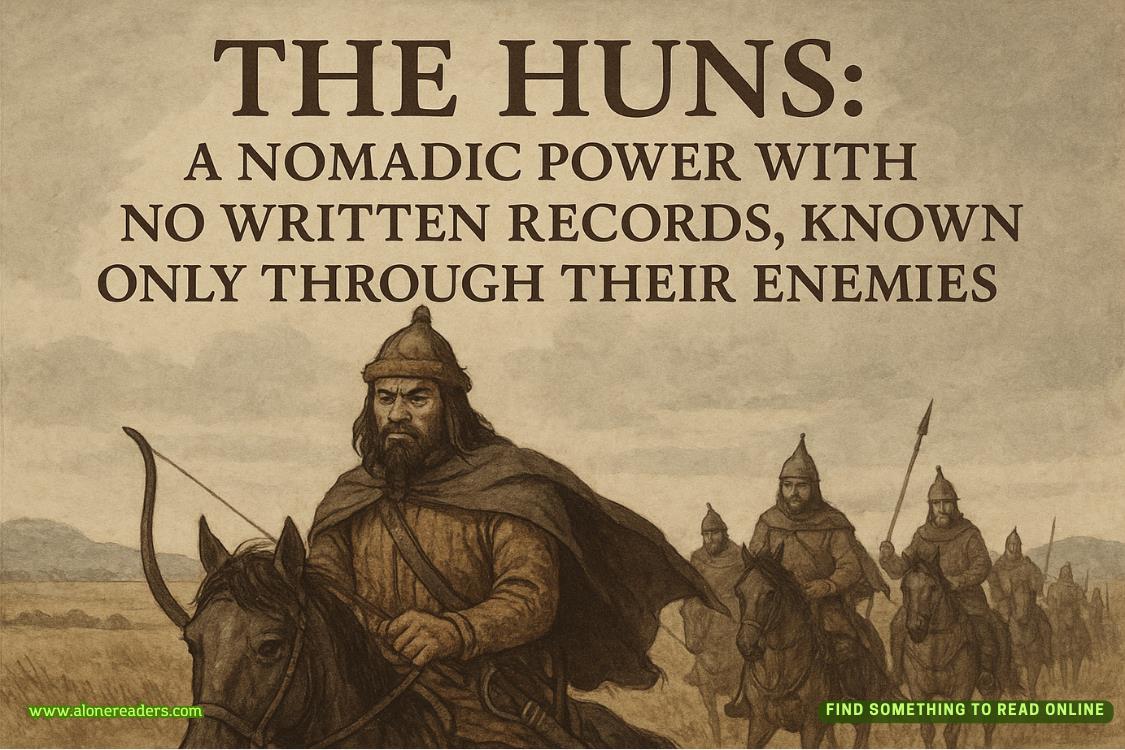
The Huns, a nomadic tribe that emerged as a formidable force in the 4th and 5th centuries CE, stand as one of the most enigmatic groups in ancient history. Unlike the Romans, Persians, or even the Goths, they had no writing system of their own. This absence of a native script means that every account of their existence comes from outsiders, and more specifically, from their adversaries. What survives of their story is filtered through the lens of fear, cultural bias, and propaganda. As a result, the Huns have been remembered as ruthless destroyers of civilizations, though the reality of their culture and society was almost certainly more complex.
The first widespread awareness of the Huns in European history occurred during the late Roman Empire, around the 370s CE, when they crossed the Volga River into Eastern Europe. Their sudden appearance sparked waves of migrations among Germanic tribes, forcing groups such as the Goths to seek refuge inside Roman territories. This mass movement destabilized the frontiers of Rome and set into motion the so-called "barbarian invasions," which historians later viewed as central to the collapse of the Western Roman Empire. To the Romans, the Huns were portrayed as terrifying horsemen from the distant steppes, skilled archers who could rain destruction on cities and armies alike. Yet it is important to remember that all these depictions were written by Roman historians, diplomats, and church officials who experienced the Huns as enemies at the gates.
One of the most detailed descriptions of the Huns comes from Ammianus Marcellinus, a Roman historian of the late 4th century. He described them in unflattering terms, emphasizing their physical appearance, their supposed barbarity, and their nomadic lifestyle. Ammianus painted a picture of a people who lived entirely on horseback, lacking cities, laws, or permanent homes. This portrayal, however, reflects less an objective reality and more the perspective of a Roman elite horrified by a culture so different from their own. Roman society was built upon urban life, written law, and a sense of cultural superiority, so the Huns, who lived in tents, herded animals, and relied on oral tradition, were seen as a direct opposite of everything Rome valued.
The Huns’ lack of a writing system also means that we know almost nothing of their internal political structures from their own perspective. What is certain is that they were not a disorganized rabble, as their enemies sometimes portrayed them. By the time of Attila the Hun in the mid-5th century, the Huns had built an empire that stretched from the Danube to the steppes of Central Asia. Such a vast domain required effective leadership, diplomacy, and systems of tribute and loyalty among different groups. Attila, in particular, demonstrated political cunning in playing different factions of the Roman Empire against each other, extracting immense sums of gold as tribute. While Roman accounts vilify him as a "Scourge of God," these same sources acknowledge his skill as a negotiator and commander.
The absence of Hunnic writing also affects how we understand their cultural and spiritual life. Archaeology provides some clues: burial mounds, horse trappings, and weaponry reveal a culture deeply tied to mobility, warfare, and ritual practices. Elite Huns were often buried with elaborate grave goods, including decorated saddles and ornate weapons, suggesting both social stratification and strong warrior traditions. Their enemies accused them of brutality and savagery, but the archaeological evidence hints at a society with complex social bonds and spiritual practices tied to the natural and supernatural world. Unfortunately, without their own words, these dimensions remain speculative, seen only dimly through material remains and hostile narratives.
One of the most intriguing aspects of the Huns’ legacy is how their image has endured. The name "Hun" itself became synonymous in later centuries with barbarism and destruction. During World War I, for example, Allied propaganda often referred to the Germans as "Huns," evoking the terror once associated with Attila’s armies. This lingering perception demonstrates how powerful enemy-written histories can be in shaping memory. The Huns, who had no opportunity to record their own deeds or worldview, were permanently cast as villains in the narratives of others. In reality, they were not uniquely cruel compared to other peoples of their time; they simply suffered the disadvantage of having their story told entirely by outsiders.
Another challenge in reconstructing the Hunnic past is identifying their origins. Historians debate whether the Huns were directly descended from the Xiongnu, a confederation of nomadic tribes who troubled China’s northern frontiers centuries earlier. The similarities in military tactics and nomadic culture suggest a connection, but without Hunnic records, the link remains unproven. Linguistic evidence is also limited. Only a handful of Hunnic words survive, preserved in Greek and Latin texts, and even these are disputed among scholars. Were the Huns Turkic, Mongolic, or an amalgamation of steppe peoples? The answer is elusive, a reminder of how much is lost when a culture leaves no written trace.
The fall of the Huns’ power after Attila’s death in 453 CE was as rapid as their rise. His sons attempted to maintain unity, but revolts among subject peoples and defeats at the hands of Germanic tribes shattered the empire. Within a generation, the Huns had largely disappeared from the political map of Europe. Without a written tradition to preserve their memory, their identity soon dissolved, absorbed into the cultures they once dominated. Yet their impact was profound: they reshaped the map of Europe, accelerated the decline of Rome, and forever altered the course of Western history.
What makes the story of the Huns remarkable is not only their meteoric rise and fall but also the way history itself treats them. We must approach their legacy critically, recognizing that nearly everything we know about them comes from hostile voices. These sources exaggerate their cruelty, demonize their appearance, and deny their sophistication. At the same time, they cannot conceal the undeniable fact that the Huns commanded respect and fear across a vast region. Their mastery of mounted warfare, their ability to unite disparate groups, and their skill in exploiting the weaknesses of Rome speak to a people far more organized and effective than their enemies admitted.
In the end, the Huns stand as a reminder of the fragility of historical memory. A people without writing depend on others to preserve their legacy, and when those others are enemies, the story is warped. The Huns may forever be remembered as destroyers, yet their true identity remains hidden behind the veil of silence they left behind. They are both present and absent in history—an unstoppable force whose voice we will never hear. Their story is one of conquest, terror, and transformation, but also of loss, not just for them but for the world that can never know them as they knew themselves.



 Château de Vincennes: France’s Forgotten Royal Fortress and Medieval Stronghold
 Château de Carcassonne: Europe’s Greatest Medieval Citadel and Fortress
 Château de Chenonceau: The Castle Built by Remarkable Women
 Château de Chambord: France’s Magnificent Renaissance Castle and Architectural Wonder
 Tehri Dam: India's Tallest Dam and the Debate Behind It
 Bhakra Nangal Dam: India's Temple of Modern Development