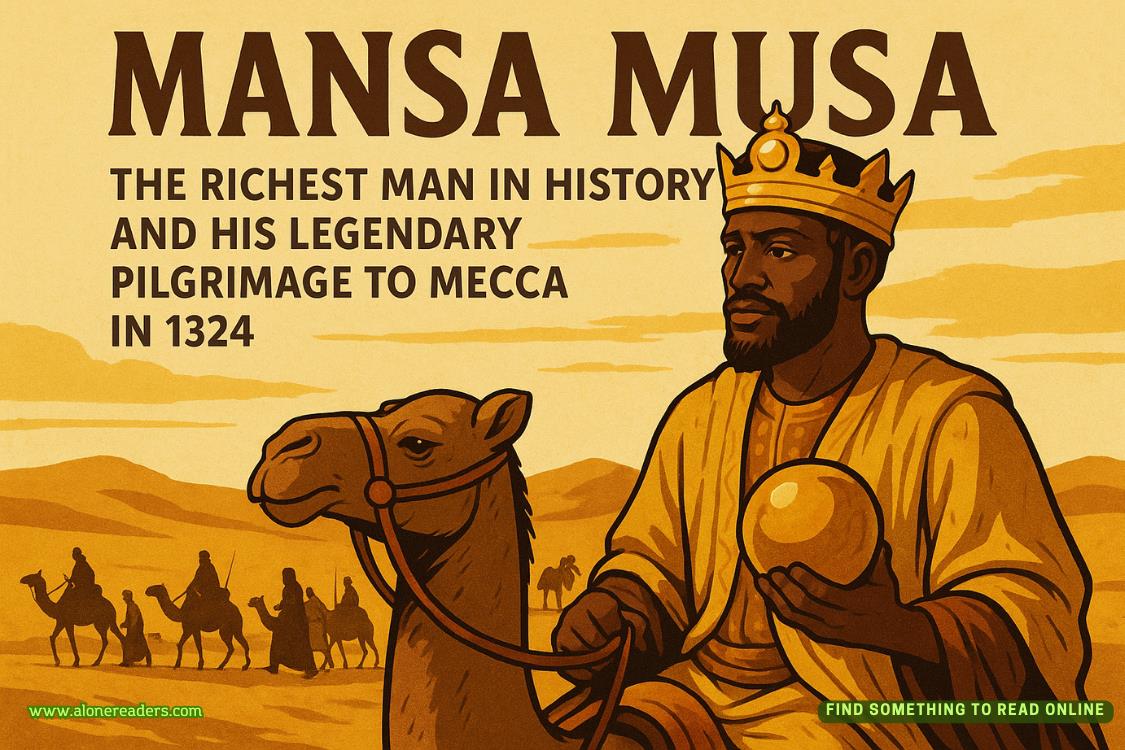
Mansa Musa of Mali remains one of the most fascinating figures in global history, a ruler whose wealth was so vast that it defies modern comprehension. Known as the richest man who ever lived, Musa Keita I, or simply Mansa Musa, reigned over the Mali Empire during the 14th century, a time when West Africa controlled some of the richest gold mines in the world. His empire stretched across much of modern-day Mali, Senegal, Gambia, Niger, and beyond, controlling vast trade routes that connected Africa to Europe and the Middle East. His reign not only expanded the Mali Empire’s political and economic dominance but also transformed it into a hub of culture, learning, and architecture that would leave a lasting legacy.
The defining moment that brought Mansa Musa to the attention of the world occurred in 1324, when he undertook his hajj, the Muslim pilgrimage to Mecca. This journey was not only a religious obligation but also a demonstration of his empire’s immense wealth and power. Historical accounts describe a procession that stunned all who witnessed it. He traveled with a caravan of 60,000 men, including courtiers, officials, and soldiers, all dressed in fine silks and bearing arms. Among them were 12,000 slaves, each carrying a gold bar weighing around four pounds. To add to the spectacle, Mansa Musa brought along 80 camels, each loaded with anywhere between 50 and 300 pounds of gold dust. This was not just wealth—it was an exhibition of an empire’s limitless resources.
The scale of the journey is almost impossible to compare to modern terms. Mansa Musa’s caravan was more than a pilgrimage; it was a statement to the Islamic world and beyond that Mali was a center of power, prosperity, and faith. Everywhere he passed, he distributed gold to the poor and generously funded mosques, schools, and communities. His generosity was so extravagant that it had unintended consequences. In Cairo, where he stayed for several months, his lavish gifts of gold caused such an influx of the metal that the value of gold collapsed. Inflation surged, and it took over a decade for Egypt’s economy to stabilize. This single event highlights the magnitude of Musa’s wealth—he could alter the economy of an entire region simply by spending money.
What made Mansa Musa’s wealth so immense was Mali’s natural resources. During his reign, Mali produced nearly half of the world’s supply of gold. The trans-Saharan trade routes carried not only gold but also salt, ivory, and other goods, connecting the empire with North Africa, the Middle East, and Europe. This immense wealth allowed Mansa Musa to support large standing armies, build monumental architecture, and fund centers of learning that would define Mali’s golden age. Yet, his fortune was not only measured in gold—it was also in the legacy of intellectual and cultural growth he left behind.
After completing his pilgrimage, Mansa Musa returned to Mali with scholars, architects, and artisans who contributed to the empire’s flourishing. One of his most famous contributions was in Timbuktu, which he transformed into a world-renowned center of Islamic learning. He funded the construction of the University of Sankore and numerous mosques, including the Djinguereber Mosque, which still stands today. Timbuktu became a beacon of knowledge, attracting scholars, poets, and theologians from across the Islamic world. The manuscripts produced there, covering science, mathematics, law, and philosophy, would endure for centuries as a testament to the intellectual vibrancy Musa encouraged.
It is difficult to calculate exactly how wealthy Mansa Musa was, but historians and economists estimate his fortune in today’s terms would be worth over $400 billion, far surpassing modern billionaires like Jeff Bezos, Elon Musk, or any European monarch of his era. Unlike modern fortunes, which are tied to fluctuating industries, Mansa Musa’s wealth was based on direct control over gold production, trade networks, and territorial power. His fortune was so extraordinary that many chronicles described it as immeasurable, a wealth of legendary proportions.
The pilgrimage of 1324 was not just an extravagant journey—it was a turning point in world history. It put Mali on the map for European cartographers, with depictions of Mansa Musa appearing in medieval maps such as the Catalan Atlas, where he is shown holding a golden scepter and orb. For Europeans, who were seeking new sources of wealth and trade, tales of Mansa Musa’s riches fueled the imagination and later influenced exploration and the search for trade routes to West Africa. His pilgrimage served as both a religious act and an international declaration of Mali’s influence, connecting Africa to the broader Islamic and global world.
While Mansa Musa’s wealth often dominates the narrative, it is important to recognize his governance and vision. He used his resources not solely for personal luxury but to expand religious, educational, and cultural institutions. His reign stabilized Mali and promoted prosperity across its vast lands. He was deeply devout, funding the building of mosques and ensuring the spread of Islam across West Africa, but he also respected and incorporated local traditions, strengthening the cohesion of his empire.
In the centuries since, Mansa Musa’s name has become synonymous with unimaginable wealth and generosity. He remains a symbol of Africa’s rich history, one that is often overlooked in broader global narratives. His pilgrimage to Mecca in 1324 stands as a unique event in history, a moment when a single man’s fortune altered economies, influenced cultures, and reshaped the world’s understanding of Africa. His story reminds us that the continent has long been a cradle of wealth, knowledge, and civilization, far before colonial powers ever arrived.
The legacy of Mansa Musa is one of wealth, faith, and vision. His empire, though eventually weakened after his death, left a cultural and intellectual imprint that resonates to this day. Timbuktu remains legendary as a city of knowledge, and his name continues to be celebrated as an example of leadership that combined prosperity with cultural and religious advancement. Mansa Musa’s journey to Mecca in 1324 was more than a pilgrimage—it was the ultimate display of wealth, generosity, and power, one that has never been rivaled in human history.



 Château de Vincennes: France’s Forgotten Royal Fortress and Medieval Stronghold
 Château de Carcassonne: Europe’s Greatest Medieval Citadel and Fortress
 Château de Chenonceau: The Castle Built by Remarkable Women
 Château de Chambord: France’s Magnificent Renaissance Castle and Architectural Wonder
 Tehri Dam: India's Tallest Dam and the Debate Behind It
 Bhakra Nangal Dam: India's Temple of Modern Development










