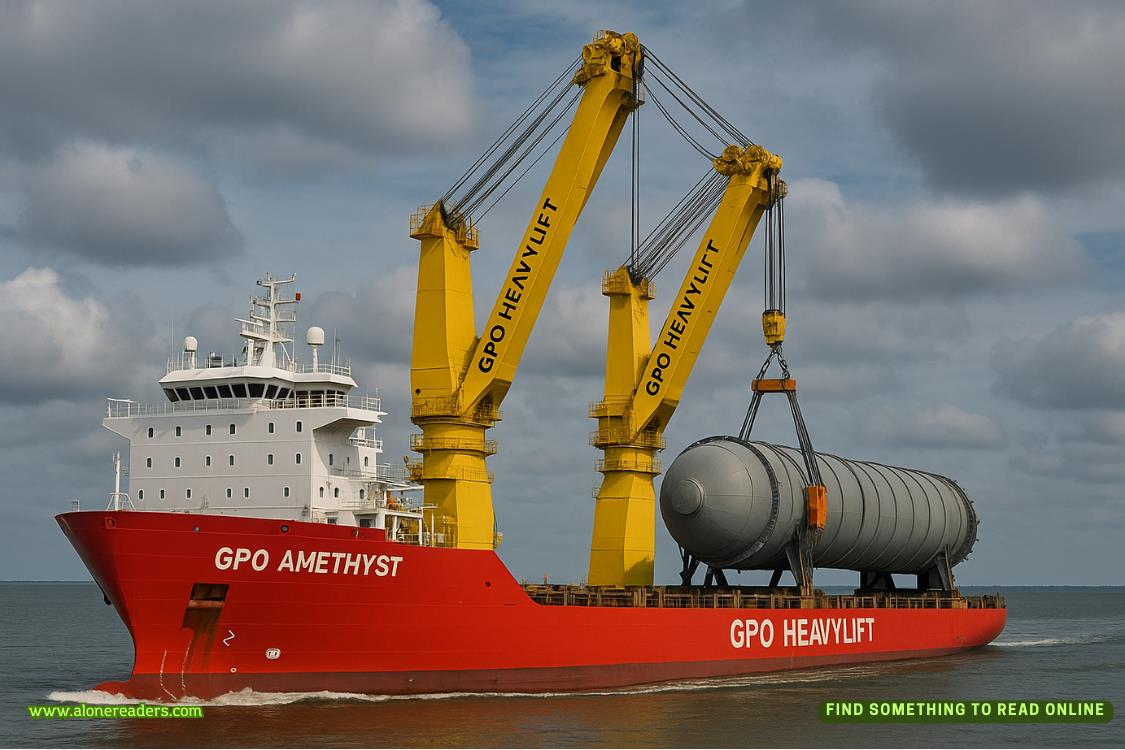
The oceans are home to marvels of engineering, not just beneath the waves but on the water itself. Among these giants of modern technology, the GPO Amethyst stands as a striking example of what humanity can achieve when faced with the challenge of moving the seemingly unmovable. Designed as one of the most advanced heavy-lift semi-submersible vessels in the world, this ship is part of a class of offshore transportation behemoths capable of carrying oil rigs, wind farm structures, massive yachts, and even other vessels across continents. At over 225 meters long and more than 48 meters wide, the Amethyst was created not merely as a ship, but as a floating industrial platform that redefines the boundaries of marine logistics.
The concept behind heavy-lift vessels like the GPO Amethyst lies in solving an age-old problem: how to move massive objects that cannot be broken down into smaller parts. Conventional cargo ships are not designed for this purpose, as their hulls and loading methods are limited to standardized containers, bulk goods, or liquid cargo. Offshore oil rigs, floating production units, and large energy infrastructure cannot be dismantled easily and require relocation as complete structures. This is where the semi-submersible heavy-lift vessel becomes indispensable. The GPO Amethyst operates with ballast tanks that allow it to sink its main deck beneath the surface of the water. This controlled submersion enables huge structures to be floated directly over the deck. Once positioned, the vessel resurfaces by pumping out water from its ballast tanks, lifting the cargo out of the sea and securing it for transport. This ingenious method eliminates the need for cranes or port infrastructure to handle the load, making the ship a true self-sufficient giant.
The GPO Amethyst belongs to the fleet of GPO Heavylift, a company founded with the ambition to design and operate some of the largest and most capable heavy-lift ships in the world. The Amethyst and her sister vessels are built to handle extreme offshore conditions, equipped with reinforced hulls, powerful dynamic positioning systems, and massive deck strength ratings that enable them to carry loads exceeding tens of thousands of tons. Each voyage the vessel undertakes is a carefully orchestrated operation that involves marine engineers, naval architects, and logistics planners working in unison to calculate stability, weight distribution, hydrodynamic resistance, and route safety. The stakes are enormous—one miscalculation could compromise not only the cargo but the ship itself and the environment it traverses.
What makes the Amethyst remarkable is not only its ability to carry weight but also the versatility of its missions. One day it may be transporting a decommissioned oil rig from the North Sea to a recycling facility in Asia; another day it could be carrying sections of an offshore wind farm to support the renewable energy boom. As global demand for offshore infrastructure increases, so does the relevance of ships like the Amethyst. Its deck space, measuring more than two football fields, is an open platform adaptable to virtually any massive object. Engineers custom-build support cradles and securing systems for each job, ensuring that the load is stabilized against the unpredictable forces of ocean travel. Every bolt, weld, and fastening point is checked repeatedly because in the world of heavy-lift shipping, redundancy equals safety.
Operating such a vessel requires more than just brute strength—it demands precision. The GPO Amethyst is fitted with cutting-edge navigation technology and automation systems that allow it to maintain exact positions even in rough seas. Dynamic positioning uses thrusters and satellite guidance to keep the vessel steady to within a meter of accuracy, a crucial feature when loading or unloading structures that may weigh tens of thousands of tons. The crew, often numbering fewer than 30 people, is highly trained in both seamanship and heavy cargo operations. Each mission becomes a blend of maritime tradition and high-tech execution, where old knowledge of the sea meets the most advanced systems modern engineering can provide.
From an economic perspective, vessels like the GPO Amethyst represent the backbone of offshore industries. Oil exploration, liquefied natural gas terminals, and the rapidly expanding offshore wind energy sector all depend on these ships to move colossal infrastructure. Without them, construction timelines would extend by years and costs would soar. A single voyage might save a company hundreds of millions of dollars compared to alternatives. Moreover, heavy-lift vessels contribute to sustainability by enabling the relocation and repurposing of existing offshore platforms, reducing the need for entirely new construction. They are also integral to decommissioning projects, where aged oil platforms are removed safely to minimize ecological impact. In this sense, the Amethyst is not just a transporter of massive structures, but a facilitator of global energy transitions.
The challenges faced by the GPO Amethyst and its crew are immense. Weather conditions in open oceans can be brutal, with high seas testing the limits of both ship and cargo. Navigation requires avoiding shallow waters and accounting for shifting ballast that affects stability. Engineers must run simulations to predict how the vessel and its load will behave during storms, swells, or sharp maneuvers. Every voyage is unique, with risks that must be calculated and managed. Insurance companies, regulators, and classification societies all play roles in overseeing these operations to ensure compliance with international maritime standards. Behind every successful delivery lies months of planning, risk assessment, and cross-disciplinary expertise.
Beyond its immediate role in logistics, the GPO Amethyst embodies the spirit of modern engineering—pushing boundaries, solving problems, and enabling industries to achieve the impossible. Its very existence challenges the idea that certain objects are too large, too heavy, or too complex to move. Each time it sails with a massive rig or energy module secured to its deck, it symbolizes the union of human ingenuity and industrial necessity. It reminds us that progress is not always about building something new from scratch, but often about finding ways to move and adapt what already exists.
As global infrastructure continues to grow in scale, ships like the GPO Amethyst will only become more critical. The world is building taller wind turbines, larger oil platforms, and floating liquefied natural gas plants that must be positioned with pinpoint accuracy. Each of these developments requires the mobility and strength provided by semi-submersible giants. Looking to the future, it is likely that the role of vessels like the Amethyst will expand beyond the energy sector into new fields such as space exploration support, where launch platforms and ocean-based facilities may need to be transported. The flexibility and capacity of these ships make them adaptable to emerging industries, just as they have adapted to the changing energy landscape of the past two decades.
In the end, the GPO Amethyst is more than just a ship—it is a moving stage upon which some of the greatest industrial performances are carried out. To watch such a vessel in action is to witness the transformation of the impossible into the routine. From sinking its massive deck below the waves to lifting entire oil rigs as though they were Lego pieces, it carries with it the story of human determination to conquer obstacles of size and scale. Inside the GPO Amethyst lies not just steel and ballast, but a philosophy of moving the unmovable—a philosophy that continues to drive the boundaries of maritime engineering forward.



 Château de Vincennes: France’s Forgotten Royal Fortress and Medieval Stronghold
 Château de Carcassonne: Europe’s Greatest Medieval Citadel and Fortress
 Château de Chenonceau: The Castle Built by Remarkable Women
 Château de Chambord: France’s Magnificent Renaissance Castle and Architectural Wonder
 Tehri Dam: India's Tallest Dam and the Debate Behind It
 Bhakra Nangal Dam: India's Temple of Modern Development










