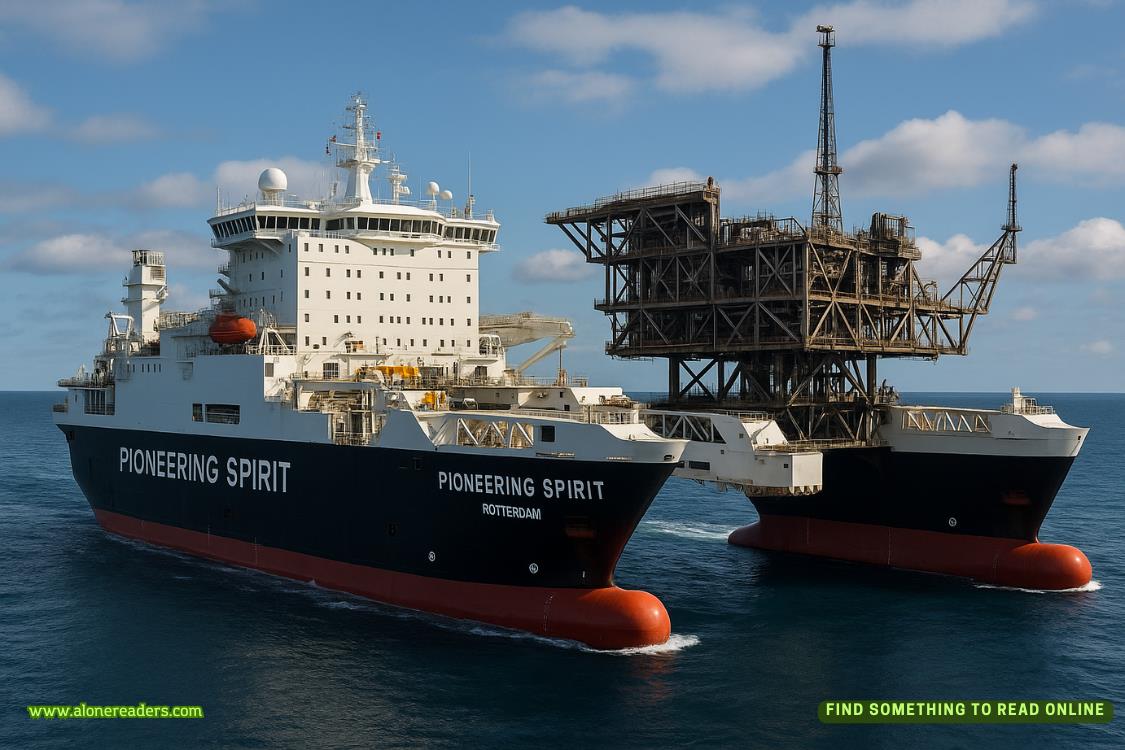
The offshore oil and gas industry has always demanded machines of extraordinary size, strength, and precision, but few have captured global attention quite like the Pioneering Spirit. Built by the Swiss-based Allseas Group, this colossal twin-hull vessel is widely regarded as the largest construction ship ever constructed and a true engineering marvel of the modern world. Measuring an astounding 382 meters in length and 124 meters in width, it is longer than three football fields placed end-to-end and nearly as wide as a city block. What makes Pioneering Spirit unique, however, is not just its massive dimensions, but its unprecedented ability to lift entire oil and gas platforms in one piece—a feat that was previously unthinkable in offshore engineering.
Traditionally, removing or installing oil rigs and production platforms required months of preparation, piecemeal dismantling, and countless support vessels. Every module, crane, or deck segment had to be lifted individually, creating enormous logistical challenges and extensive costs. Pioneering Spirit revolutionized this process by introducing a vessel that could, with its twin-hull design and specialized lifting beams, raise entire topsides weighing up to 48,000 metric tons in a single operation. To put this into perspective, that is equivalent to lifting more than eight Eiffel Towers at once. Such lifting capacity makes the ship indispensable for both platform installation and decommissioning, allowing oil companies to manage offshore assets with efficiency and reduced risk.
The origins of Pioneering Spirit can be traced back to the vision of Allseas founder Edward Heerema, who believed that the future of offshore engineering required not incremental improvements, but a radical leap in capability. Construction of the ship began in South Korea at the Daewoo Shipbuilding & Marine Engineering yard, one of the few places in the world capable of handling such a large build. After its launch in 2013, the vessel underwent extensive outfitting in the Netherlands to integrate its sophisticated lifting systems, dynamic positioning thrusters, and cutting-edge technology. By 2016, Pioneering Spirit had completed its first major lift—the removal of the Yme platform in the North Sea—instantly proving its value and establishing itself as the flagship of offshore heavy lifting.
At the core of its design is a distinctive twin-hull structure, resembling two massive parallel ships joined by a deck. The open slot between the hulls is wide enough to straddle platform structures, allowing the ship to position itself directly beneath an offshore topside. Once aligned, a series of hydraulically operated lifting beams extend to connect with the platform. Within minutes, an entire structure weighing tens of thousands of tons can be separated from its legs and raised, before being transported to shore for dismantling or recycling. This capability has changed the economics of platform decommissioning, where aging rigs in the North Sea and beyond require safe and cost-effective removal as part of environmental compliance.
Beyond lifting topsides, Pioneering Spirit also boasts an impressive capacity for laying subsea pipelines. With its onboard tensioners and firing line, it can deploy pipes up to 68 inches in diameter along the seabed. This dual function—combining heavy-lift and pipelaying—makes it a versatile tool for offshore development projects. In fact, the vessel has been involved in major pipeline projects across Europe, including work on the TurkStream and Nord Stream 2 gas pipelines, where its stability and sheer size proved vital for precision operations in challenging sea conditions.
The engineering behind the vessel’s operation is as impressive as its size. Equipped with 12 giant thrusters, Pioneering Spirit can maintain its position with millimeter accuracy using a dynamic positioning system that integrates GPS, gyrocompasses, and sensors. This ensures that even in rough seas or strong currents, the vessel can remain perfectly aligned during delicate lifting operations. Its crew capacity is equally staggering, with accommodations for up to 571 people, including engineers, technicians, and support staff who manage complex offshore campaigns lasting weeks or months.
Environmental considerations have also played a role in the design of the ship. By lifting platforms in one piece, Pioneering Spirit minimizes offshore cutting and dismantling, reducing the risk of debris, oil leaks, or accidental spills that could harm marine ecosystems. Additionally, its large-scale capacity allows older platforms to be removed more efficiently, supporting global efforts to responsibly retire obsolete oil and gas infrastructure. In this way, the ship contributes not only to industrial progress but also to the sustainability of marine operations.
The financial scale of Pioneering Spirit is as massive as the vessel itself. The ship cost more than $3 billion to design and build, representing one of the largest private investments in maritime construction. Yet, its efficiency in executing operations that once required multiple vessels and extended timelines ensures long-term savings for oil and gas operators. Companies are willing to contract the vessel at premium rates because its unique abilities cannot be matched by any other ship in existence. Its presence has effectively set a new global standard for offshore heavy lifting, prompting discussions in the industry about the future design of similar mega vessels.
Some of the most notable projects completed by Pioneering Spirit include the removal of the Brent Delta topside from the North Sea in 2017, one of the heaviest single lifts in offshore history at over 24,000 tons. The ship transported the massive structure to Teesside in the UK, where it was dismantled and recycled. This single operation underscored the scale of environmental responsibility tied to offshore decommissioning and showcased the vessel’s unmatched capability. Since then, it has been contracted for multiple removals of aging platforms as well as installations of new structures, reinforcing its reputation as the centerpiece of modern offshore construction fleets.
Looking ahead, Pioneering Spirit remains central to the future of offshore energy, both in oil and gas and in emerging renewable sectors. Offshore wind farms, for instance, require the installation of increasingly large substations and support structures, many of which rival oil platforms in size. The ship’s capacity to lift, transport, and install massive modules could be equally transformative in accelerating renewable energy infrastructure. Allseas has already indicated its interest in adapting the vessel for wind-related projects, ensuring its relevance as global energy priorities evolve.
The human aspect of this engineering marvel should not be overlooked. Operating such a vessel requires highly skilled crews trained in marine engineering, heavy lifting operations, subsea construction, and dynamic positioning. Safety protocols are exhaustive, with continuous monitoring and rehearsal of emergency procedures. For the crew, working aboard Pioneering Spirit is both a technical challenge and a career highlight, as they participate in projects that are reshaping the offshore industry.
Ultimately, Pioneering Spirit stands as more than just a ship. It represents a paradigm shift in how humanity interacts with the offshore environment. Where once dismantling a platform was a logistical nightmare, it is now a streamlined process conducted with precision, safety, and efficiency. Where once installing massive pipelines required multiple vessels and months of work, it can now be executed with a single, integrated ship. The vessel’s existence demonstrates how bold vision, combined with advanced engineering, can overcome the limitations of scale and redefine entire industries.
As offshore energy continues to evolve—balancing the demands of oil and gas with the growing emphasis on renewables—the role of vessels like Pioneering Spirit will only expand. It remains the undisputed champion of heavy lifting at sea, a symbol of human ingenuity, and a reminder that in engineering, as in exploration, the greatest achievements are often born from the willingness to dream beyond what was previously thought possible.



 Château de Vincennes: France’s Forgotten Royal Fortress and Medieval Stronghold
 Château de Carcassonne: Europe’s Greatest Medieval Citadel and Fortress
 Château de Chenonceau: The Castle Built by Remarkable Women
 Château de Chambord: France’s Magnificent Renaissance Castle and Architectural Wonder
 Tehri Dam: India's Tallest Dam and the Debate Behind It
 Bhakra Nangal Dam: India's Temple of Modern Development