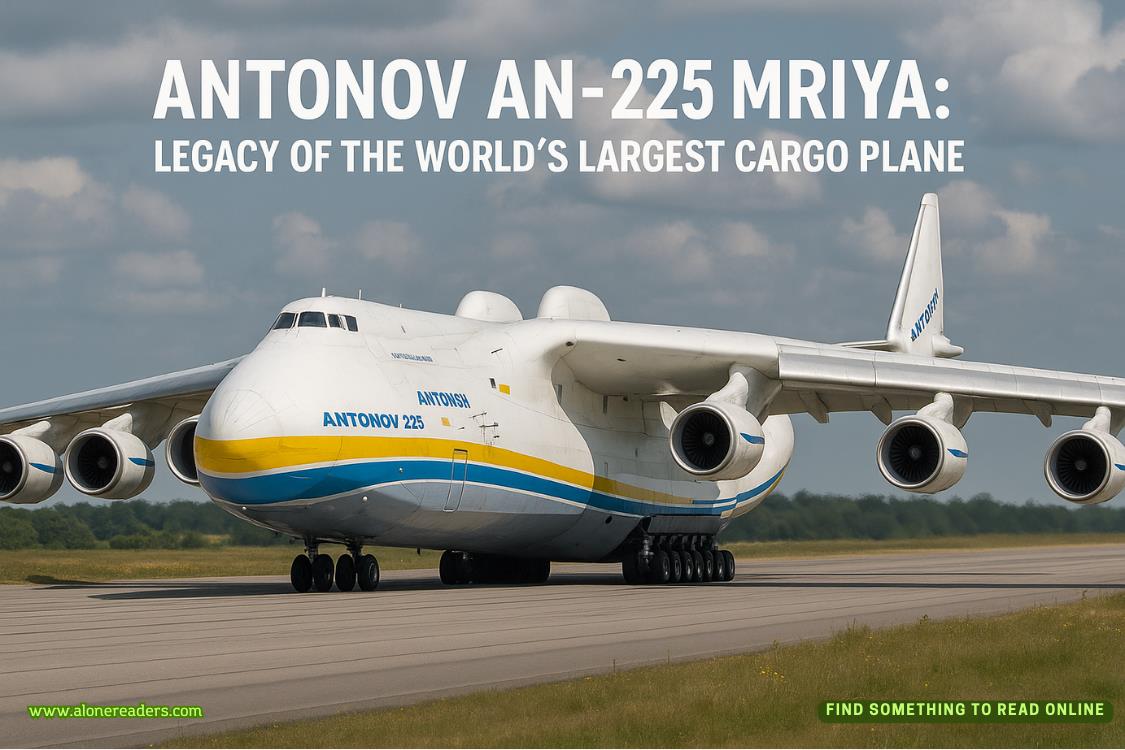
The Antonov An-225 Mriya, often simply called “Mriya,” meaning “Dream” in Ukrainian, stands as one of the most iconic achievements in aviation history. Designed during the Soviet era in the 1980s, the An-225 was not just another aircraft—it was a symbol of engineering ambition, global logistics capability, and human ingenuity. With its colossal size, unmatched cargo capacity, and distinctive six engines, the An-225 represented the peak of heavy-lift aviation, making it a legend in both military and civilian aviation circles.
The origins of the An-225 can be traced back to the ambitious Soviet space program. In the late 1970s and early 1980s, the Soviet Union developed its counterpart to NASA’s Space Shuttle—the Buran orbiter. The challenge was not only to build the shuttle but also to transport it from assembly facilities to the Baikonur Cosmodrome launch site. The Antonov Design Bureau, already known for producing heavy cargo aircraft like the An-124 Ruslan, was tasked with creating a plane that could carry the massive Buran orbiter on its back. Out of this challenge emerged the An-225, an aircraft that dwarfed every other plane in existence.
When it first flew in 1988, the Antonov An-225 instantly claimed multiple world records. Measuring 84 meters in length and with a wingspan of 88.4 meters, it was longer and wider than any commercial jetliner. Its maximum takeoff weight was an astounding 640 tonnes, the highest of any aircraft ever built. With six Progress D-18T turbofan engines and a unique 32-wheel landing gear system, the An-225 was capable of transporting oversized and ultra-heavy cargoes that no other plane could handle. From giant turbines to humanitarian aid supplies, the aircraft’s versatility was unmatched.
One of the most remarkable aspects of the An-225’s design was its ability to carry external loads. Much like the American Boeing 747 Shuttle Carrier Aircraft, the Mriya could carry the Soviet Buran space shuttle on its back. This capability was crucial during the short-lived Soviet shuttle program, though the collapse of the USSR in 1991 curtailed the project and left the An-225 without its primary mission. Nonetheless, the aircraft was adapted for commercial purposes, and under the banner of Antonov Airlines, it began transporting oversized industrial equipment and critical supplies across the globe.
The An-225 became a true global workhorse, despite being only one in existence. Its ability to transport up to 250 tonnes of cargo meant it was often called upon for highly specialized missions. From delivering massive power generators to carrying relief supplies after natural disasters, the Mriya served industries and humanitarian missions alike. During the COVID-19 pandemic, for example, the An-225 played a critical role by transporting huge quantities of medical supplies, including personal protective equipment, to countries in urgent need.
For aviation enthusiasts, watching the An-225 land or take off was a spectacle. Crowds gathered at airports around the world whenever news broke that the giant would be arriving. Its scale made even the largest passenger jets like the Boeing 747 or Airbus A380 look small in comparison. Its unique double vertical stabilizers, six massive engines, and expansive wingspan gave it a presence that few could ignore. It became not only a marvel of engineering but also a cultural icon, frequently featured in documentaries, exhibitions, and air shows.
Yet, despite its glory, the An-225 had limitations. Its sheer size restricted it to airports with runways long and strong enough to handle its weight. Maintenance and operation costs were enormous, and because only one aircraft was ever completed, the absence of a fleet meant that logistical support was often complex. A second An-225 was partially constructed during the Soviet era but never completed, leaving the world with a single functioning Mriya. This rarity further added to its mystique, making it a true one-of-a-kind aircraft.
Tragically, the fate of the An-225 took a dark turn in 2022 during the Russian invasion of Ukraine. Stationed at Hostomel Airport near Kyiv, the aircraft was destroyed in a military attack. Images of the burnt-out remains of the world’s largest plane shocked aviation enthusiasts and the general public alike. Its destruction was mourned internationally as not just the loss of an aircraft, but the loss of a symbol of human achievement, collaboration, and engineering brilliance. The Mriya had transcended its role as a machine and had become a global cultural treasure.
Since its destruction, discussions about rebuilding the An-225 have captured headlines. Antonov officials and Ukrainian leaders have expressed interest in completing the second unfinished airframe, effectively giving the world a “reborn” Mriya. However, such a project comes with enormous financial and technical challenges. Estimates suggest it could cost billions of dollars to reconstruct the aircraft, not to mention the need for global cooperation in sourcing components and ensuring long-term operational support. Whether the dream of restoring the An-225 will ever be realized remains uncertain, but the spirit of Mriya continues to inspire engineers, aviation fans, and future innovators.
The legacy of the Antonov An-225 is not defined solely by its specifications or records. It stands as a testament to what is possible when engineering ambition meets human determination. The aircraft bridged eras—from the Cold War rivalry of space programs to modern global humanitarian missions. It showed that technology could be both a tool of geopolitical ambition and a means of global service. Even in its absence, the An-225 lives on in the memories of those who saw it, the photographs and films that documented its flights, and the global admiration it garnered.
In many ways, the Antonov An-225 was more than an aircraft. It was a dream made real—a Mriya that connected nations, carried hope, and symbolized the limitless potential of human innovation. Though its physical form was destroyed, its story ensures that it will remain immortal in aviation history. Whether or not another An-225 takes to the skies, the original Mriya’s place as the world’s largest cargo plane and a legendary icon of flight is forever secured.



 Château de Vincennes: France’s Forgotten Royal Fortress and Medieval Stronghold
 Château de Carcassonne: Europe’s Greatest Medieval Citadel and Fortress
 Château de Chenonceau: The Castle Built by Remarkable Women
 Château de Chambord: France’s Magnificent Renaissance Castle and Architectural Wonder
 Tehri Dam: India's Tallest Dam and the Debate Behind It
 Bhakra Nangal Dam: India's Temple of Modern Development