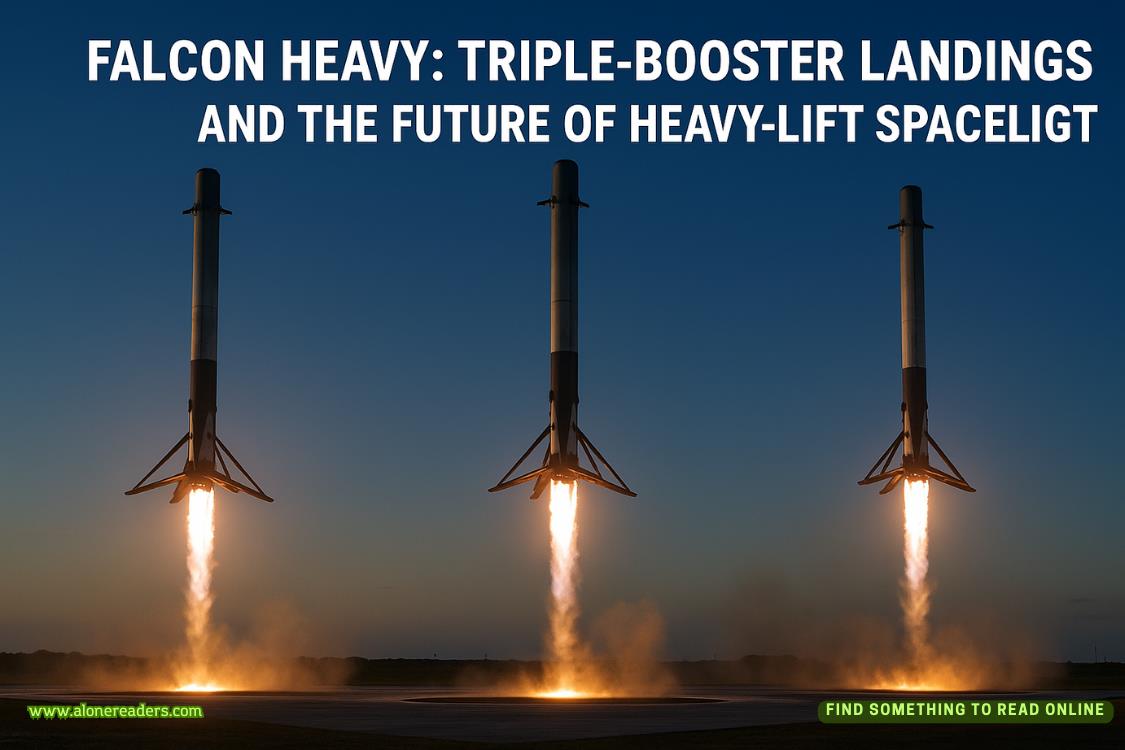
Falcon Heavy, SpaceX’s most powerful operational rocket, represents one of the greatest engineering achievements of modern spaceflight. Designed to carry massive payloads into orbit while simultaneously pioneering reusability, Falcon Heavy stands as both a technological marvel and a symbol of a new era of commercial space exploration. Its most iconic feature—the synchronized landing of its triple boosters—has captured worldwide attention, redefining what rockets can do and how humanity thinks about sustainable spaceflight.
The Falcon Heavy is essentially three Falcon 9 first-stage boosters strapped together, creating a powerhouse capable of lifting 63,800 kilograms (140,660 pounds) into low Earth orbit (LEO). This figure makes it the most capable rocket currently in service, second only to NASA’s retired Saturn V and the Soviet N1 in raw lift capacity. Each booster is powered by nine Merlin engines, totaling 27 engines firing simultaneously at liftoff, producing more than five million pounds of thrust. This immense power allows Falcon Heavy to not only deliver satellites and spacecraft into various orbits but also to support missions that could one day extend humanity’s reach to the Moon, Mars, and beyond.
What sets Falcon Heavy apart from earlier heavy-lift launch vehicles is not just raw power but reusability. Traditionally, heavy-lift rockets like Saturn V were entirely expendable, burning through billions of dollars in hardware that ended up as scrap metal in the ocean. SpaceX changed this paradigm by engineering boosters that return to Earth intact. The triple-booster configuration of Falcon Heavy allows for two side boosters to separate and perform synchronized landings at designated landing zones near the launch site, while the central core attempts to land on an autonomous drone ship at sea. Watching the twin boosters descend in perfect harmony, firing their engines in the final seconds before touchdown, has become one of the most striking images in spaceflight history.
The first Falcon Heavy test flight on February 6, 2018, demonstrated the rocket’s capabilities in a spectacular way. Carrying Elon Musk’s personal Tesla Roadster as a dummy payload, the launch was both a technological trial and a marketing spectacle. The mission succeeded in sending the car into a heliocentric orbit stretching out toward Mars, while both side boosters returned flawlessly to Cape Canaveral. The center core, however, missed its landing and was lost at sea. Despite that setback, the launch proved that Falcon Heavy was capable of doing what no other rocket in the world could at that time—launching heavy payloads and recovering a majority of its hardware for reuse.
Since then, Falcon Heavy has evolved into a reliable workhorse for commercial, governmental, and scientific missions. It has carried payloads for the U.S. Department of Defense, delivered satellites into geostationary orbit, and supported scientific missions requiring unique orbital trajectories. The ability to recover boosters not only reduces costs but also accelerates the turnaround time for future launches. This reusability aspect is particularly vital in making spaceflight more sustainable and commercially viable, enabling more frequent missions without the prohibitive costs of building entirely new rockets for each launch.
One of the most impressive demonstrations of Falcon Heavy’s prowess came during the Arabsat-6A mission in April 2019. This launch marked the first time all three boosters returned successfully—the side boosters landed at Cape Canaveral, while the central core touched down on a drone ship stationed in the Atlantic Ocean. This achievement showcased the maturity of SpaceX’s landing technology and provided proof that heavy-lift rockets could indeed be reused effectively, an accomplishment once deemed impossible in aerospace engineering.
The triple-booster landing spectacle is not merely a showpiece; it represents a fundamental shift in the economics of space travel. By reusing the most expensive parts of the rocket, SpaceX can offer heavy-lift services at a fraction of the cost charged by traditional aerospace companies. For example, while older heavy-lift rockets such as the Delta IV Heavy have launch costs exceeding $350 million, Falcon Heavy’s advertised base price is around $90 million, with variations depending on mission complexity. This dramatic reduction in cost has made high-capacity launches more accessible to both governments and private companies, fueling an expanding ecosystem of satellite operators, scientific institutions, and even prospective lunar missions.
Beyond Earth orbit, Falcon Heavy has demonstrated capabilities for interplanetary missions. NASA selected Falcon Heavy for several critical projects, including the Psyche mission to a metallic asteroid in the asteroid belt. Its heavy payload capacity and ability to inject spacecraft onto deep space trajectories position it as a strong candidate for upcoming lunar missions under NASA’s Artemis program, as well as commercial cargo deliveries to the Moon. In the long term, the lessons learned from Falcon Heavy are expected to inform the development of SpaceX’s next-generation launch system, Starship, which aims to carry even larger payloads and eventually transport humans to Mars.
The heavy-lift aspect of Falcon Heavy is particularly important in supporting humanity’s long-term goals in space. Missions to Mars, for instance, require massive amounts of cargo—habitats, supplies, equipment, and fuel. Without rockets like Falcon Heavy, staging such missions would be prohibitively difficult. The ability to launch large payloads reduces the need for multiple smaller launches, streamlining mission planning and reducing risks. Moreover, Falcon Heavy can support national security missions that demand launching extremely heavy and sensitive payloads into precise orbits, bolstering its strategic importance for the United States and allied nations.
Despite its successes, Falcon Heavy also highlights the engineering challenges of heavy-lift reusable rockets. The central core landings remain the most difficult aspect due to the extreme velocity and distance it must cover before attempting recovery. While side booster landings have become nearly routine, successful recovery of the center booster has only been achieved once. These challenges underline that while reusable heavy-lift flight is now possible, refining it into a consistent process remains a work in progress.
Nevertheless, the broader significance of Falcon Heavy lies not just in its individual missions but in its role in reshaping global expectations for spaceflight. Its triple-booster landings symbolize the shift from wasteful expendability to sustainable reusability. Its heavy-lift power expands possibilities for exploration beyond Earth orbit. And its relatively affordable launch costs democratize access to space for more players than ever before. In many ways, Falcon Heavy is both a transitional and transformative vehicle—a bridge between the expendable giants of the past and the fully reusable spacecraft of the future.
Looking forward, Falcon Heavy will likely continue to serve high-priority missions throughout the decade. With increasing demand for mega-constellations of satellites, deep space probes, and lunar exploration initiatives, the rocket’s unique blend of heavy-lift power and reusability will remain invaluable. At the same time, SpaceX is shifting focus toward the even larger Starship system, which aims to surpass Falcon Heavy in payload capacity while achieving full reusability across all stages. When Starship becomes operational, Falcon Heavy may be remembered as the rocket that proved heavy-lift reusability was not just possible but practical, paving the way for the next leap in space exploration.
In conclusion, Falcon Heavy represents a landmark in the history of rocketry, combining unprecedented power with revolutionary reusability. Its triple-booster landings have become an iconic visual of modern spaceflight, while its heavy-lift capabilities have opened new opportunities for science, defense, and exploration. By lowering costs and proving reusability at scale, Falcon Heavy has not only changed how rockets are built but also how humanity thinks about traveling into space. As the world stands on the threshold of deeper ventures into the cosmos, Falcon Heavy’s legacy will remain firmly secured as the rocket that redefined the future of heavy-lift spaceflight.



 Château de Vincennes: France’s Forgotten Royal Fortress and Medieval Stronghold
 Château de Carcassonne: Europe’s Greatest Medieval Citadel and Fortress
 Château de Chenonceau: The Castle Built by Remarkable Women
 Château de Chambord: France’s Magnificent Renaissance Castle and Architectural Wonder
 Tehri Dam: India's Tallest Dam and the Debate Behind It
 Bhakra Nangal Dam: India's Temple of Modern Development