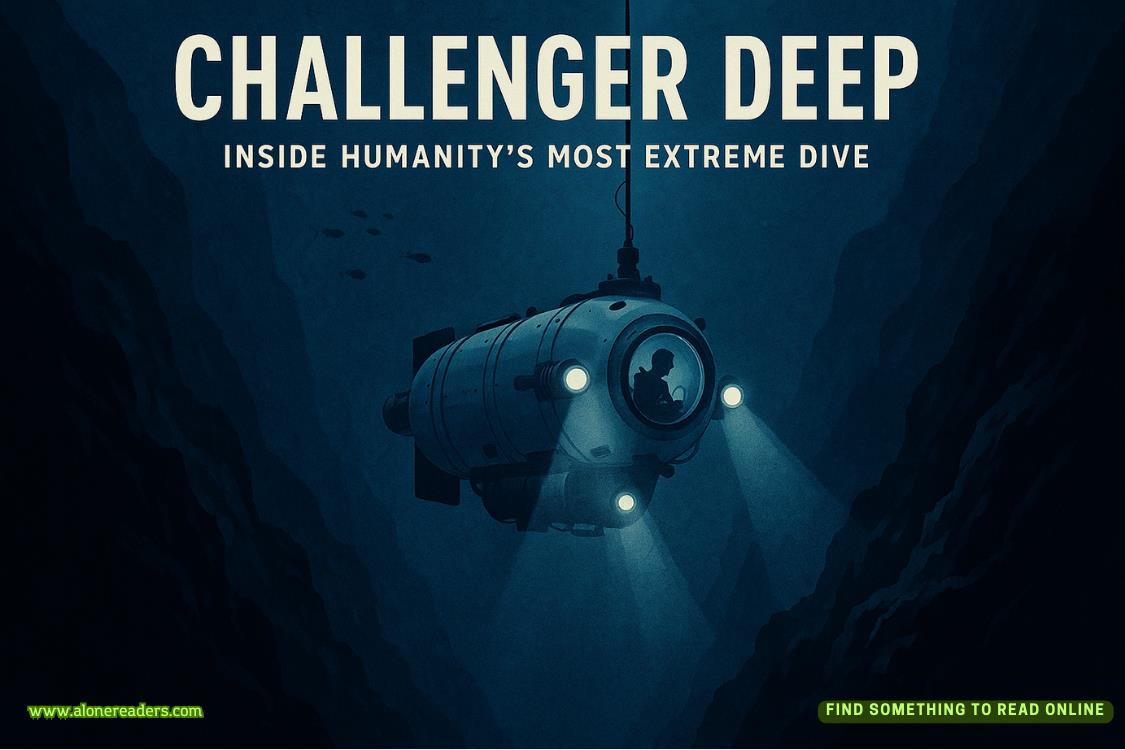
Challenger Deep is the single deepest known point in Earth’s oceans, lying within the Mariana Trench in the western Pacific. Its depth, approximately 10,935 meters below sea level, makes it an environment as extreme and alien as any encountered by humanity. Unlike mountain peaks, which are visible to the eye, Challenger Deep remains hidden beneath kilometers of crushing seawater. It represents not only a geographical point of interest but also a symbol of human curiosity and technological daring, as only a handful of people have ever visited it.
The trench itself was first measured during the 1870s by the British Royal Navy vessel HMS Challenger, which gave the site its name. Sounding lines lowered into the water indicated extraordinary depths far beyond what scientists then believed possible. Subsequent surveys with sonar in the 20th century refined those measurements, confirming that Challenger Deep was the most profound abyss on the planet. The allure of such a place soon sparked visions of descending into its inky void, but the challenge was immense. The water pressure at that depth is more than 1,000 times the atmospheric pressure at sea level—enough to crush most submarines instantly.
The first humans to descend to Challenger Deep did so in 1960. The Bathyscaphe Trieste, piloted by Swiss oceanographer Jacques Piccard and U.S. Navy Lieutenant Don Walsh, reached the bottom after a nearly five-hour descent. Their dive was a landmark achievement in exploration, comparable to the first ascent of Mount Everest or the Apollo missions to the Moon. Trieste’s steel sphere, only large enough for two people, endured the crushing pressure and allowed its crew to briefly observe a murky seafloor. Their reports of flatfish-like organisms living in such conditions challenged assumptions about the limits of life.
After that historic dive, no human returned to Challenger Deep for more than 50 years. The technical difficulties, staggering costs, and limited practical payoff of such extreme expeditions meant that deep-sea exploration was often left to remotely operated vehicles (ROVs) or sonar mapping missions. However, the mystique of Challenger Deep never faded. In 2012, Canadian filmmaker James Cameron reignited public fascination by piloting the Deepsea Challenger, a vertical green submersible of his own design, into the trench. Cameron’s solo dive was a remarkable feat of engineering, offering high-definition footage and detailed observations of the seafloor. His success demonstrated that new materials, such as specially designed syntactic foams, could withstand the unimaginable pressure while still allowing for lightweight mobility.
Since Cameron’s dive, a handful of other missions have followed. In recent years, private ventures led by explorers like Victor Vescovo have made multiple descents, further mapping the trench and proving that technology is now advanced enough for repeated visits. Vescovo’s Five Deeps Expedition in 2019 marked the first time multiple dives were conducted to Challenger Deep, confirming depths with high precision and documenting new life forms. These missions revealed amphipods and other creatures adapted to pitch-black, freezing, and pressurized conditions, broadening our understanding of biology in extreme environments.
The significance of Challenger Deep is not limited to its depth alone. It offers profound insights into geology, chemistry, and biology. The trench lies at a tectonic plate boundary where the Pacific Plate is subducted beneath the Philippine Sea Plate. Studying its sediments and structures helps scientists understand earthquakes, volcanism, and the cycling of material into Earth’s mantle. Chemically, the trench’s environment is marked by unique processes, such as methane seeps and mineral reactions that occur only under high pressure. Biologically, the organisms that thrive there could hold clues to the resilience of life, potentially informing studies of extraterrestrial environments like Europa or Enceladus, moons thought to harbor deep oceans beneath icy crusts.
Yet diving into Challenger Deep remains perilous. The descent requires hours of travel in cramped quarters, total reliance on life-support systems, and an acceptance of risks that cannot be fully eliminated. A single flaw in a submersible’s hull or life-support system could mean instant catastrophe. Communication with the surface is limited to low-bandwidth signals, meaning that those inside the vessel are largely on their own. The psychological strain of isolation in darkness, surrounded by crushing water, is as challenging as the technical hazards. For these reasons, every successful dive to Challenger Deep stands as a testament to human ingenuity and courage.
The exploration of Challenger Deep has also been a frontier for innovation. Advances in materials science, robotics, and sonar mapping have emerged directly from efforts to probe its depths. Pressure-resistant alloys, syntactic foams, and battery systems designed for extreme environments have found applications in engineering and even space exploration. The data gathered from deep-sea dives also feeds into conservation work, as the trench and surrounding areas are vulnerable to human impacts. Alarmingly, traces of plastic and pollutants have already been discovered in the trench, a sobering reminder that human activity reaches even Earth’s most inaccessible places.
Public imagination often frames Challenger Deep as Earth’s final frontier, a place where the known world ends and mystery begins. Unlike space, which stretches infinitely above us, the trench is tangible yet almost equally alien. Its exploration underscores humanity’s dual role as explorers and caretakers of the planet. We are capable of designing machines that can descend into the darkest depths, but we are also responsible for ensuring those depths remain intact and unspoiled.
Looking forward, Challenger Deep will likely continue to attract both scientists and adventurers. More affordable submersible technology, combined with international collaboration, may open the way for routine scientific missions. With every descent, we expand our understanding not only of the ocean but of ourselves—our capacity for curiosity, resilience, and pushing limits. As with the Moon landings, each dive into Challenger Deep is not merely a technical milestone but a cultural one, reminding us of the unquenchable drive to explore the unknown.
In sum, Challenger Deep is not simply the lowest point on Earth but a symbol of exploration at its most daring. From Trieste’s pioneering descent in 1960 to Cameron’s cinematic voyage and the ongoing missions of private explorers, each journey has peeled back a small layer of mystery from this abyss. Its depths continue to challenge our perception of life, resilience, and the very boundaries of possibility. It is humanity’s most extreme dive, a reminder that even on our own planet, vast worlds remain hidden, awaiting discovery beneath the waves.



 Château de Vincennes: France’s Forgotten Royal Fortress and Medieval Stronghold
 Château de Carcassonne: Europe’s Greatest Medieval Citadel and Fortress
 Château de Chenonceau: The Castle Built by Remarkable Women
 Château de Chambord: France’s Magnificent Renaissance Castle and Architectural Wonder
 Tehri Dam: India's Tallest Dam and the Debate Behind It
 Bhakra Nangal Dam: India's Temple of Modern Development










