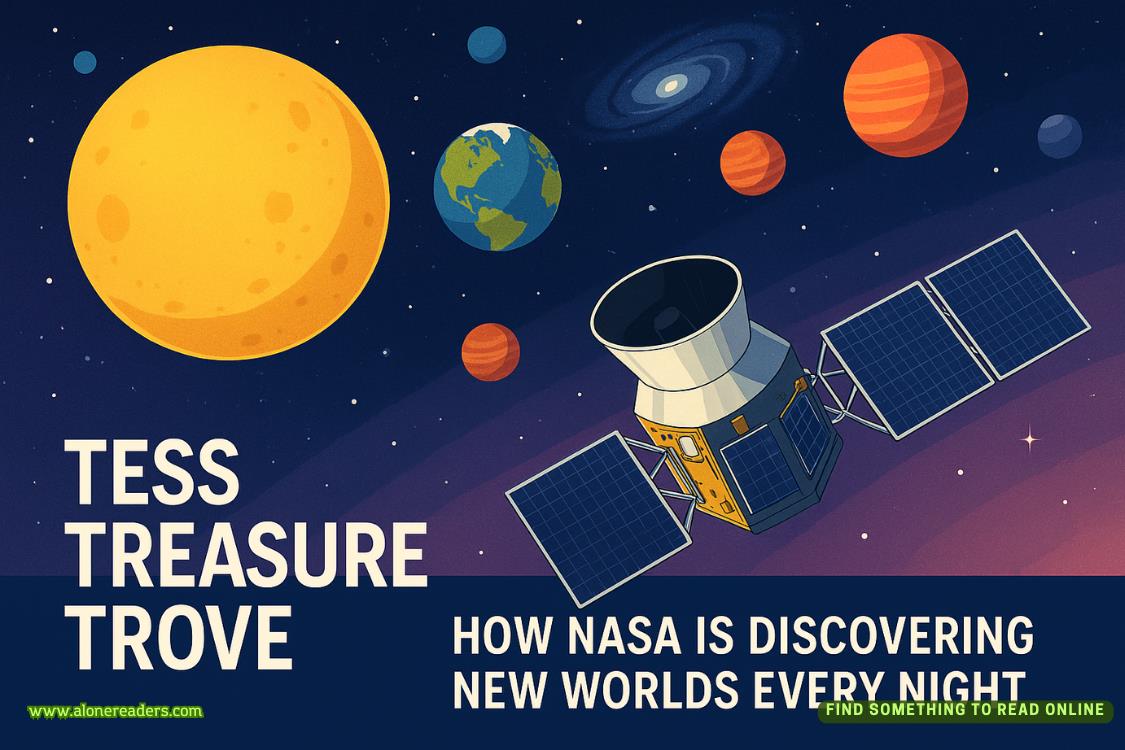
When NASA launched the Transiting Exoplanet Survey Satellite (TESS) in April 2018, the mission carried a clear ambition: to scan the vast skies and systematically search for planets orbiting stars beyond our Sun. In just a few years, TESS has transformed exoplanet science, capturing the attention of both professional astronomers and the public with its nightly yield of potential new worlds. It has been described as a “treasure trove” because of the sheer volume and diversity of discoveries, and the mission continues to reveal just how common planets may be throughout the galaxy.
TESS operates by observing wide swaths of the sky, methodically splitting its time across 26 sectors that together cover about 85% of the entire celestial dome. Its main method of detection is the transit method, a proven technique where the satellite measures the tiny, periodic dimming of a star as a planet crosses in front of it. Each subtle dip in brightness becomes a clue, potentially signaling the presence of an orbiting world. With its four highly sensitive cameras, TESS is designed to catch these fleeting events with precision, enabling astronomers to identify planets ranging from gas giants larger than Jupiter to rocky bodies only slightly bigger than Earth.
What makes TESS stand out from earlier missions, like the iconic Kepler telescope, is its focus on stars that are relatively nearby and bright. Kepler provided the first statistical census of planets, revealing that planets are common throughout the galaxy, but many of its targets were faint and distant. TESS, in contrast, concentrates on stars close enough that follow-up studies can be performed with ground-based telescopes and, most importantly, the James Webb Space Telescope. This deliberate design means that the planets TESS discovers are prime candidates for atmospheric studies and habitability assessments. Instead of just telling us how many planets exist, TESS is giving us worlds we can study in detail.
The nightly pace of discovery is extraordinary. Each time the satellite observes a sector, astronomers receive torrents of data filled with light curves—graphs of star brightness over time—that need to be analyzed. Automated algorithms flag potential planetary transits, and then teams of scientists carefully vet the candidates to separate genuine planets from false positives caused by stellar activity, binary star systems, or instrumental noise. Even so, thousands of candidates have been identified, and many have already been confirmed as bona fide exoplanets. These include super-Earths, sub-Neptunes, and even planets in systems with multiple worlds, painting a picture of an astonishingly diverse cosmic neighborhood.
Among the most exciting TESS discoveries are planets that could potentially harbor life. Several small, rocky worlds have been found in the habitable zones of their stars, where conditions might allow liquid water to exist on their surfaces. While these worlds remain unproven as cradles of life, they serve as tantalizing targets for Webb and other observatories. The discovery of TOI-700 d, for example, a roughly Earth-sized planet in its star’s habitable zone, was hailed as a landmark moment for TESS. Later, additional planets in the same system were found, underscoring the mission’s ability to reveal entire planetary families.
Another remarkable aspect of TESS is how it has democratized the search for exoplanets. Because its data is publicly available, professional astronomers, students, and even amateur sky-watchers can contribute to the effort. Citizen science projects like Planet Hunters TESS invite volunteers worldwide to sift through light curves, identifying transit signals that algorithms might miss. This collective approach has already led to several significant discoveries, proving that the excitement of planetary exploration is not limited to research institutions alone but is shared across the global community.
The mission has also produced unexpected scientific bonuses beyond planets. TESS has observed countless variable stars, supernovae, and other transient events, creating a rich archive of stellar phenomena. By watching the brightness of so many stars over time, the satellite has helped refine models of stellar evolution, measure the masses and sizes of stars with greater accuracy, and provide alerts for unusual cosmic events. This dual role as a planet hunter and general astrophysical observatory has expanded TESS’s impact far beyond its original charter.
As the mission continues, astronomers are looking ahead to the synergy between TESS and Webb. When TESS identifies a promising exoplanet, Webb can be directed to observe its atmosphere through techniques like transmission spectroscopy, where the light of the star passing through the planet’s atmosphere reveals its composition. These follow-up studies may detect water vapor, carbon dioxide, or other molecules associated with habitability. In this way, TESS functions as the scout, pointing us toward the most valuable planetary systems, while Webb serves as the microscope, examining them in exquisite detail.
TESS’s discoveries are reshaping our view of the universe on a nightly basis. What once seemed like distant speculation—that Earth-like worlds might be common—is now grounded in evidence. The sheer number of planets identified suggests that our galaxy alone may host billions of habitable-zone worlds, raising profound questions about the possibility of life elsewhere. Each confirmed planet is a data point in a grand cosmic census, telling us not only about other worlds but about the processes that formed our own.
The mission is not without challenges. Data processing remains a monumental task, with false positives still requiring careful elimination. The interpretation of light curves also depends on accurate models of stars, and stellar activity such as spots or flares can sometimes mimic planetary signals. However, advances in data science, machine learning, and collaborative analysis have improved the reliability of detections and accelerated the pace of confirmation. With every passing month, the catalog of confirmed TESS planets grows, adding richness to humanity’s astronomical archives.
Ultimately, the TESS treasure trove represents one of the most profound shifts in modern astronomy: the transition from speculation to observation. For centuries, philosophers and scientists debated whether planets existed around other stars, but now their presence is not only confirmed but cataloged by the thousands. More importantly, these are not abstract statistics—they are nearby, real worlds, many of which we may study in depth within our lifetimes. Each night, TESS quietly watches the stars, and with every dimming of starlight, we inch closer to understanding our place in the cosmos.
In the years to come, the legacy of TESS will likely be measured not only in the number of planets it discovers but also in the opportunities it opens for deeper exploration. By identifying the most promising candidates for atmospheric characterization and potential habitability, TESS has effectively set the stage for a new era of exoplanet science. Its nightly finds remind us that the universe is not a static backdrop but a dynamic, evolving landscape filled with hidden treasures waiting to be uncovered. Every flicker of starlight it records could be a new world, and with each one revealed, humanity takes another step in its journey to answer the timeless question: Are we alone?



 Château de Vincennes: France’s Forgotten Royal Fortress and Medieval Stronghold
 Château de Carcassonne: Europe’s Greatest Medieval Citadel and Fortress
 Château de Chenonceau: The Castle Built by Remarkable Women
 Château de Chambord: France’s Magnificent Renaissance Castle and Architectural Wonder
 Tehri Dam: India's Tallest Dam and the Debate Behind It
 Bhakra Nangal Dam: India's Temple of Modern Development










