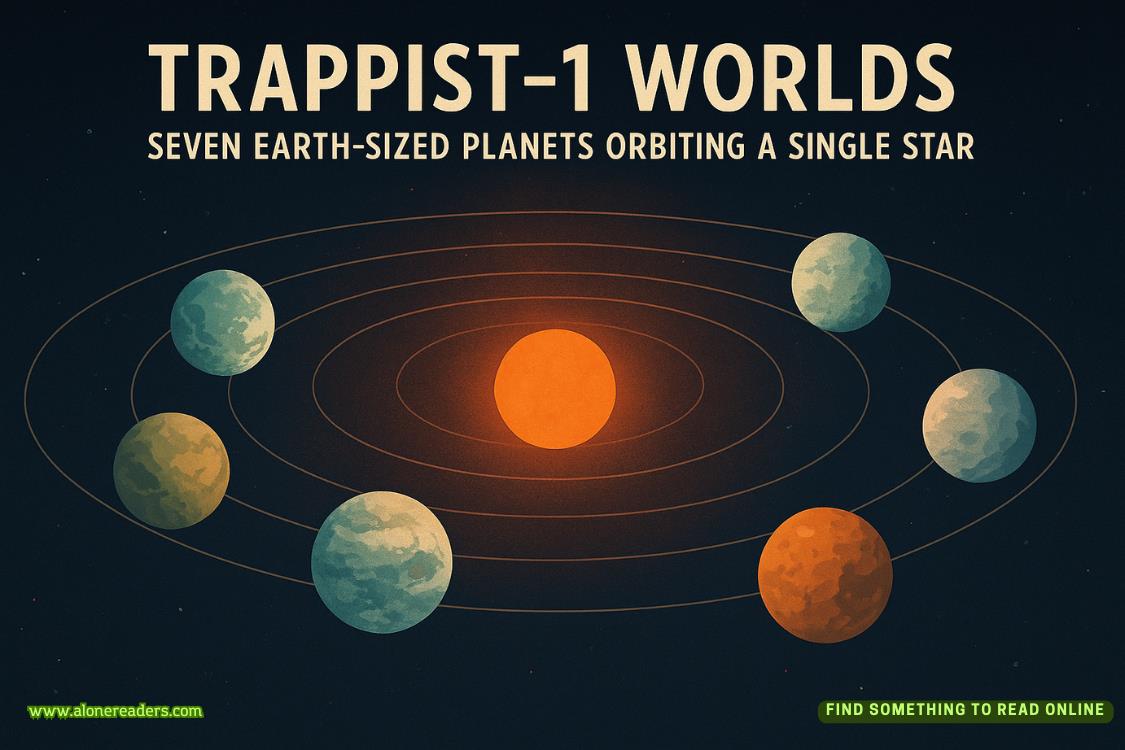
The TRAPPIST-1 system represents one of the most extraordinary astronomical discoveries of the 21st century. Located about 40 light-years away in the constellation Aquarius, it has captivated astronomers and the public alike because of its unique configuration: a single ultra-cool dwarf star orbited by seven Earth-sized planets. This remarkable system not only challenges our understanding of planetary formation but also provides a rare opportunity to study worlds that may share similarities with our own. The implications for habitability, atmospheric evolution, and the search for extraterrestrial life make TRAPPIST-1 a cornerstone in modern exoplanetary science.
The discovery was first announced in 2016 when astronomers identified three planets around the faint star using the TRAPPIST telescope in Chile. The following year, NASA confirmed that the system actually hosted seven Earth-size worlds, making it the largest batch of terrestrial planets ever detected around a single star. The significance of this discovery cannot be overstated. Each planet is rocky rather than gaseous, and at least three of them orbit within the star’s so-called habitable zone, the region where conditions could allow liquid water to exist on the surface. The star itself is a dim red dwarf, about the size of Jupiter, and only slightly larger in diameter. It emits far less radiation than our Sun, which means its habitable zone is much closer to the star compared to Earth’s orbit around the Sun.
One of the most fascinating aspects of TRAPPIST-1 is the compact nature of its planetary orbits. All seven planets orbit closer to their star than Mercury does to the Sun, yet because the star is so faint, this proximity does not automatically rule out the possibility of habitable conditions. In fact, the planets form a kind of cosmic clockwork, locked in orbital resonances that stabilize their movements. This gravitational dance provides astronomers with a wealth of data about their masses, densities, and potential compositions. Several of the planets have densities suggesting rocky surfaces with possible atmospheres, while others may even harbor subsurface oceans, similar to the icy moons of Jupiter and Saturn.
The potential for habitability within the TRAPPIST-1 system has generated intense interest. While three of the planets—designated TRAPPIST-1e, TRAPPIST-1f, and TRAPPIST-1g—lie within the star’s habitable zone, habitability depends on more than just distance. The composition and thickness of atmospheres, levels of greenhouse gases, and the intensity of stellar radiation all influence whether liquid water could actually exist. Researchers are particularly hopeful about TRAPPIST-1e, considered the most Earth-like in terms of size, density, and the amount of stellar energy it receives. However, the harsh realities of red dwarf stars complicate the picture. Such stars are known for their frequent flares, which can strip away atmospheres and bombard planets with high-energy radiation, potentially making the environment hostile to life.
Despite these challenges, the TRAPPIST-1 system remains one of the best laboratories for studying exoplanet atmospheres. The planets are relatively close to Earth in cosmic terms, and their transits across the face of the star offer astronomers an opportunity to examine starlight filtered through their atmospheres. Using telescopes like the Hubble Space Telescope and, more recently, the James Webb Space Telescope (JWST), scientists are searching for chemical signatures such as water vapor, methane, oxygen, or carbon dioxide. These molecules could provide critical evidence about whether these worlds maintain stable atmospheres or even show biosignatures hinting at life. Early studies suggest that some of the planets may lack thick hydrogen envelopes, a positive sign that they could have Earth-like atmospheres instead of being mini-Neptunes.
The TRAPPIST-1 discovery also forces scientists to rethink the diversity of planetary systems. Our own solar system, with its wide spacing between planets and distinct categories of rocky and gas giants, appears quite different from TRAPPIST-1’s compact and uniform arrangement. This raises profound questions about planetary formation. Did these seven planets migrate inward after forming further out, or did they form in place from a dense protoplanetary disk? Understanding this process helps refine models of how planets evolve and how common such systems might be across the galaxy. If tightly packed Earth-size planets around dwarf stars turn out to be common, the number of potentially habitable worlds in the Milky Way could be far greater than previously imagined.
Beyond pure science, the TRAPPIST-1 system has captured the human imagination because it feels almost like a miniature version of our solar system—a compact family of rocky planets huddled around a faint star. This has fueled speculation about future exploration. While sending spacecraft to TRAPPIST-1 is beyond our technological reach for now, studies of its planets with advanced telescopes are already reshaping the way we think about life in the universe. If even one of these worlds shows signs of an atmosphere suitable for sustaining water, it would dramatically expand the horizons of astrobiology. In turn, this would have profound philosophical implications for humanity’s place in the cosmos.
The role of the James Webb Space Telescope is especially critical in advancing our understanding of TRAPPIST-1. Equipped with powerful instruments capable of analyzing the faintest of light signals, JWST is well-suited to probe the atmospheres of these planets. The data it collects could determine whether greenhouse effects make some planets too hot, or whether others retain enough warmth to support oceans beneath their surfaces. Even if none of the TRAPPIST-1 worlds turn out to be truly habitable, studying them will offer invaluable insights into the boundary conditions of planetary climates, shedding light on the delicate balance that makes Earth itself a rare gem in the universe.
TRAPPIST-1 also underscores the importance of international collaboration in astronomy. The discovery relied on telescopes and observatories across the globe, along with support from space agencies such as NASA and ESA. It also illustrates how advances in technology, from sensitive infrared detectors to sophisticated data analysis techniques, are enabling humanity to peer deeper into the cosmos than ever before. The continued monitoring of TRAPPIST-1, coupled with theoretical modeling, promises to keep this system at the forefront of astronomical research for decades to come.
In the broader context of space exploration, the TRAPPIST-1 system serves as a symbol of both possibility and limitation. On one hand, it demonstrates that Earth-sized planets are not rare and that compact systems of such planets may be abundant. On the other hand, it highlights the immense difficulties of confirming habitability from afar. Distinguishing between a planet that is barren and one that harbors life requires patience, technological innovation, and careful interpretation of limited data. Yet, the pursuit itself is a testament to humanity’s enduring curiosity and desire to understand its place in the universe.
Ultimately, the TRAPPIST-1 system is a reminder that the search for life beyond Earth is both a scientific and existential quest. The seven Earth-sized planets orbiting a single, faint star may not turn out to host thriving biospheres, but they represent a crucial stepping stone in the journey. Each measurement, each transit observation, and each atmospheric analysis brings us closer to answering one of the oldest questions: Are we alone? Whether the answer lies in TRAPPIST-1 or elsewhere, the journey to find it enriches our knowledge, deepens our wonder, and fuels the imagination of generations to come.



 Château de Vincennes: France’s Forgotten Royal Fortress and Medieval Stronghold
 Château de Carcassonne: Europe’s Greatest Medieval Citadel and Fortress
 Château de Chenonceau: The Castle Built by Remarkable Women
 Château de Chambord: France’s Magnificent Renaissance Castle and Architectural Wonder
 Tehri Dam: India's Tallest Dam and the Debate Behind It
 Bhakra Nangal Dam: India's Temple of Modern Development