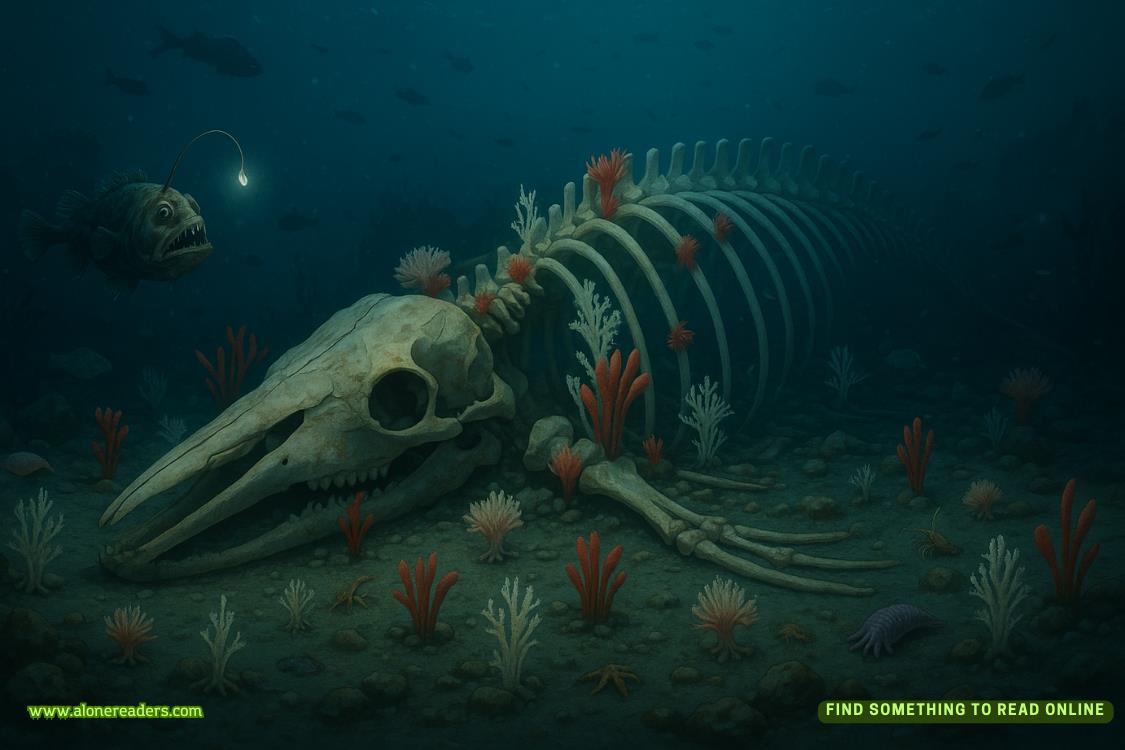
When a whale dies in the open ocean, its massive body begins a final journey that reshapes the environment around it. Unlike smaller creatures, whose remains are quickly consumed or dispersed, a whale carcass sinks to the ocean floor in an event known as a “whale fall.” This phenomenon creates an ecosystem that can thrive for decades, sustaining countless species in an otherwise barren and nutrient-poor deep-sea world. From the initial descent to the final stages of decomposition, whale falls are a striking reminder of how even in death, giants of the sea continue to give life.
The process begins as the whale’s body, sometimes weighing over 100 tons, descends through the darkening water column. This descent alone can take hours, and scavengers often follow closely. When the carcass finally comes to rest on the ocean floor, it delivers a sudden, concentrated burst of organic material. The deep sea, normally characterized by scarce nutrients, is abruptly transformed into a feast site. Sharks, hagfish, and sleeper sharks arrive first, tearing into the soft tissue. Their feeding frenzy may last months, stripping away blubber and flesh in astonishing efficiency.
As the large scavengers depart, smaller opportunistic creatures move in. Crabs, worms, amphipods, and shrimp pick apart the remaining scraps, feeding on tissue hidden in crevices. Within a year or two, much of the flesh is gone, leaving behind a massive skeleton. But the whale’s gift does not end here. The bones themselves contain lipids and oils that slowly release nutrients into the sediment. These resources attract an entirely new set of organisms adapted to thrive in such conditions.
It is in this stage that some of the most fascinating communities emerge. Specialized bacteria colonize the bones, breaking down the fats and producing hydrogen sulfide. This chemical becomes the foundation of a unique food chain, as sulfide-oxidizing bacteria use it to produce energy in a process known as chemosynthesis. Just as hydrothermal vents support life through chemical energy instead of sunlight, whale falls create mini oases powered by decomposition. Species of mussels, clams, and tubeworms gather, feeding on these bacterial mats and sustaining higher predators like sea cucumbers and crabs.
Whale falls also act as incubators of biodiversity. Many organisms associated with them are rarely found elsewhere, and some species may be exclusive to these habitats. For example, bone-eating worms known as Osedax bore into the skeleton to extract fats, their root-like structures allowing them to thrive in this unusual niche. These worms, discovered only in the early 2000s, have since expanded our understanding of how life adapts to deep-sea extremes. Their presence highlights the ecological novelty of whale falls as distinct ecosystems rather than just temporary feeding sites.
Over time, the whale fall progresses into a sulfophilic stage, where bones become fully colonized by bacteria and worms. This stage can persist for decades, depending on the size of the whale and the conditions of the seafloor. Eventually, the nutrients are exhausted, and the site fades back into the nutrient-poor environment. Yet the legacy of the whale fall endures, as genetic material, energy, and even species that once thrived there disperse into surrounding areas, enriching the broader deep-sea ecosystem.
The significance of whale falls extends beyond ecology. They provide insight into the evolutionary history of deep-sea life. Scientists believe that whale falls may have acted as stepping stones for the colonization of hydrothermal vents and cold seeps. Both ecosystems rely on chemosynthesis, and whale falls might have served as temporary habitats that allowed species to spread across the vast distances of the ocean floor. In this sense, whale deaths may have shaped the distribution and diversification of life in the deep.
Human activity, however, poses new challenges for this natural cycle. Industrial whaling in the past two centuries drastically reduced whale populations, which in turn decreased the frequency of whale falls. With fewer carcasses reaching the ocean floor, entire communities that depend on them may have diminished. Today, as whale populations recover in some regions due to conservation efforts, scientists are hopeful that whale falls are once again becoming more common, reestablishing their role as vital ecological hotspots.
Exploration of whale falls also underscores how much remains unknown about the deep sea. Many discoveries are made accidentally by remotely operated vehicles or deep-sea submersibles encountering carcasses during unrelated missions. Each new whale fall provides an opportunity to study rare organisms, novel chemical processes, and complex food webs. The rarity and unpredictability of these events make them difficult to study systematically, but also increase their scientific value.
From a broader perspective, whale falls embody the principle of ecological recycling. A creature that once roamed the ocean as a titan continues to nourish life long after its death. This cycle mirrors the interconnectedness of all ecosystems, where death and decay are not ends but transformations that sustain future generations. The ocean floor, often portrayed as desolate and lifeless, reveals itself instead as a stage for renewal and adaptation, sparked by the fall of a whale.
In the grand narrative of the ocean, whale falls are chapters that remind us of both the fragility and resilience of life. They are reminders that even the end of a life can be the beginning of countless others, and that the ocean, vast as it is, thrives on hidden connections. By continuing to study and protect whales, humanity safeguards not only magnificent creatures but also the unseen communities born from their bones.



 Château de Vincennes: France’s Forgotten Royal Fortress and Medieval Stronghold
 Château de Carcassonne: Europe’s Greatest Medieval Citadel and Fortress
 Château de Chenonceau: The Castle Built by Remarkable Women
 Château de Chambord: France’s Magnificent Renaissance Castle and Architectural Wonder
 Tehri Dam: India's Tallest Dam and the Debate Behind It
 Bhakra Nangal Dam: India's Temple of Modern Development