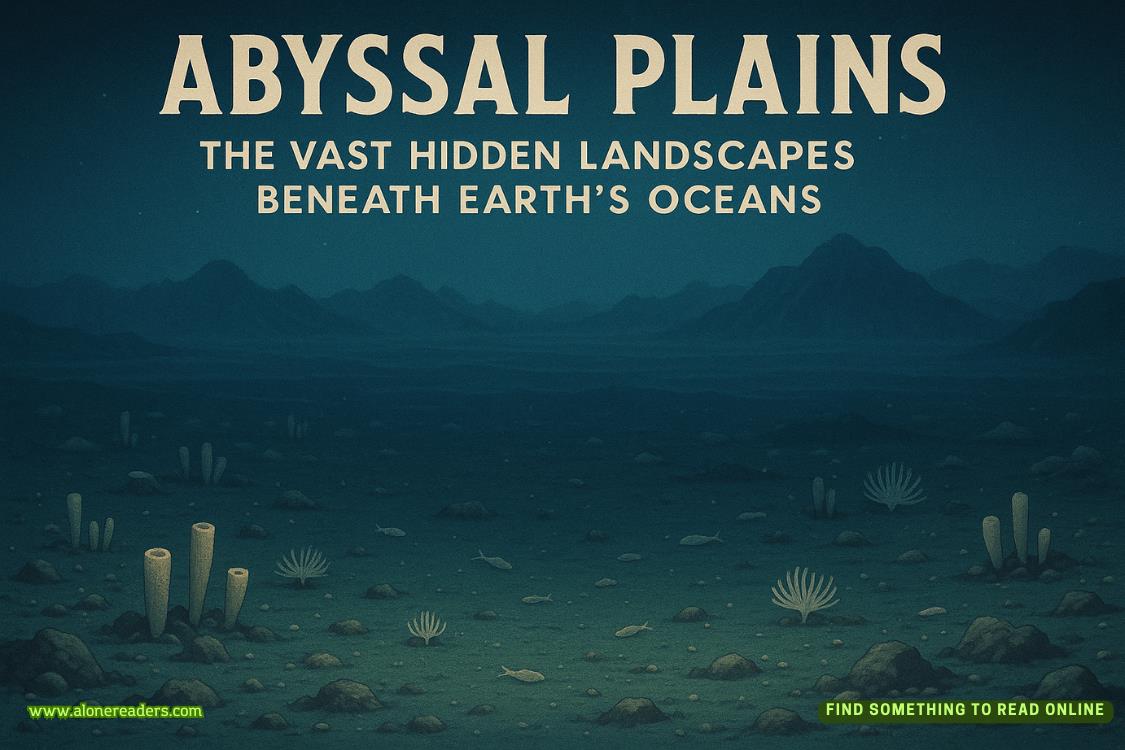
The abyssal plains are among the most expansive yet least understood regions of our planet. Hidden beneath thousands of meters of water, these vast underwater plateaus stretch across the ocean floor, forming the largest continuous landscapes on Earth. They are so extensive that they cover more than half of the planet’s surface, yet remain invisible to human eyes without the aid of deep-sea exploration technology. The paradox of their immensity and inaccessibility makes them one of the loneliest and most enigmatic environments on the planet.
Formed primarily from the slow accumulation of fine sediments that settle over millions of years, abyssal plains are remarkably flat and featureless. This flatness is deceptive, however, as it masks the immense geological processes at play beneath the surface. The sediment layers bury the rugged topography of mid-ocean ridges, seamounts, and volcanic crust, creating a surface that appears almost as smooth as a tabletop on geological scales. They are usually found at depths ranging between 3,000 and 6,000 meters, where sunlight can never penetrate and pressures reach crushing levels.
Despite their seemingly barren appearance, abyssal plains are crucial for regulating the Earth’s carbon cycle and maintaining ocean health. Organic material, often referred to as “marine snow,” drifts down from surface waters and accumulates on the plains, forming a rich but sparse food source. This slow rain of particles fuels ecosystems uniquely adapted to scarcity, with creatures ranging from burrowing worms to giant sea cucumbers playing key roles in recycling nutrients. The plains thus act as vast, silent recyclers of the ocean’s organic matter, linking surface productivity with the deep ocean.
Life in the abyssal plains is sparse compared to shallower marine zones, but it is far from absent. Many species living here are endemic, found nowhere else on Earth. Deep-sea fish such as rattails and grenadiers patrol the plains, while brittle stars, amphipods, and microscopic organisms burrow into the sediment. These species have evolved extraordinary adaptations to survive in conditions of perpetual darkness, extreme pressure, and limited food supply. Some produce bioluminescence, creating faint pulses of light in the blackness, while others conserve energy by moving slowly and reproducing infrequently. This life may seem alien, yet it reveals the resilience of evolution under extreme constraints.
The abyssal plains are also a frontier for scientific discovery. Because they preserve layers of sediment that accumulate slowly over time, they serve as natural archives of Earth’s history. These sediments record climatic fluctuations, volcanic eruptions, and even the impacts of celestial objects. Scientists drilling cores from the plains can reconstruct past climates and ocean conditions stretching back millions of years, offering insights into how Earth’s systems have evolved. In this sense, the abyssal plains function as both a living ecosystem and a geological library of Earth’s past.
Human interest in the abyssal plains has grown in recent decades not only for scientific purposes but also for resource exploration. These plains are rich in polymetallic nodules—potato-sized mineral deposits containing valuable metals such as manganese, nickel, cobalt, and rare earth elements. With demand for these materials increasing due to modern technologies like batteries and renewable energy systems, the abyssal plains have become targets for potential deep-sea mining. However, this raises ethical and ecological concerns, as the disruption of such fragile ecosystems could have irreversible consequences for species that have taken millennia to adapt to their environment.
The remoteness of the abyssal plains also underscores their vulnerability to human impact. While direct human presence is rare, the effects of pollution, climate change, and plastic waste reach even these depths. Microplastics have been discovered embedded in abyssal sediments, and shifting ocean currents influenced by global warming may alter nutrient flows that sustain life. This illustrates that even the loneliest landscapes are not entirely insulated from human activity, emphasizing the interconnectedness of the planet’s systems.
Exploring the abyssal plains is an enormous technological challenge. Remote-operated vehicles (ROVs), autonomous underwater vehicles (AUVs), and deep-sea submersibles are essential for venturing into these depths. Such missions are costly and logistically complex, which is why vast areas remain unexplored. However, the limited expeditions that have been conducted reveal that the abyssal plains are not entirely monotonous. Occasional features such as abyssal hills, isolated seamounts, and deep trenches punctuate the plains, providing biodiversity hotspots where currents concentrate nutrients and life thrives in relative abundance.
Culturally, the abyssal plains symbolize both the vastness of Earth and humanity’s limited reach. They remind us that while satellites can map distant galaxies, large portions of our own planet remain largely unexplored. This reality humbles human ambition and sparks curiosity about what remains hidden in the depths. The abyssal plains are therefore more than geological formations—they are symbols of mystery, endurance, and the boundaries of knowledge.
Ultimately, the abyssal plains represent a paradoxical blend of emptiness and significance. Their vast expanses appear desolate, yet they are essential for sustaining oceanic and planetary systems. They hold the remains of ancient life, the potential for future resources, and the records of Earth’s climatic past. Though they are among the loneliest landscapes on Earth, their importance in connecting ecological, geological, and human dimensions cannot be overstated. As technology gradually unlocks their secrets, the abyssal plains stand as a reminder of how much of Earth remains beyond our daily awareness, waiting silently in the depths.



 Château de Vincennes: France’s Forgotten Royal Fortress and Medieval Stronghold
 Château de Carcassonne: Europe’s Greatest Medieval Citadel and Fortress
 Château de Chenonceau: The Castle Built by Remarkable Women
 Château de Chambord: France’s Magnificent Renaissance Castle and Architectural Wonder
 Tehri Dam: India's Tallest Dam and the Debate Behind It
 Bhakra Nangal Dam: India's Temple of Modern Development










