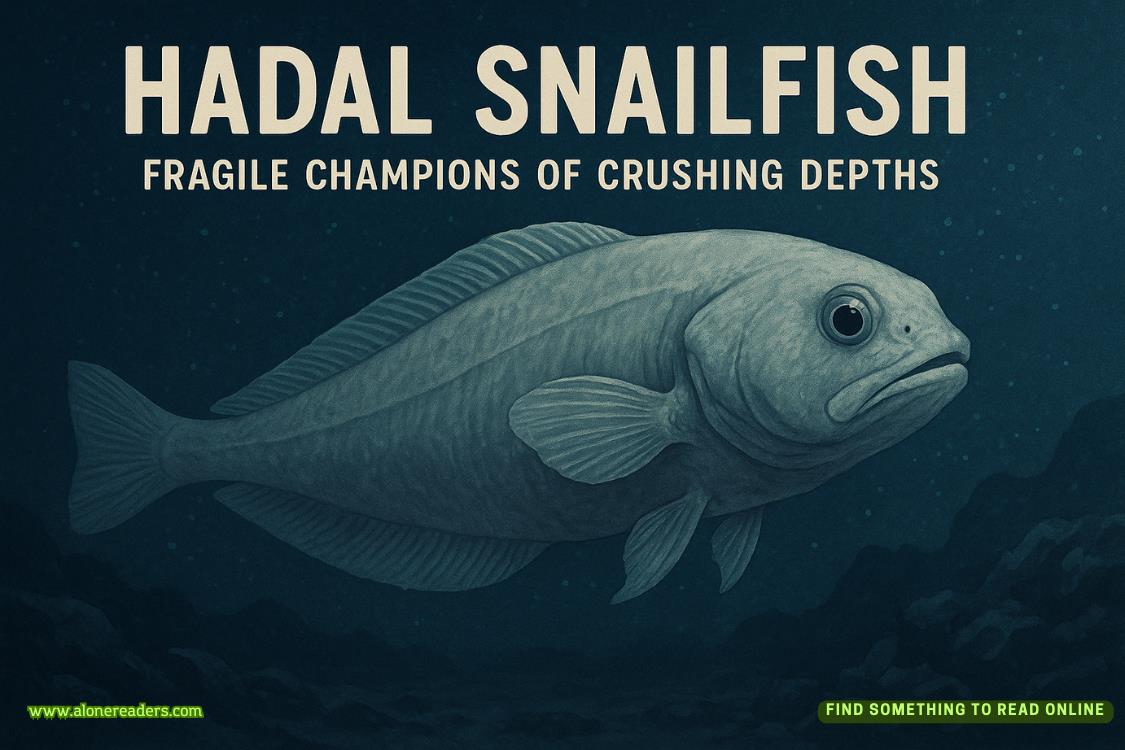
The hadal snailfish represents one of the most extraordinary examples of life thriving in Earth’s most extreme environments. Found at depths exceeding 8,000 meters in the hadal zone, including the Mariana, Japan, and Philippine trenches, these fish are the deepest-living vertebrates known to science. Despite their fragile, almost translucent appearance, they have evolved to withstand pressures over 1,000 times greater than at sea level. Their existence challenges our understanding of biological limits and demonstrates how evolution can carve out survival strategies even in the most hostile conditions.
Unlike the robust forms one might expect from creatures inhabiting crushing depths, hadal snailfish are delicate, soft-bodied organisms with scaleless, gelatinous skin. This fragility is not a weakness but an adaptation. A rigid skeleton would not withstand such immense pressure; instead, their bodies are flexible, reducing the risk of structural collapse. Their bones are thin, their muscles less dense, and their swim bladders—common in many shallow-water fish—are absent, replaced by fat and tissue that resist compression. These traits, paradoxically, make them fragile in shallow waters but resilient in their natural abyssal homes.
The biochemical adaptations of the hadal snailfish are equally remarkable. One key factor is the high concentration of a molecule called trimethylamine N-oxide (TMAO). TMAO stabilizes proteins under intense pressure, preventing them from deforming and losing function. The deeper the fish lives, the higher the concentration of TMAO in its tissues. However, this adaptation has a trade-off: beyond a certain depth, TMAO becomes so abundant that it would destabilize osmotic balance, setting a theoretical limit to how deep vertebrate life can exist. Scientists believe that the snailfish’s depth record is close to this physiological boundary, explaining why we do not find fish in trenches much deeper than around 8,200 to 8,500 meters.
Their feeding habits also reveal a fine-tuned survival strategy. The hadal snailfish primarily consumes small crustaceans, amphipods, and other invertebrates abundant in trench environments. Despite the extreme depths, food sources arrive regularly from surface waters in the form of marine snow—organic particles that sink down—and from carcasses that drift into the trenches. The snailfish occupies the role of a top predator in these deep ecosystems, outcompeting other scavengers with its efficiency and abundance. In some trench environments, they are so numerous that they form swarms, indicating their dominance as apex predators in an otherwise resource-limited habitat.
Reproduction in the hadal snailfish is still shrouded in mystery, as direct observations remain scarce due to the challenges of studying life at such depths. However, evidence suggests that they produce relatively large eggs, a trait advantageous for larvae that must survive in nutrient-scarce, high-pressure conditions. These eggs likely float to shallower depths during development, where pressures are less extreme, before juveniles eventually descend into the trenches. This reproductive strategy would reduce the biological stress on the most vulnerable stages of life, ensuring higher survival rates in a punishing environment.
Their discovery and study required significant technological advancement. Deep-sea landers and remotely operated vehicles equipped with baited cameras first revealed their presence in the hadal trenches. In 2017, researchers captured and filmed the Mariana snailfish at depths of nearly 8,200 meters, a record that stunned the scientific community. More recently, studies in the Japan and Philippine trenches uncovered distinct species of hadal snailfish, proving that multiple lineages have adapted independently to the crushing pressures of different trenches. These findings highlight the evolutionary plasticity of this group and demonstrate how geographic isolation fosters unique adaptations even in extreme habitats.
The hadal snailfish also provides crucial insights into broader questions of life’s limits. If vertebrates can survive in such hostile environments on Earth, it opens up intriguing possibilities for life in extraterrestrial oceans, such as those believed to exist beneath the icy crusts of Europa or Enceladus. Their biochemical resilience suggests that if water, pressure, and nutrients are present elsewhere, evolution might find ways to colonize even the most extreme alien oceans. Thus, the study of hadal snailfish extends far beyond marine biology into astrobiology and the search for life beyond our planet.
Despite their dominance in the deep, hadal snailfish remain vulnerable to human activities. Deep-sea mining, plastic pollution, and climate change all pose threats, even in remote trenches. Microplastics have already been detected in hadal organisms, carried down by ocean currents to the deepest points of Earth. The delicate snailfish, finely tuned to its environment, may not withstand rapid changes introduced by human impact. Protecting their habitats is therefore essential, not only for preserving biodiversity but also for maintaining the integrity of ecosystems that regulate global carbon cycles through deep-sea processes.
The fragile yet powerful existence of the hadal snailfish captures the paradox of life in the deep ocean. On one hand, it is a creature of softness, transparency, and vulnerability when viewed in the context of shallow-sea life. On the other, it is an unmatched champion of survival, perfectly adapted to thrive in a realm where few other vertebrates dare to exist. Its study continues to inspire advances in deep-sea exploration, evolutionary biology, and environmental awareness. Each new discovery adds a layer of understanding to how life persists at the edge of possibility, and each reminder of its fragility underscores the urgency of protecting the hidden worlds that sustain such marvels.
In the end, the hadal snailfish stands as a symbol of endurance against overwhelming odds. It teaches us that resilience does not always come from armor or brute strength, but from flexibility, biochemical precision, and adaptation. These champions of the crushing depths are fragile in appearance but embody a strength more profound than steel: the ability to live, flourish, and dominate in a world that was once thought to be utterly uninhabitable.



 Château de Vincennes: France’s Forgotten Royal Fortress and Medieval Stronghold
 Château de Carcassonne: Europe’s Greatest Medieval Citadel and Fortress
 Château de Chenonceau: The Castle Built by Remarkable Women
 Château de Chambord: France’s Magnificent Renaissance Castle and Architectural Wonder
 Tehri Dam: India's Tallest Dam and the Debate Behind It
 Bhakra Nangal Dam: India's Temple of Modern Development